


Businesses briefed on treaty trade rules ahead of April deadline
Photos by Johnny Bugeja


Gibraltar’s business community was briefed on Wednesday on a major shift in how goods will move in and out of Gibraltar once the UK/EU treaty on Gibraltar’s post-Brexit relations with the bloc comes into effect.
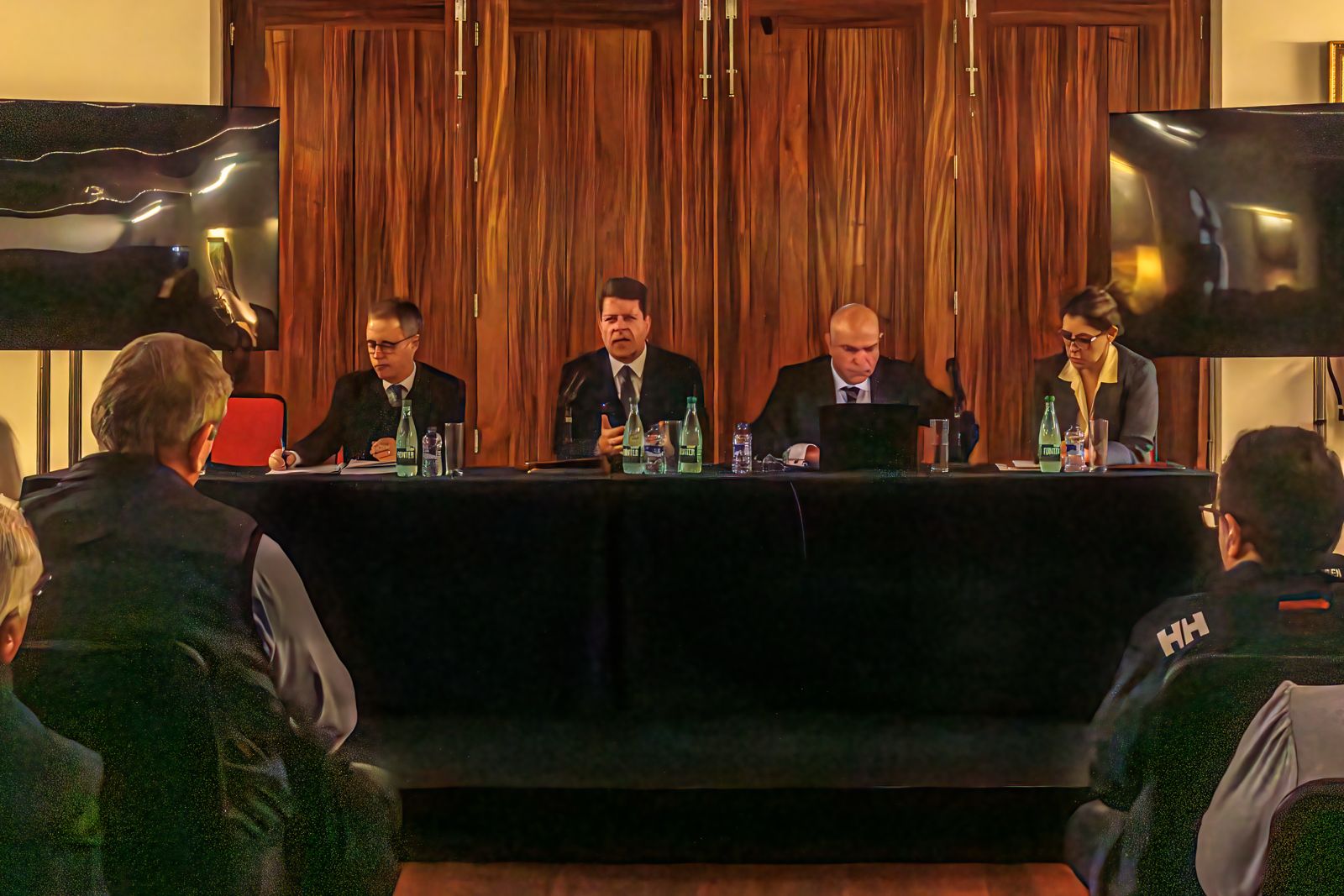
Business representatives at a packed town hall meeting in Grand Battery House were told to prepare for the change as from April 10.
The date coincides with the entry into full force of the EU’s new automated border control system, which will require non-EU nationals to register for biometric checks when entering or leaving the Schengen zone.
The treaty aims to ensure frontier fluidity and in practice will mean Gibraltar residents will be exempted from the EES requirements.
Without it, the busy frontier risks becoming a hard border where tight checks would impact negatively on the fluidity vital to communities on either side.
In parallel, the treaty also creates a bespoke customs zone between Gibraltar and the EU customs unions for goods.
It was this aspect of the treaty that was under scrutiny in the meeting on Wednesday.
In opening the session, Mr Picardo said the text of treaty had been undergoing a legal review since agreement was reached last December and would soon be circulated to EU member states ahead of the ratification process in the European Parliament.
“There is not yet what we might call an agreed scrubbed legal text,” he said.
“The European Union is expected to circulate to the European Council, in the next 24 to 48 hours, its final scrubbed text.”
“The United Kingdom and Gibraltar have a final scrubbed text too.”
“Those two have not yet been joined into one final scrubbed text that is signed as the agreed final text between the European Union and the United Kingdom.”
Mr Picardo said the text would be formally published only once the final agreed version was ready to be signed but that, once the EU text was circulated to member states, it was likely that it would be leaked.
“Because when the European Union circulates the text to the Council, it goes to the 27 embassies of the member states, and when it goes to the 27 embassies of the member states, it is inevitably leaked to a European publication,” he said.
“So you may very soon read the text before we are able, legitimately, to publish it.”
Mr Picardo also acknowledged that the period available for businesses to prepare for the changes was not as long as had been hoped but was necessitated by the EES deadline of April 10.
Ensuring Gibraltar was ready for implementation by that date was “the only prudent thing” to do, he said.
Mr Picardo noted though that this was still better than the five-day period that UK traders had been given when the UK and EU agreed the Trade and Commerce Agreement setting out the terms for their new trading relationship.
He acknowledged the change would be difficult and that some businesses would experience “turbulence”.
But he insisted too that the arrangements would be beneficial in the medium term and not so different in practical terms to current arrangements for importing and exporting goods.
The Chief Minister said the Government stood ready to assist businesses as much as possible within the constraints of EU state aid rules that will apply once the treaty was in place.
OPERATIONAL CHANGES
The trade centrepiece of the treaty is a customs union between Gibraltar and the EU that creates a new set of rules, checks and taxes for goods entering Gibraltar’s market.
Mr Llamas stressed that Gibraltar would not be joining the EU customs territory.
Instead, the treaty would create a customs union between Gibraltar and the EU, with the practical effect that EU-style free movement rules for goods would apply within that space.
The system is designed so that goods legally placed on the market in Gibraltar can also move within the customs union, and Gibraltar businesses can trade into a much larger EU customer base, subject to the rules set out in the treaty.
One of the biggest operational changes is that customs processing for imports and exports would take place at designated customs points (DCPs) on the EU side, listed in the treaty as Algeciras, La Linea, Sagunto near Valencia and a further point in Portugal still to be designated.
In simple terms, goods would typically travel from their origin, for example a supplier in Spain, France or elsewhere, to one of these designated points, where the main customs steps are completed, before moving on to Gibraltar.
Mr Llamas described this as involving familiar “transit” paperwork, with a Gibraltar-specific version opened at the DCP and closed by Gibraltar Customs on arrival, using an electronic system for tracking movements.
Mr Picardo told businesses that, although the treaty language is technical, the process should soon feel similar to what importers already do, with Spanish authorities issuing Gibraltar-specific forms and Gibraltar Customs closing out the movement on arrival.
A notable political and practical choice is that direct importation to Gibraltar by sea is constrained.
Mr Picardo said Gibraltar had not agreed to a model that would require EU - in practice, Spanish - customs officers to access Gibraltar’s port to verify compliance.
Instead, the route envisaged is that goods can be cleared at Algeciras and then brought in by land, avoiding any routine presence of Spanish officials at Gibraltar’s port.
TRANSACTION TAX
The treaty would end Gibraltar’s current import duty regime for goods and replace it with a transaction tax, collected by Gibraltar Customs when goods are imported for sale on Gibraltar’s market.
Mr Picardo described it as operating “for headline purposes, like an import duty” payable at import on the declared value, rather than as a sales tax added at the till.
The standard rate would be set by reference to the lowest standard VAT rate in any EU member state, which Mr Llamas said was currently 17% in Luxembourg at present.
There would be a three-year path to that level, namely 15% in year one, 16% in year two and 17% in year three.
There would also be a 5% reduced rate and a 0% “super-reduced” rate for categories of essential goods aligned to what EU rules allow.
This included, at 0%, widely defined foodstuffs, water, pharmaceuticals, certain medical equipment, books and periodicals, and solar panels for homes, among other items.
Alongside the transaction tax, the treaty would introduce excise duties consistent with EU law, applying only to tobacco, alcohol and fuel.
A retail price differential mechanism of 15% will apply in relation to cigarettes.
A key point for businesses was that both the transaction tax and excise duty are tied to whether goods are being placed on the market for sale in Gibraltar.
If goods are held under certain customs procedures, the tax point is delayed until they are released for sale.
On fuel, Mr Llamas said there would be no excise duty for the first three years, only transaction tax, with a later mechanism linking Gibraltar’s rates to a proportion of Spain’s.
The briefing also highlighted exemptions embedded in the EU tax framework, including an example of bunkering fuel being exempt from both the transaction tax and excise duty, and a negotiated exemption related to LNG imported for electricity generation and the electricity produced in Gibraltar.
BONDED WAREHOUSES
Businesses using bonded storage were told to expect changes.
Mr Llamas said the treaty recognises three special customs procedures, namely customs warehousing (bond), inward processing and temporary admission.
For EU goods, the time goods can be kept in these procedures is limited under the treaty model, described as warehousing for up to nine months, with some flexibility for ship supplies, and inward processing or temporary admission typically for three months, extendable with justification.
Mr Picardo noted that Gibraltar’s current system allows goods to be kept in bond for longer than is standard in the EU for EU-produced goods, and said Gibraltar had negotiated to be treated differently to EU-wide practices, even if it still represented a tightening compared with current local practice.
For non-EU goods, the briefing said the position is closer to existing practice, with longer time limits and the application of the EU’s external tariff where relevant.
The treaty structure distinguishes between EU goods and non-EU goods.
Mr Llamas said non-EU goods moving into Gibraltar would follow a similar “transit” concept, but with duties assessed under the EU’s common external tariff where applicable depending on the origin of the goods and where they were manufactured.
He added that one important practical exception related to sanitary and phytosanitary (SPS) controls, which must be carried out at the first point of entry into the EU under EU law.
That means checks for certain goods coming from the UK would occur at the first EU entry port rather than at the Gibraltar-facing customs point.
EU STANDARDS AND PERSONAL ALLOWANCES
A significant change is that, from entry into force, all goods sold in Gibraltar will have to comply with EU standards.
Goods imported from the EU would generally be presumed compliant, while Gibraltar’s Office of Fair Trading would have a market surveillance role, including conditions on manufacturing licences requiring compliance with relevant EU rules.
The treaty also provides specific exceptions in areas including some medicines sold in Gibraltar pharmacies and certain medical devices under GHA responsibility.
There was also information provided on personal allowances.
For travellers, the treaty provides an allowance-based system for the first three years.
Mr Llamas said allowances would cover goods valued up to €430 per person for travel by sea and air, and €300 for land travel.
After three years, that allowance system would fall away and be replaced by a model closer to what applies within the EU, where individuals can carry goods across borders provided they are for personal use rather than to be sold on.
Mr Picardo said that would mean a future in which EU visitors could buy on Gibraltar’s high street and take goods into the EU under the same general principles that used to underpin “booze cruises” elsewhere in Europe.
TRANSITION FOR HELD STOCK
The briefing also heard of transitional arrangements for businesses that hold stock bought under existing rules.
These included a two-month exemption for goods already in transit to Gibraltar before entry into force but not yet arrived, shielding them temporarily from the new tax and standards rules.
There were also time-limited provisions for goods imported under existing exemption certificates, goods already on shop shelves, and goods held in bond or temporary storage on the date the treaty takes effect, with periods ranging from two months to three months depending on category.
NO SERVICES
Mr Picardo emphasised that the treaty does not apply to services, with Gibraltar retaining control of its services market and continuing to rely on Gibraltar-UK arrangements in areas such as financial services, unless a service arrangement creates an unfair advantage tied to goods.
That distinction was presented as important for Gibraltar’s economic model, with the treaty framed as primarily about facilitating movement of people and goods while not rewriting Gibraltar’s services regulation.
Mr Picardo and Mr Llamas said the new tax flows would remain in Gibraltar, including transaction tax and excise duty, and that proceeds linked to duties on non-EU goods were negotiated to be returned to Gibraltar rather than retained by EU institutions.
The treaty also provides for an independent consultative body, jointly appointed by Gibraltar and Spain, to assess whether differences between Gibraltar’s transaction tax and Spanish VAT are creating significant distortions in market conditions and to recommend adjustments.
A safeguard clause may be triggered when there is non-compliance with a recommendation of the independent body where significant distortions persist.
Mr Llamas expressed confidence that the body would likely become “a very strong ally” of Gibraltar given that, even with a transaction tax that is lower than Spain’s 21% VAT, most goods sold in Gibraltar are more expensive than in Spain.
The message from the briefing was that the system is intended to be workable for traders while meeting EU concerns about unfair competition, with Gibraltar preparing for a short, intensive implementation period and a trading environment that aims for a shared market for goods.
The Government has published a detailed technical notice setting out all the forthcoming changes, which will impact businesses differently depending on their models, the goods they trade in and the origin of those products.
It will also publish its responses to detailed questions received through business organisations such as the Chamber of Commerce and the Gibraltar Federation of Small Businesses.


