Karl Ullger explores Gibraltar’s ancient coastline through art
Karl Ullger with his piece. / JOHNNY BUGEJA


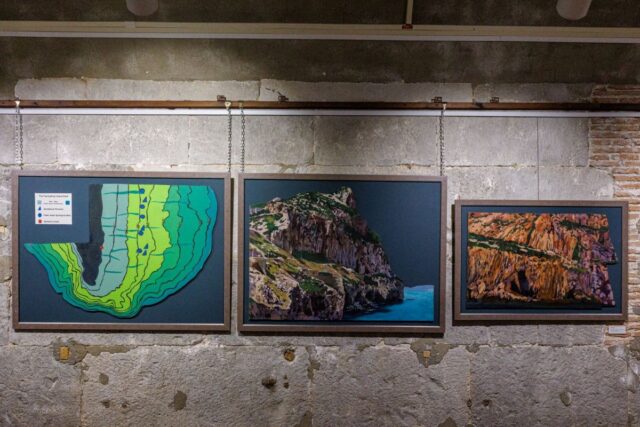
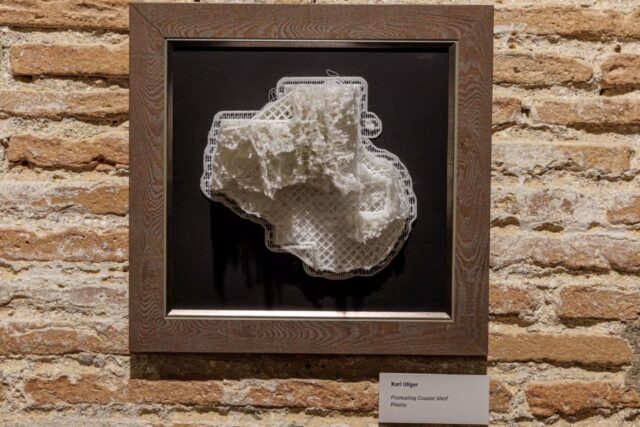
Karl Ullger has explored 90,000 years of geological change on Gibraltar’s eastern coastline through a triptych and a 3D-printed sculptural model created for the Traces of Humanity exhibition.
The work, centred on Gorham’s Cave, examines how Gibraltar’s coastal shelf has changed over time and considers how vegetation and habitats once extended miles beyond the cave’s present-day entrance.
The three-panel artwork combines landscape painting with sculptural interpretation to present Gibraltar’s coastline as an evolving geological story.
The top panel depicts the Rock of Gibraltar in daylight, presenting the limestone cliffs surrounding Gorham’s Cave as a constant geological feature.
The second panel shows the cave at sunset, with the changing light highlighting erosion, shadow and the scale of the landscape through a frontal view of the site.
The final panel moves away from traditional representation, presenting a 3D interpretation of the coastal shelf extending from one metre to 4,500 metres offshore. It traces erosion, changing sea levels and the movement of the coastline over 90,000 years.
Together, they are intended to be a single work measuring 1.4 metres high by 1.2 metres wide, with interlocking panels creating an irregular, jigsaw-like triptych.
Mr Ullger said the accompanying 3D-printed sculpture translated geological processes into a tactile form.
He told the Chronicle: “This 3D-printed sculptural model interprets the fluctuating coastal shelf of Gibraltar near Gorham’s Cave, translating geological processes into a tactile, translucent form.”
“Layered lattices and vertical extrusions evoke erosion, sediment build-up and the constant negotiation between land and sea.”
“The fragile filament strands echo tidal pull, wind abrasion and time’s slow carving of the limestone cliffs.”
“Simultaneously precise and unstable, the work sits between mapping and abstraction, science and speculation.”
“By compressing millennia of geological change into a compact object, the piece invites close inspection and reflection on Gibraltar’s vulnerable coastal threshold.”
Mr Ullger said producing the sculpture required two attempts before achieving the final version.
He explained that the model was intended to reflect how the sea had gradually advanced over land around 90,000 years ago.
The sculpture was based on the Gibraltar Museum’s interpretation of how the eastern side of the Rock has changed over time.
“This is a print from an image made by the Museum,” Mr Ullger said.
“I played with the 3D concept, but inverting the image and with all the pieces together.”
He said the process helped him better understand how the coastline has gradually become smaller over time.
The third and final stage of the international Traces of Humanity exhibition is on display at the Gustavo Bacarisas Gallery until July 31, following earlier exhibitions in Margate and London.