


Gap-toothed Neanderthal child brought to life in new museum gallery
An image of Neanderthal child Flint based on a forensic reconstruction by paleoartist Mauricio Anton of a skull found in Devil’s Tower Cave in 1926.


A new addition to the Gibraltar National Museum is set to draw international attention, as a forensic reconstruction of a four-year-old Neanderthal child, Flint, went display in the newly opened ‘Flint Gallery’.
In addition, the gallery includes a dramatic sculpture of an eagle owl inspired by bones found in 2023 and dating back 100,000 years, as well as another sculpture of of a cinereous vulture.
Flint Gallery was opened last Friday by the Minister for Heritage, Dr John Cortes, in the presence of the Director of the Museum Professor Clive Finlayson and CEO of the Museum Professor Geraldine Finlayson, curators and government representatives.
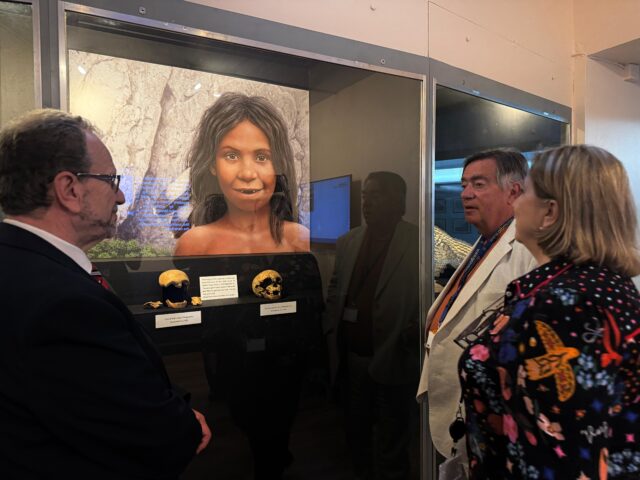
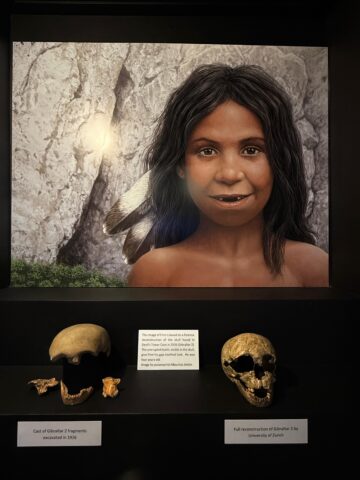
At the heart of the exhibit is the face of “Flint”, a Neanderthal child whose features have been painstakingly reconstructed by specialist forensic artist Mauricio Anton.
The work is based on skull found in Devil’s Tower Cave 100 years ago.
Explaining the reconstruction, Prof Geraldine Finlayson noted that the model shows a child whose two adult teeth are impacted and have yet to erupt, confirming that he had already lost his milk teeth.
Crucially, as a four-year-old, he does not yet show the pronounced brow ridge, the orbital torus,that is usually associated with Neanderthals, added Prof Clive Finlayson.
The result is a face that is familiar and human, with Dr Cortes noting, “frankly, he could be one of the school kids I saw this morning”.
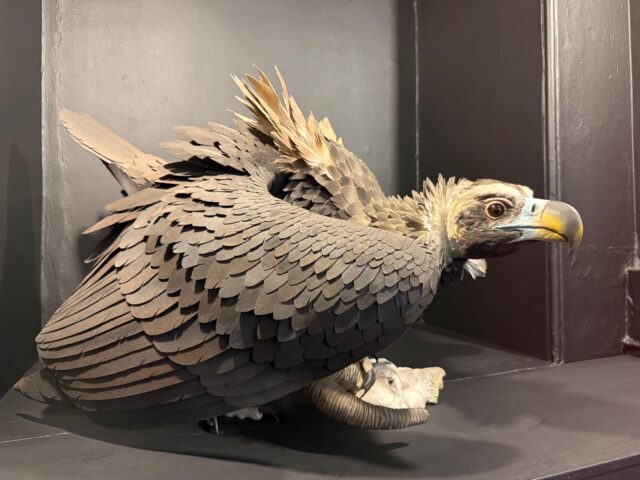
The cinereous vulture sculpture had been seen before but as it is linked to Neanderthals it has been placed in the gallery for its symbolic capacity.
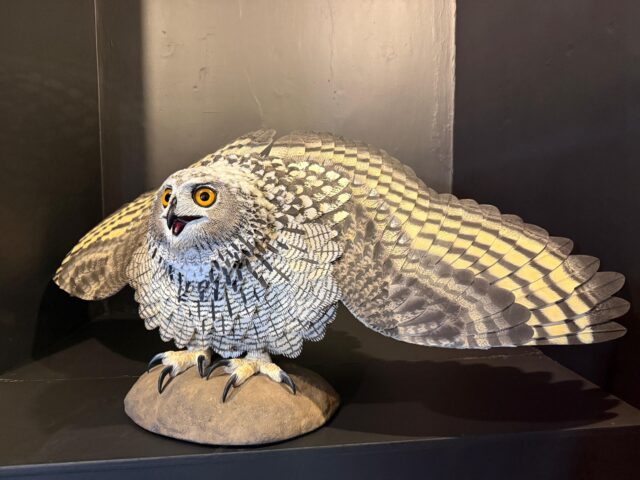
The new sculpture of an eagle owl is inspired by a remarkable find made in 2023 in an anatomical collection. The bird’s talons are believed to have been removed, possibly as adornments.
The sculptor has depicted the juvenile bird mid-threat, wings flared and head plumage raised.
“Interesting that they’re back on the Rock 100,000 years later,” Dr Cortes said.
Alongside the owl is a reconstructed red deer antler from the same archaeological level.
Interpretation panels guide visitors through the wider story, linking objects, the landscape and scientific research.
Speaking after touring the exhibit, Dr Cortes, an ornithologist and naturalist, praised both the scientific and emotional impact of the display.
“It’s great. I mean, like everything else that we're seeing developing the museum, it's a really attractive display and very impactful,” he said.
“It gives you a picture of what Gibraltar was like all those years ago.”
However, he said the most impactful item on display in the gallery was the reconstruction of the face of Flint.
The image “drives several points home” about how human the Neanderthals were and how they lived in Gibraltar in ways comparable to children today.
He predicted that the face of this Neanderthal child is “an image that’s going to make its way around the world” and that “anybody working on Neanderthals will want to have this as part of their repertoire”.
Dr Cortes said the new display was “a clear example” of efforts “to respect our heritage, to encourage knowledge of our heritage, to promote our heritage”, and praised the “excellent work” of the National Museum team, not only in the field at Gorham’s Cave and at the Natural History Museum in Parsons Lodge, but in the core museum itself.
The museum, he said, portrays Gibraltar’s history and heritage “at a level that that everybody must recognise reflects the excellent work that is being done in Gibraltar at the moment.”
Prof Geraldine Finlayson said the face of Flint brings to light that he was a young boy.
The final portrait is the third such reconstruction she had seen, but it was the first to show the child with his mouth open and the distinctive gap teeth.
“This is the first time I’ve seen [him] with the mouth open and with the gap teeth, and for me, I don’t know, that really sort of pulls at my heartstrings, maybe because I’ve got grandchildren,” she said.
“As a scientist, it’s very easy to see things as objects. But when you see that child looking at you, you realise that we’re talking about a human being before us. They hurt, they laughed, they were human.”
The child’s age, now firmly set at four years old, has been the subject of scientific debate for decades.
She explained that modern methods rely on growth rings in the teeth. Earlier researchers had suggested the jaw might belong to a child as old as six or even eight, based on parts of the jawbone growing at different rates.
Today, however, there is broad agreement that he is “definitely four years old”.
Prof Finlayson explained that Neanderthal children appear to have developed more rapidly.
“It seems that the Neanderthal child starts progressing much faster, and probably walked sooner than our children walk and grew faster” she said.
By around eight years old, modern humans are thought to “catch up”, but Neanderthals may have reached puberty earlier, perhaps around 10 years of age.
“They seem to have been slightly ahead of us,” she said.
This also points to why Gibraltar One, the first skull found, was called Nana, because at the age of 36 she was most likely a grandmother.
Flint is named after Captain Flint, the man who found Nana, but it also happens to be the material used for Neanderthal stone tools.
Archaeologist Dorothy Garrod, who found Flint in 1926, originally named him Abel, as in Cain and Abel. Prof Finlayson herself liked the name Jasper.
But “Flint, certainly, I think it’s a good name for him now,” she said.
Ms Garrod arrived in Gibraltar as a very young archaeologist, invited by the French cleric and archaeologist Abbé Breuil.
Breuil, who had visited the Devil’s Tower Rock Shelter during the First World War, recognised its potential for yielding human or Neanderthal remains, especially given its proximity to the site where Gibraltar One was discovered. His aim was to better date the life of “Nana”.
Garrod secured funding, came out to Gibraltar and found the skull.
“That is amazing, it’s difficult to do, but she did it,” said Prof Finlayson.
She did so in hazardous conditions.
“Working in a place like Devil’s Tower Rock Shelter, rockfalls are a real danger. It’s not something that’s recent, it’s been happening forever. Who knows, maybe that’s how Flint died. We don’t know, but we can’t rule out the rockfall.”
Garrod went on to build a distinguished career, becoming a major figure for her work in Mount Carmel in what was then known as the Holy Land, and later making history in academia as a Disney Professor of Archaeology at the University of Cambridge and the first woman to hold a chair at either Oxford or Cambridge University.
“At a time when women weren’t allowed to get degrees, she was very much a forerunner in many ways, and she opened a lot of doors for women,” said Prof Finlayson.
The museum team plans to tell her story in greater depth very soon.
Founded in 1930, the Gibraltar Museum is one of the oldest in the Mediterranean.
“The Governor put out a call to the people of Gibraltar to donate items to the museum. So, a lot of the collection was donations from local families,” she said.
“And so this is Gibraltar’s museum, and I always feel very strongly, so I will say it whenever I get a chance”
Photos by Eyleen Gomez
Most Read
New group to plan healthcare jobs and placements for returning graduates
Tue 13th Oct, 2026
Gibraltar treaty marks ‘new era of cooperation’ with EU and Spain, UK tells UN
Wed 14th Oct, 2026

Today's Paper
15th May 2026
Read our latest newspaper by downloading our app from the link below.


