


Goodbye, Frontier!


For those of us living in Gibraltar and the Campo, the middle part of July 2026 held enough excitement to last a generation or more. Far from being ‘a perfect storm’ there was a serendipitous convergence where the stars aligned. Excited? You bet! And I wasn’t even lucky enough to get invited to the ‘exclusive’ Red & White party; I don’t think I could have coped with such glee overload. More on that later.
To witness the Gibraltar-Spain frontier fence coming down overnight, Andy Burham becoming Leader of the Labour Party then UK Prime Minister, all while the FIFA World Cup was in full swing was truly a time to be alive. The thought of Jacob Rees-Mogg spiralling into meltdown whilst frantically waving a black passport (dark navy blue, please) added an extra touch of pizazz to the proceedings.
The history of our frontier spans over 300 years of military sieges, diplomatic friction, physically forced isolation, and political evolution and the small area around Four Corners (Focona), where the two ‘countries’ meet, has gone through multiple changes.
In 1704 an Anglo-Dutch force captured Gibraltar and in 1713 the Treaty of Utrecht was signed where Spain ceded "the full and entire propriety of the town and castle of Gibraltar, together with the port, fortifications and forts thereunto belonging" to Great Britain in perpetuity. The isthmus connecting the two territories was an unstable plain which was not always walkable at high tide. For decades no physical barrier existed, and British and Spanish guards simply watched each other across this strip of no-man's land known as the Neutral Ground; neither side was supposed to fortify or permanently occupy the area…
In 1730, Spain built a huge system of fortifications known as the “Spanish Lines”. This Línea de Contravalación de Gibraltar (roughly where Avenida del Ejército runs today) established a defensive barrier across the entrance to the peninsula and played an important role in the Great Siege (1779-1783). The Peninsular War then recast Britain and Spain as allies against the French and ‘The Lines’ were joyously blown up on the evening of 14 February 1810 where thousands of people crowded onto Gibraltar's walls and bastions to watch the explosions. 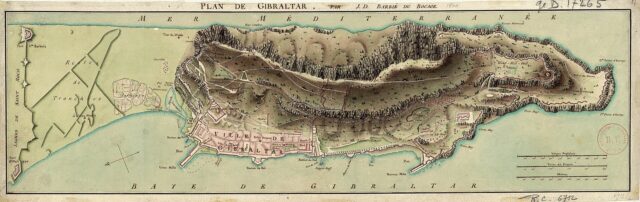
During outbreaks of yellow fever in the early 19th Century, quarantine camps were established on the Neutral Ground because they were outside the crowded town. Over the years these ‘temporary health measures’ gave way to Britain extending northward. Spain protested repeatedly, arguing Britain was occupying land that had never been ceded. Britain countered that its long, uncontested occupation created rights over the area. Eventually in 1908 the British erected an unclimbable frontier fence to clearly define the outer limits of the territory and stop smuggling. The big swoop came during World War II when the airfield and runway was built across much of the isthmus.
Why didn't Spain stop Britain? Simple, Britain was one of Europe's strongest naval powers and Gibraltar was a valuable military base controlling access to the Mediterranean. Spain’s diplomatic protests fell on deaf ears, and they were unable to force the issue militarily.
On 8 June 1969, Spanish dictator General Francisco Franco ordered the complete closure of the land border. Telephone lines were cut, ferry routes stopped, families were physically separated, and thousands of Spanish commuters lost their jobs overnight. The gates remained firmly shut until December 1982 when only pedestrians were allowed to cross. The full reopening on 5 February 1985 was a strict prerequisite for Spain to join the EU. Things had changed and the times of closure affected the psyche of the people, especially the Gibraltarians, who had been effectively locked up on a rocky island for almost fifteen years.
On 23rd June 2016, 96.6% of Gibraltar voted Remain in the Brexit Referendum. To avoid economic paralysis, the EU, UK, Spain, and Gibraltar negotiated a framework to incorporate Gibraltar into the Schengen Area. This culminated in the treaty that brought the frontier fence down on 15 July 2026, ending over a century of physical division.
All that historic information and more was delivered on GBC television by national treasure Richard Garcia on the eve of 14 July. I considered going down to the border but whilst watching France v Spain in the big semi-final clash, we also had ‘Frontier Live’ running on a second screen and I couldn’t tear myself away. GBC must be congratulated for their exemplary coverage. Wonderful documentary programs and live studio discussions were interspersed with quick fire shifts to ‘on the ground’ reporters giving viewers a blow-by-blow account of the momentous occasion. Poor old Kev Ruiz was jostled by boisterous and boozy football fans on the La Linea side and Jonathan Sacramento’s razor-sharp wit described a special event which the press was denied access to. The invite-only jamboree which nobody heard about until it happened was long enough in the making to bear an official title. The imaginatively named Red & White Party (not to be confused with New York’s legendary Black and White Ball) was held on the first-floor terrace of the airport terminal. Drones captured the ‘secret gathering’ where only the finest Gibraltar VVVVVVIPs could gain entry; someone obviously didn’t get the “egalitarian hands across nations” memo.
A countdown to midnight can often be tedious but we were thoroughly entertained with Gibraltar’s own Fab Four. The living Chief Ministers (you may remember them from the infamous Convoy of Black Land Rovers episode) lined up tug-of-war style and grabbed onto a rope which was attached to the last remaining piece of metal fence. Heave, Ho! Down it came amidst cheers from a jubilant crowd. However, the mood quickly became ominous as a large mob appeared on the Spanish side waving huge red and yellow flags and pressed up against the old black gates. For a moment everyone anxiously held their breath, but when the clock struck twelve and the gates swung open the people on the ground merrily merged and joined together in song and celebration. There wasn’t a dry eye in the house.


