


The Calpe Conference 2026: A personal view (I)
Professor Geoffrey Bailey, at the Calpe Conference.


By Dr Alex Menez
This year’s Calpe Conference was the 30th and ran from the 2nd to the 5th of September at the University of Gibraltar. From the first Calpe Conference in 1997 to this year’s, the record shows a healthy diversity of themes. All have been successful, in the high quality of speakers and academic lectures, discussions, large audiences, and expert organization of the conferences. A good number have focused on evolution, human origins, and Neanderthals; themes that are always of immense interest, especially since Gibraltar is famous for the discovery of two Neanderthal skulls and ongoing palaeoanthropology research by local and international scientists. This year marks the 100th anniversary of the discovery of Gibraltar’s second Neanderthal fossil, named Gibraltar 2, The Devil’s Tower Skull, Able, and most recently, Flint. To mark the centenary, scientists from around the world gathered in Gibraltar for a dedicated Neanderthal conference.
Within a few minutes the hall was packed with members of the public, students, and speakers. Professor Catherine Bachleda, Vice-Chancellor of the university, welcomed all, adding that the university is extremely proud to host such an exciting conference. She then introduced Professor John Cortes, Minister for Education, Public Health, Environment, Sustainability, Climate Change, Heritage, and Culture, who inaugurated the conference. In welcoming all, he noted that “this year’s conference carries particular significance,” commemorating the discovery of Gibraltar 2. He added: “I extend a warm welcome to representatives of sixty-one academic institutions from fifteen countries…Gibraltar has, in many ways, become a natural meeting point for scholars working on Neanderthals, and human evolution in general.” Minister Cortes also noted that “this year also marks another milestone: the tenth anniversary of the inscription of the Gorham’s Cave Complex onto the UNESCO World Heritage List.”
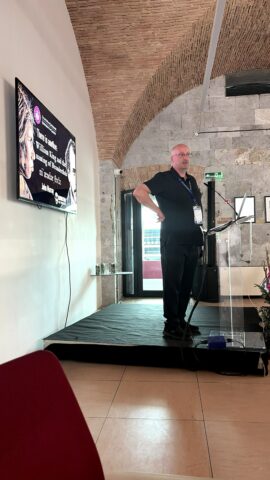
Dr John Murray.
I chaired the entire conference. From The Gibraltar National Museum and University of Gibraltar, I was thrilled to be the opening speaker, more especially having launched my book ‘Dorothy Garrod And The Devil’s Tower Skull’ the day prior to the conference. My lecture told the story of Dorothy and the discovery of Gibraltar 2, and profiled individuals whose varied contributions to the story ultimately enabled her monumental discovery, detailing her excavation at Gibraltar and the materials she found.
After coffee, Professor José María Fernández-Palacios from the University of La Laguna, Spain, spoke of islands as refugia. He explained that “islands are well known for their relictualism, or the capacity of storing lineages and ecosystems already gone in the mainlands, behaving thus as museums,” an example being Macaronesia. The Macaronesian laurel forest is “present in the Azores, Madeira and the central and western Canaries,” holding “outstanding biodiversity” including palaeoendemic trees, endemic shrubs, herbs, birds, and invertebrates. He held that “the largest value of this forest type is its relict status, the last remnant of a lost world, that is nowadays being threatened by the ongoing climate change.”
Next was Professor Geraldine Finlayson from The Gibraltar National Museum, University of Gibraltar, and Liverpool John Moores University, and co-authors. She noted that “understanding why certain places endure as refugia during glacial phases is central to reconstructing past biogeographies,” exploring factors that “make particular locations suitable as strongholds and refugia for species during glacial periods in the northern hemisphere, highlighting the particular importance of west-facing coastlines.” Focusing on the Strait of Gibraltar and the Gulf of Cadiz “reviewing multiple strands of evidence that point to this region as a major glacial refugium,” then considering the implications of this setting for Neanderthals “whose long and recurrent occupation of Gibraltar and wider southern Iberia reflects the ecological stability and opportunities afforded by such refugial landscapes.”
Dr John Murray from the University of Galway, Ireland, spoke of William King who “first proposed the name Homo neanderthalensis at the 1863 meeting of the British Association for the Advancement of Science for fossil human remains discovered in a cave in the Neander Valley of Germany seven years previously.” John noted that King’s suggestion “received a mixed response from the scientific community in the years which followed,” adding that King “remains the first scientist to name a new and extinct species of human based on actual fossil material. His proposal essentially marked the beginning of one of the longest standing debates in human evolutionary studies: what is the precise taxonomic and phylogenetic position of the Neanderthals?”
Following lunch, Dr Carlos Neto de Carvalho from the Universidade de Lisboa and Universidade de Évora, and Dr Fernando Muñez from the Universidad de Sevilla described work on trace fossils. “The hominin footprint record offers a uniquely direct archive of behaviour at the shifting boundary between land and sea. In marine coastal settings, such as tidal, beaches, and dune systems, these traces capture patterns of locomotion, social group structure, and environmental interaction rarely preserved elsewhere.” Explaining that the once-sparse record of Neanderthal coastal footprints has grown significantly, offering strong evidence of a frequent coastal presence in Europe, they added that “evidence comes from southern Portugal, Cape Trafalgar, and Gibraltar, where sites such as Catalan Bay and Vanguard Cave preserve Neanderthal footprints and other impressions in dune deposits.”
The final lecture of the day was by Professor Geoff Bailey from the University of York. He reflected on several terms that are commonly used but rarely analyzed in the context of Neanderthals, specifically the concept of ‘history.’ Did their predecessors possess a sense of their own history, “or are we being misled by taxonomic boundaries of uncertain relevance?” and furthermore he added, what constitutes historical causation and what are its primary driving forces on evolutionary time scales? One driving force “which is the topic of much current interest is climate change usually conceived of as changes in temperature and or precipitation.” Another type of climate change is sea-level change, Geoff noted that this is a “world-wide phenomenon at all latitudes and has periodically exposed and then drowned up to 20 million square kilometres of productive territory on the continental shelf and its adjacent coastlines during the Pleistocene-interglacial cycle. This has far-reaching implications for patterns of human demography and dispersal, and for what we are missing by way of evidence for the deep history of coastal occupation and marine subsistence.”
Most Read
PP MEP says ‘things will change’ on Gib treaty with right-wing govt in Madrid
Tue 27th Oct, 2026
HMS Queen Elizabeth sails into Gibraltar, strengthening long-standing links
Sun 25th Oct, 2026
Leaving the Rock: The emotional and practical challenges facing Gibraltar students in the United Kingdom
Wed 28th Oct, 2026

Today's Paper
30th October 2026
Read our latest newspaper by downloading our app from the link below.


