


Mark Sanchez releases Lowlife Tales Llanito edition


By Sophie Macdonald
With the release of Lowlife Tales (Llanito Dialogue Edition), M.G. Sanchez continues his long-standing literary engagement with place, language, and identity.
Known for interrogating the complexities of Gibraltarian life beyond stereotypes, Sanchez’s latest bilingual edition foregrounds Llanito, placing it at the heart of the text and challenging readers to engage with both the rhythms of speech and the cultural nuances embedded within them.
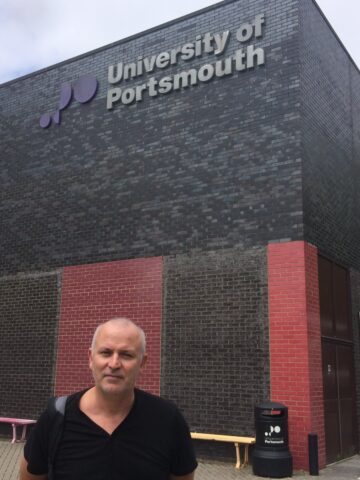
When asked about the origins of Lowlife Tales, Sanchez reflects on a personal experience that sparked the project. Several years ago, he suffered a serious leg injury that prevented him from traveling from the UK to Gibraltar. Upon his return after several years, he was struck by how much the territory had changed.
“The streets, the buildings, the vibe down Main Street, even the way people spoke seemed different—with fewer youngsters speaking Llanito than I remembered,” he said.
This observation prompted him to write a series of stories contrasting the Gibraltar of his youth with the contemporary city, preserving both memory and cultural detail through fiction.
For Sanchez, the collection is part of a larger literary project centred on marginalised voices.
“I have no interest in squeaky-clean, sanitised accounts of the past […] what is left unsaid often reveals more about a place than the selective soundbites parroted by the custodians of official memory,” he said.
In Lowlife Tales, readers encounter a cast of criminals, loners, smugglers, bullies, sycophants, and ordinary individuals navigating the challenges of everyday life.
Sanchez also emphasises the spatial geography of the Rock, guiding characters through streets, squares, housing estates, beaches, and coastline in a deliberate attempt to “seek out the voices on the margins and salvaging those stories that are habitually overlooked and ignored”.
A key feature of this edition is its use of Llanito dialogue, a principle Sanchez has developed in previous bilingual works.
“With Lowlife Tales I am bringing out the bilingual version first… I believe the bilingual edition is the most authentic. It captures the rhythms and cadences of everyday speech, reflecting how people spoke in Gibraltar during the 1980s and 1990s.”
He urges Gibraltarian readers to engage with the bilingual edition if possible, viewing it as a cultural record that preserves linguistic heritage and lived experience.
Sanchez situates this work within the broader context of Gibraltarian literature, noting that the field is growing in international academic recognition.
He cites conferences in Cambridge, Vigo, and Basel, as well as special journal issues in Spain and Poland devoted to Gibraltarian writing, contrasting this with limited engagement by cultural institutions at home.
“It feels strange to see foreign academics and universities taking such a keen interest, while at home there is such limited engagement,” he observes, highlighting the paradox of local cultural recognition.
The bilingual edition also serves a preservationist function. Sanchez acknowledges concerns about the decline of Llanito, stating: “The more that Llanito is used—whether in reading, speaking, or writing—the less likely it is to fade… if it is no longer spoken, then at least this book will remain as a record of how people once spoke.”
The two-version approach (one in Llanito and one in English) ensures both authenticity and accessibility, future-proofing the work for readers unfamiliar with Llanito.
Looking ahead, Sanchez emphasises that, for him, “writing a Gibraltarian text was always a balancing act, in the sense that it needs enough Llanito to be recognisably Gibraltarian, but not so much that it alienates English readers”.
The method that works best for him is to produce two versions, one in Llanito and one in English, to ensure he remains “authentic to the language and culture while still reaching beyond a just Llanito speakers.”
This approach, while labour-intensive, reflects his commitment to sustaining both the literary and linguistic heritage of Gibraltar - he believes “Gibraltar deserves a literature that keeps Llanito alive, without closing the door to outsiders”.


