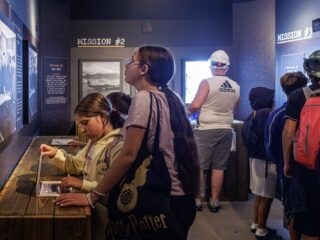
Renovated tunnels get kids back into the darkest hours of World War II


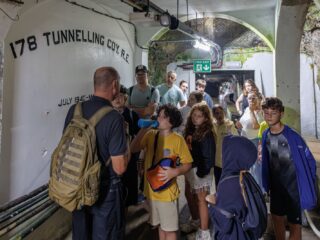
More than 10 children and their parents stepped back into one of the darkest chapters of Gibraltar's history as they explored the recently renovated World War Two Tunnels during a guided visit led by the Gibraltar National Museum.
The tour took visitors through the vast underground city carved into the Rock during the Second World War, with new exhibition rooms, interactive displays and personal stories highlighting Gibraltar's strategic military importance during the conflict.
Among the exhibits are displays on wartime espionage, including the stories of Ian Fleming, David Scherr and Larissa Swirski ‘the Queen of Hearts’, alongside a recreated secret chamber, a Hall of Fame, accounts of soldiers' lives and displays explaining the wartime Evacuation.
Leading the tour, Gibraltar National Museum guide Phil Smith explained how the tunnel network expanded rapidly during the war.
"Now, the tunnel system in Gibraltar is over 50 kilometres long," he said.
"The very first tunnel was built in Gibraltar during the Great Siege back in the 1780s, and the last tunnels in Gibraltar were built in the 1960s just to improve road traffic."
"But most of those tunnels, 30 kilometres of them, were built during the Second World War."
Mr Smith said the expansion was driven by concerns that Nazi Germany would attempt to capture Gibraltar through Spain.
"The British Prime Minister, Winston Churchill, realised how important it was that we protected Gibraltar, so that we got the base here and we could make sure supplies were coming through the Mediterranean," he said.
"So, he ordered his generals to build a city inside the Rock."
"That city was big enough for 17,000 men."
The underground complex included sleeping quarters, kitchens, canteens, hospitals, fuel and water storage tanks, and vehicle repair workshops, allowing thousands of troops to live and work beneath the Rock.
"Everything that you could need for 17,000 men to live inside the Rock was here," Mr Smith said.
"It is absolutely incredible."
Children on the tour also learned how British and Canadian engineers excavated around 30 kilometres of tunnels between 1940 and 1943.
Mr Smith explained that British engineers generally worked on the smaller tunnels while Canadian teams excavated the larger chambers using water-cooled diamond-tipped drills and carefully planned explosive charges.
He described how engineers drilled a pattern of holes they called a "necklace", allowing explosives to detonate in sequence and remove large sections of rock while using the minimum amount of dynamite.
"Everything had to be brought here, on ships, all the equipment and everything," he said.
"So, if they could use the least amount of dynamite for the largest chamber, it was good."
The guide also described the difficult conditions faced by those who built the underground city.
"The drilling was all made by hand," he said.
"To do that, one man was drilling and another one was holding him to help push him."
"It was hard work, it was very dusty work, and it's very warm inside the tunnels."
Visitors also learned how the excavation transformed Gibraltar above ground.
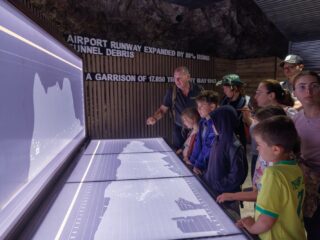
Mr Smith explained that much of the rock removed from the tunnels was used in land reclamation, extending Gibraltar's runway from one kilometre to two.
"What we can see here is that a lot of the stone that was taken out of the tunnels was pushed into the sea," he said.
"They made the runway two kilometres long."
"So, at one point we're drilling and taking stuff out of the rock."
"In other places, we're reclaiming land to make the runway."
"Clever stuff."
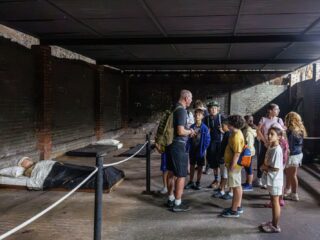
The tour also explored how soldiers lived underground, with reconstructed storage areas illustrating how food, equipment and other supplies were shipped from Britain to sustain the thousands of troops stationed inside the Rock.
"This room that we're in now is where they stored the food," Mr Smith said.
"The food was army rations, it all came in boxes, and it was shipped over from Britain."
"But the food was basic, but it gave you enough energy to do all this hard work."
Throughout the visit, original engravings left by British and Canadian engineers remained visible on the tunnel walls and at Jock's Balcony, providing a lasting reminder of those who built one of Gibraltar's most remarkable wartime engineering achievements.
The exhibitions also examine the impact of the war on Gibraltar's civilian population through displays on the Evacuation and the experiences of those who lived through the conflict.
The recreated secret chamber and weapons room proved particularly popular with the younger visitors, helping to bring to life the challenges faced on the Rock during the Second World War.