


The weather and other elements of historical facts around 100 years ago


It should not surprise me, but a fair number of our readers have stopped and asked if Alice’s Table was going to feature any more stories from the Colonial Reports? And, yes, I have been working on it as it offers not just a window to our past but a real understanding of how far we have come in the past (mostly) 100 years. Interest in the past – which is essentially what our pages are weekly filled with – continues to grab us. One of the key reasons cited for the rise in nostalgia today may work as a mechanism for coping with the great uncertainty in the world today – there is also our interest in the changes that have taken place, just how far we have actually come, which allows for a certain optimism that the world and our lives are constantly on the move. But I also genuinely believe that a look back to our individual stories also allows us to revisit that safe environment which relates to our childhood when one felt comfortable and where the future was a long way away.
So, let us delve back into the past in this Alice’s Table. At long last sunshine has reached us this week. Has the weather in the last month been one of the worst we have ever experienced? Everyone seems to think so. Last summer was the worst heat wise. Was it? It never ceases to amaze me how short our memories can be. But growing up – in a world where weather Apps did not exist – one left the house each morning come rain or shine – come drizzle or downpour – and you just got on with your day with a hat, wellington boots and umbrella in hand. What happened? It is just the consequences when being ruled by our mobile phones. I wonder what they would have said 100 years ago. Let me take you there when the general climate, according to the Colonial Report of 1926, was still mild and temperate but also hot and “oppressive” during the summer months of July and August. Sounds familiar? The meteorological record for 1926 saw 21.5 degrees Celsius as the mean temperature. The highest shade temperature was 32 degrees Celsius and was recorded on 17 July that year. The lowest temperature in 1926 was 2.2 degrees Celsius.
But I guess what you the readers are interested in is in the rain.
The rainy season 100 years ago is still the same today – spread over the period from September to May. 1926 saw an annual average rainfall of 35 inches, but that year only 25.83 inches were registered - October saw a total of 7.40 inches of rainfall.
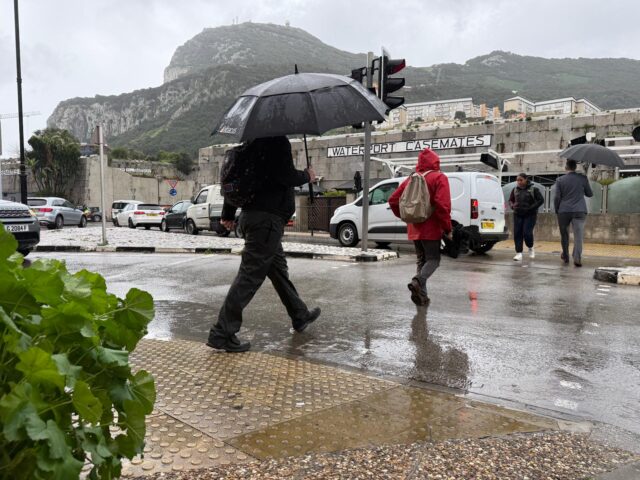
The previous year in 1925, remembering the average rainfall is registered at 35 inches – 39.24 inches fell. That year 19.72 inches fell in November.
One year back to 1924 the average rainfall registered was 44 inches of which 15.17 inches fell in February.
And if we go a little further back to 1922 there was an unusually low record of 25.8 inches of rain registered. That year the rainiest month was October with just 5.85 inches of rain registered.
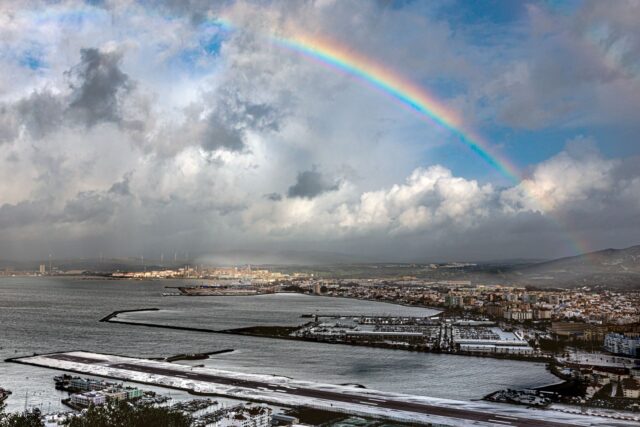
How does that compare? Well, so far this year we have had exceptionally wet and stormy weather. According to the MET Office last month we saw recorded more than double the average rainfall of 299.4 mm – that is 11.7 inches. This year has also come with severe gale-force wind warnings. And Storm Oriana caused significant disruption earlier in the month following weeks of heavy downpours. High winds and gale warnings, and heavy, prolonged rainfall have all been common.
Everywhere has been the same and in our neighbouring country the destruction has been severe in many areas. Let us now hope for better weather. But, I guess, one cannot help wondering if the worst is really behind us. I am an optimist.
UNCERTAINTY
So, let us remain in 1922 where the effects of the First World War were still being felt locally with a gradual return to “normal conditions” after the disturbance in economic and other matters caused by the war and which continued throughout that year. This according to the Colonial Report of 1922 would see an unfortunate reduction in the work in the dockyard. It would result in the “discharge of a number of employees” and thus was to cause considerable distress in the town from unemployment.
The report highlights that in wanting to meet the situation, relief work was instituted by the Government. After considering several schemes it was decided there would be a reclamation of a portion of the shore flanking the road to Spain – the aim was to afford an additional and much needed playground for the children in the elementary and other schools in the town.
The work would be undertaken by the City Council at the expense of the Colonial Government – this proved successful in providing much needed employment for a considerable number of unskilled as well as skilled workers.
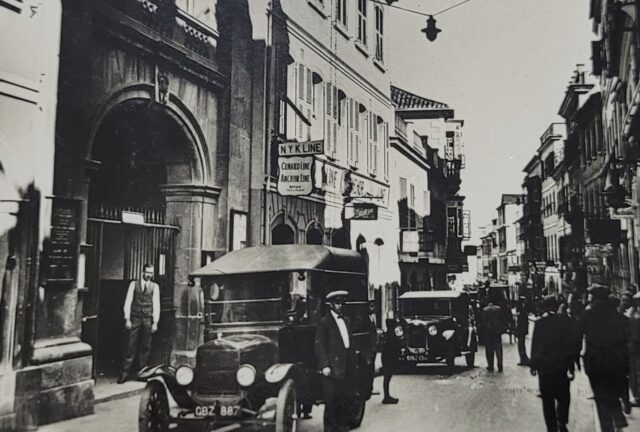
In 1922 the estimated civil population of Gibraltar at the end of year was 17,327, of whom 16,182 were (what was referred to as) “fixed residents”. According to the report both figures represented the population between sunrise and sunset.
“To calculate the daily population, it will be necessary to add some 8,000 aliens and 1,500 British subjects’ resident in the neighbouring Spanish town of La Linea, who come into Gibraltar daily.”
That year – 1922 – saw a total of 366 births in Gibraltar, of which 177 were boys and 180 girls. The births only referred to the fixed population. As we have featured before this was because under the Aliens Order in Council, no alien could give birth in the colony. And on an optimistic note, that year, only 304 deaths had been registered – 157 male and 127 females. Here it is interesting to point out that although “cancer” would remain a taboo word for many years to come – the document reports that “the number of deaths from cancer was 15, a slight decrease from the previous year”. But a year later this had risen to 18 deaths related to cancer.
EDUCATION
A Board of Education had been established in 1921 – an Ordinance a few years earlier in 1917 had made education compulsory for all children between the ages of five and 14. The Board was set up to advise on general education on all matters relating to Government-aided schools. Its chairman was the Colonial Secretary, the Director of the Christian Brothers Government-aided Schools, three representatives from the Roman Catholic Schools, one representative from the undenominational schools, and the Resident Inspector of schools.
In 1922, the total number of scholars on the registers were 2,588, and the average number in attendance during the year stood at 2,242.
When the Inspector from the Home Board of Education visited Gibraltar that year for the purpose of examining pupils from the Government-aided schools and reporting of their efficiency – all the schools with the exception of two, received the full grant.
In the five secondary schools in Gibraltar at the time – Line Wall College, Loreto and St. Francis Xavier, Brympton, and Bringhurst - pupils were prepared for the Cambridge Local Examinations and Examination of the London College of Preceptors – both were held annually.
Several private local schools with about 300 pupils taught only the elementary and basics.
By 1925 the total number of scholars on the registers had risen to 2,610. By 1938 with the population standing at 20, 339 of which 17,331 were fixed residents, the number of scholars had grown slightly to 2,714. By then there were only four secondary schools with Bringhurst having closed.
CURRENCY AND BANKING
In 1922 the legal tender for Gibraltar was British currency but Spanish currency (like today’s Euro) circulated freely. With a very large portion of supplies of foodstuffs etc. being obtained in Spain meant payments having to be made in pesetas. Many merchants and traders therefore kept their accounts in pesetas and centimos, and dollars and cents as well. Back then the Colonial Government Currency Notes in circulation amounted to
£150. 763. The notes were then issued under the Bank Note Ordinance dating back to 1914, with values of £50, £5, £1, 10 shillings, and 2 shillings.
Gibraltar then had four banks – the long established A.L. Galliano’s Bank of Gibraltar and the Rugeroni Bros and Co. of Gibraltar, together with the Anglo-Egyptian Bank, and the Credit Foncier d’Algerie et de Tunisie. All were private banks and had correspondents in all the principal cities of the world “offering every facility for the transaction of banking business”. By 1925 Barclays Bank had arrived in Gibraltar.
THE COST OF LIVING
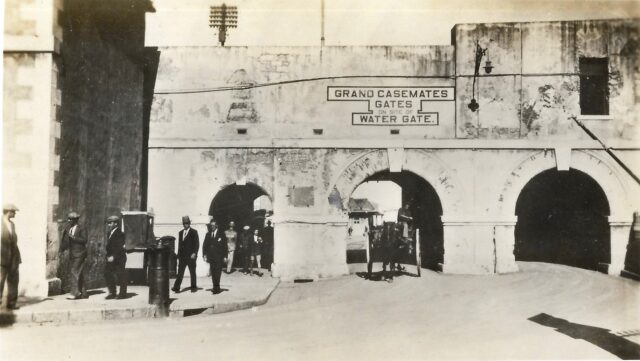
1931 was the first year that the ‘annual report on the social and economic progress of the people of Gibraltar’ saw the introduction of the section dedicated to the ‘wages and cost of living’.
That year the Public Works programme of works included improvements to the Colonial Hospital, public markets, and Government House. The General Post Office was also completely remodelled and enlarged.
The wages paid by the then Public Works Department were approximately the following:
Labourers – 7 pence per hour for a 50 hour week.
Artisans – 8 and a half pence per hour for a 50 hour week.
Leading carpenters etc. were paid half a pence or 1 pence per hour more than the artisans employed on the particular work.
The wages paid by private employers to similar classes of employees were:
Labourers – 45 pesetas per week for a 48 hour week.
Artisans - 60 pesetas per week for a 48 hour week.
Leading carpenters etc.- 75 pesetas per week for a 48 hour week.
The value of the peseta during 1931 was approximately 5 and a half pence. This section also included details on the staple food of the labouring classes which would have consisted of bread, coffee, olive oil, and vegetables. The daily cost of a man and his wife was worked out at around 5 pesetas.
The report highlights that it was very difficult to work out or give any very comprehensive figure with regard to the cost of living of Government officials appointed from outside the Colony. But according to the report “the expenses of a married couple without children, provided they lived in a Government quarter, might not exceed £450 per annum, but such a figure would not allow for any provision for leave expenses, and the cost of furniture on first arrival”.
The section further suggests that hotel charges gave some indication of the cost of living and of the range between “15 shillings and 20 shillings, per diem (per day) in winter, and 12 shillings and 17 shillings and 6 pence, per diem, in summer according to the class of establishments”.
AIR TRANSPORT
The air service between Gibraltar and Tangier inaugurated in 1931 by Gibraltar Airways Limited had to be suspended by the following year.
According to the report “the machine” – the plane used for this operation did not prove entirely suitable and “the service suffered in consequence from frequent interruptions”. But there was a certain amount of hope that the company would be able to re-establish the operation looking into the future.
At one time there was also a seaplane service between Gibraltar and Genoa which was maintained by the S.A. Navigazione Aerea in connection with the Italina mail service. But this, writes the report, had to be suspended and discontinued in August of 1932. The reason for this was the introduction of the new liners Rex and Conte di Savoia which brought new high speeds of these vessels, which meant the time saved was “small” in comparison. But the liner Rex was given a second mention in the Colonial Report of 1932 when on the same month of her maiden voyage to New York this new Italian transatlantic vessel experienced trouble with her turbo dynamos. It happened about 100 miles east of Gibraltar, and at the same time also suffered from a burst feed tank. The report describes how the vessel entered the port of Gibraltar at a reduced speed, but after just three days of continuous work “temporary repairs were effected by His Majesty’s Dockyard” this then enabled the vessel to quickly – and with minimal delay – to proceed to New York, her next port of call.
PUBLICITY AND VISITS
In 1933 the ongoing publicity campaign designed to “bring before the public” the advantages of Gibraltar as a tourist resort and travel centre was proceeding “energetically”. There is, continued the report, evidence that it is “bearing fruit”.
The number of tourists visiting Gibraltar that year saw a satisfactory increase and the number of cruising steamers which included the Port of Gibraltar in its itinerary totalled 125 that year compared to 112 in the previous year in 1932. Many tourists, continued the report as also stated in previous years, also took advantage of the facilities available for using Gibraltar as a centre for visiting Spain and Morocco.
That year saw a visit from the Chief Scout and Chief Guide Lord Baden Powell and Lady Baden Powell. They attended a Rally on 15 March 1933 held by the Boy Scouts and Girl Guides locally. They paid a short visit to Gibraltar. The Rally on the Rock was also attended by detachments of Scouts from various towns in Spain and also from Ceuta and Tangier.


