


Twenty-five ideas. Twenty-five ambitions. One place to build a business


By Denise Matthews
Applications for the second Startup Grind Gibraltar Build Local, Think Global Pitch Battle closed on 31 October, with 25 entries in the main competition, compared with ten last year. Only six will make the final. That represents a 150% increase in participation. But beyond the numbers lies a more interesting story about the people prepared to build something of their own locally.
Finding opportunities in everyday problems
Some of the most interesting business ideas begin with ordinary frustrations. Services that are difficult to find, processes that take too long or information that is not readily available. Kylan Gomez's RockServ and Vanessa Byrne's Gib Flow both reflect an interest in making local services more accessible, while Anchor Gibraltar, developed by Petronela Murgu, addresses the challenges people encounter when navigating residency and administrative requirements.
A related ambition can be seen in Sorted, developed by Nooran Tizniti and Hugo Volny who participated in Young Enterprise Gibraltar last year. Their proposed platform connects residents reporting public issues with the government departments responsible for resolving them, introducing greater visibility into the process. The ideas may differ in their intended customers and delivery models, but they share an understanding that opportunities can emerge from improving things people already need or use.
Turning knowledge and experience into enterprise
Not every applicant is starting with a completely new idea. For some, entrepreneurship means recognising that years of professional experience, an existing customer base or specialist knowledge could support something larger. Which fits exactly into the scalability model we are keen to promote.

Little Lingua, developed by Sophie Clifton-Tucker Hedley and Chris Hedley, builds on their experience in language education, combining established teaching methods with digital learning. Zenith Software Engineering, founded by Jonathan Pennell, draws on knowledge of the insurance industry to develop specialist software and data services. In financial services, Djamal Marcel Adib's SME Limited is pursuing subscription-based market analysis tools, while Nutrition by Karen, founded by Karen Jacobson, seeks to extend specialist health and nutrition services into structured programmes and digital education.
Technology as a means of solving business problems
Artificial intelligence and automation feature prominently among this year's applications, although the proposed uses are far from identical. GibComply, founded by Yousef Ghabraoui, and Simeko AI, founded by Dr Marie Oldfield, are both concerned with the increasingly complex relationship between technology, compliance and organisational responsibility. Gmonitor, led by Rishin Kesarla, approaches business intelligence through the collection and analysis of regulatory and market information. Others are looking at how technology can change everyday commercial operations. John CEO, represented in Gibraltar by Victoria Zduniak Cruz, proposes an AI coworker capable of carrying out business tasks, while Reddington explores the concept of a personalised AI chief of staff.
Marketing and business development provide another area of interest. Jake Ciruela's Clickrabbit focuses on improving paid advertising and customer acquisition, while Tony Bocoya's Brand OS by APP/ART proposes an integrated branding and growth system for specialist deep-technology companies. Quantum Heaps, represented by Andrew Garner, is developing business-to-business revenue automation software, with ambitions to expand into international markets.
What connects these applications is not simply their use of technology, but the commercial questions behind it: whether businesses will pay for the solutions, whether they can be delivered reliably and whether they offer sufficient value to sustain growth.
Health, wellbeing and the value of communityHealth, wellbeing and the value of community
The range of applications also challenges the assumption that entrepreneurship must involve software or international technology markets.
Elevate, founded by Julia Francis, is an example of an existing wellness business looking to grow from demonstrated customer demand. Its small-group Pilates and personal training sessions are operating at capacity, with plans to expand through additional instructors, corporate wellness, events and digital services. Eva Guerini's Sleep & Longevity offering is focused on helping individuals and organisations improve wellbeing through specialist programmes, while The Reset, proposed by Lauren Lyon, brings together fitness, recovery and independent wellness services in a shared facility.

Community needs are equally evident in Strength in Numbers, founded by James Alan Warden, a proposed nonprofit initiative creating opportunities for men to connect through friendship, support and physical activity. These applications raise different questions about what makes an enterprise successful. Financial sustainability matters, but so do the needs being addressed, the people being served and the potential to create something of lasting value.
Finding a wider audience for specialist interests
Not every business needs to begin with a large market. Sometimes the opportunity lies in identifying a particular audience and creating something that serves it exceptionally well starting in Gibraltar. GibNebula, developed by Jordan Montado, seeks to turn an interest in astronomy into educational and tourism experiences through stargazing and related activities.
The wider range of applications also includes Bylocal, reflecting another approach to identifying opportunities connected with Gibraltar's economy and community. These ventures illustrate how a relatively small place can provide the starting point for ideas that appeal to specialist audiences, whether those audiences are local, visiting Gibraltar or based elsewhere. One further applicant has chosen to remain confidential at this stage, a preference that has been respected rounding off our 25 applications for 2026.
A difficult choice, but an encouraging response
The judging panel now faces the challenge of comparing businesses with very different starting points. A venture with paying customers and a waiting list cannot be assessed in precisely the same way as a founder developing an early prototype. Equally, an ambitious international technology proposal must demonstrate more than the size of the market it hopes to enter.
However, recognition for all those who step into the startup arena is a top priority within the community. These events are designed to connect people who may otherwise not have the opportunity to share their ideas to someone who can help. So the winner takes a cash prize but joining a room full of potential can be just as valuable or even more.
Twenty-five applications do not tell us that Gibraltar's entrepreneurial economy has suddenly transformed. They do, however, show a growing willingness to participate.
And that is worth recognising.
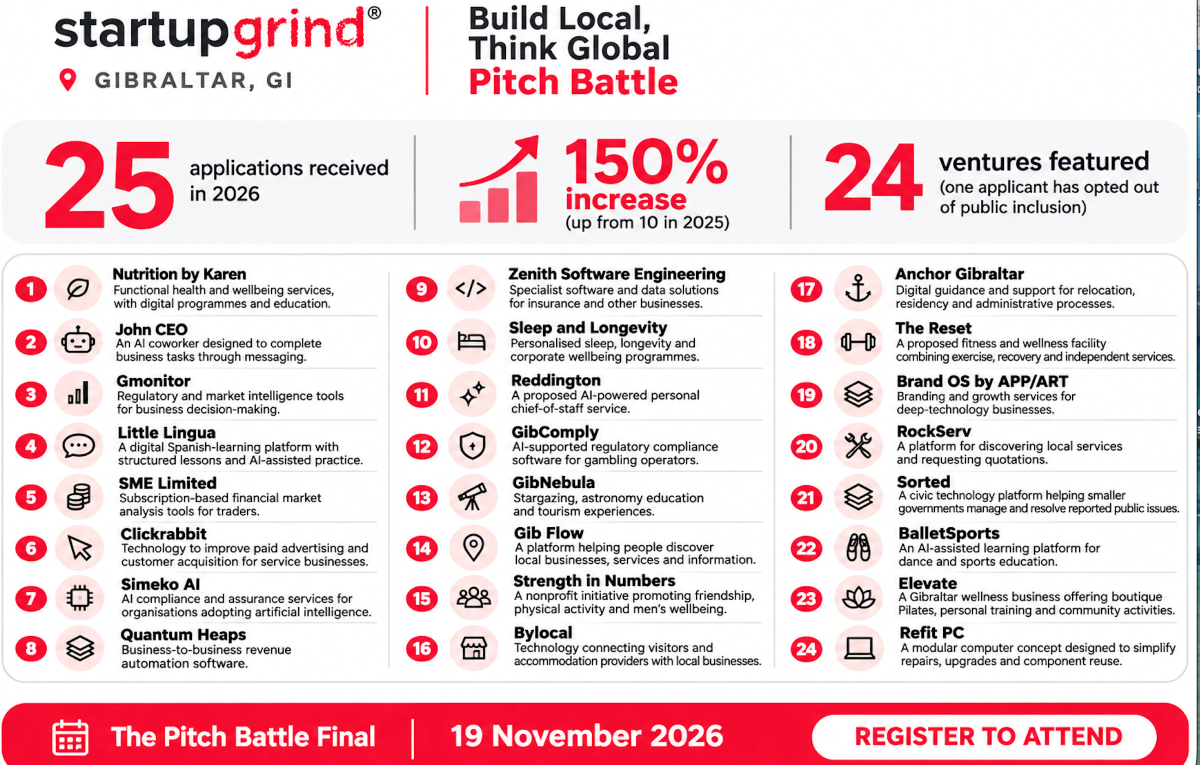
The Startup Grind Gibraltar Pitch Battle Final takes place on Thursday 19 November at 5:30pm in the Borealis Room, Sunborn Gibraltar. Attendance is free and open to everyone.
Register: https://www.startupgrind.com/e/mw6jrt/
Further information: www.startupgrind.com/gibraltar.
Most Read
Protesters march up Main Street over reclamation projects, pollution and data centre
Sun 8th Nov, 2026
RGP apologises to James Levy for ‘procedurally flawed’ Op Delhi search warrants
Sat 7th Nov, 2026

Today's Paper
9th November 2026
Read our latest newspaper by downloading our app from the link below.


