


When the Gibraltar Song Festival became an international event


The first Gibraltar Song Festival held in December 1965 was such a success – as we highlighted in Alice’s Table two Saturdays ago – that a second festival was called for immediately. But little did the organisers know that this very local event born to raise funds for the building of the Catholic Community Centre would very quickly firmly establish itself on the international festival circuit with international entries in its second edition and continue to grow steadily.
Yes, this week we return to pay tribute to all those who organised and participated in this very first edition of the festival from1965 to 1976 - which as we read two weeks back celebrates its 60th anniversary this month when the first festival was held on 3 December 1965. By the time the last song was played in the first year the Songwriters Guild, later BASCA - British Academy of Songwriters, Composers and Authors - was already knocking at the door. The festival would provide a platform for local talent.
It opened the door to songwriters – composers and lyricists, singers, and musicians in this small community who had limited exposure on international stages – although some local groups like the Romanceros and the Diamond Boys had achieved some success in Spain. The festival would have a huge influence on the Rock’s music scene and bring together musicians from the Gibraltar Symphony Orchestra, local bands and military bands. All brought together by musician extraordinaire – conductor Pepe Noguera.
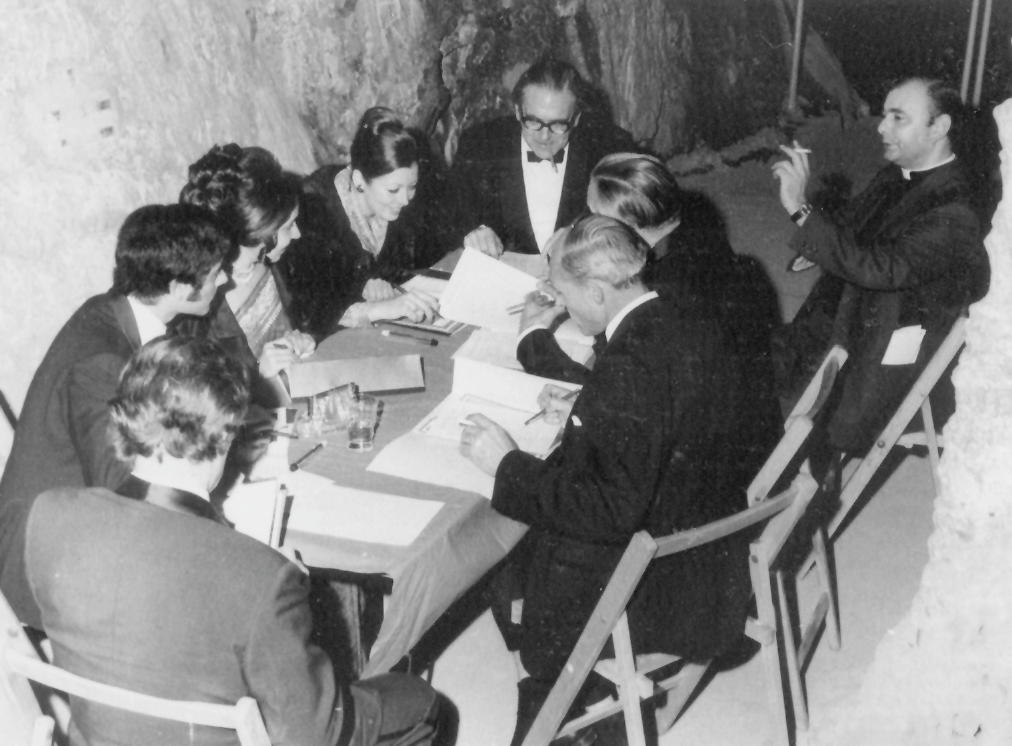
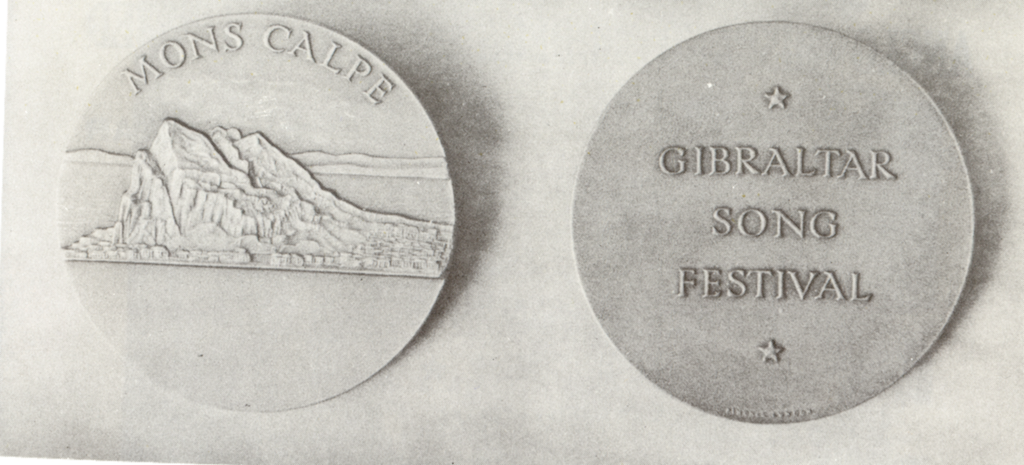
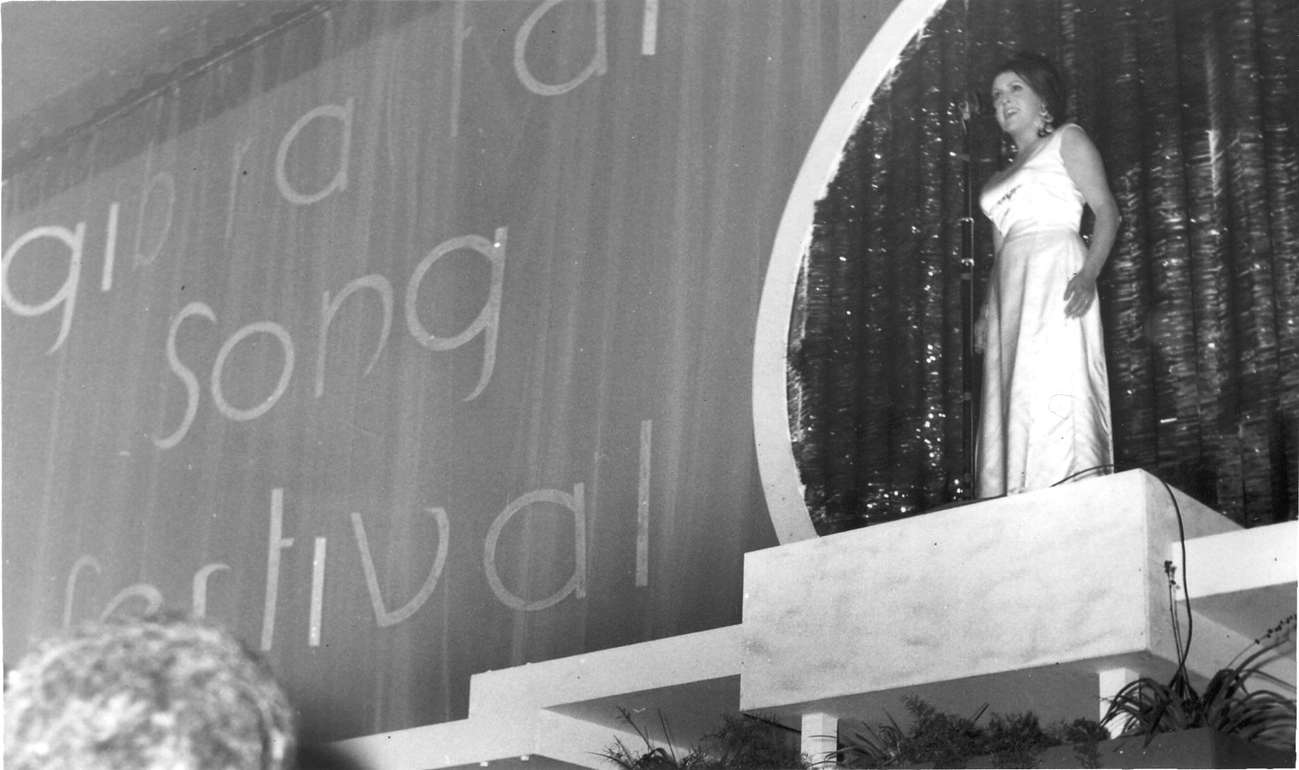
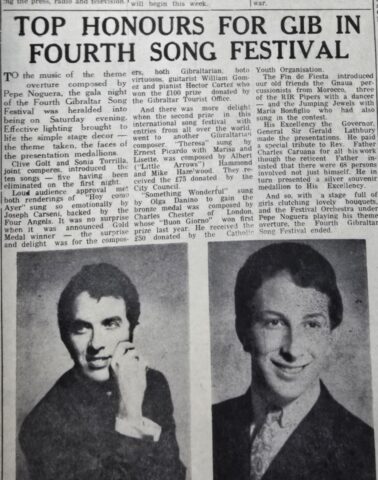
The 1966 Song Festival attracted some 43 entries – songs from all over the world from nine countries. The worldwide circulation of the Guild News (Songwriters’ Guild of Great Britain) inviting composers from all over the Commonwealth proved effective. That second year the festival was held at the old Naval Trust Cinema, and once again under the patronage of the Roman Catholic Bishop of Gibraltar, Bishop Healy, and under the helm of Father Charles Caruana with monies still being collected for the building of the Catholic Community Centre.
The first prize which went to a song from England would receive £100. ‘Please Forgive Me’ written by Dr. Kathleen Waldron and Eugene Nako, was performed in the first instant by Ernest Picardo and the second time around by Manolo Gatt – both well-known local musicians and singers. Joe Pike and Louis Diaz continued to find success in those early years. You may recall that the first Gibraltar Song Festival had been won by them with their song ‘Sounds of Christmas’ the previous year. Well, in this second edition they took the second prize with ‘City of Dreams’ and the third prize – with ‘Return to Me My Love’ (both songs were performed by Maribel Oton and Isaac Wahnon). Other singers that year included Marlene Schaaf, Eric Randall, Louis Hathaway, C. Gomez, and C. Frendo.
The third Gibraltar Song Festival in1967 was held at the Queen’s Cinema and continued growing with 98 songs entered from seven countries. The Guild became more involved, and organised the pre-audition held in London. There were entries from Trinidad, Malta and India.
Singers included Wallace Viagas, Maribel Oton, Marisa Picardo, Ernest Picardo, Olga Danino, Joseph Carseni, Rose Isola, Isaac Wahnon, Laura Monteverde and Richard Cartwright. The winning £100 song that year was ‘Buon Giorno’ by composers: Charlie Chester and Benny Litchfield and proved a very popular choice on the night. It was sung by Olga Danino (she was chosen as the best female singer at the festival), and the second time around by Joe Carseni.
British composers Charlie Chester and Benny Litchfield would collaborate on Christian songs, notably ‘Friend of Jesus, Friend of Mine’. The second prize went to a song called ‘Roma’ locally composed by Lawrence Belotti. On the night it was performed by his sister Rose Isola. And the third prize was another win for the songwriting partnership of Diaz and Pike with their song ‘Out of My Mind’. Two years later this song would be recorded by Ken Roland on the CBS label.
I have strong recollections of the Gibraltar Song Festival, but it was not really until 1968 that I truly started to listen – I can remember hearing the songs played over Radio Gibraltar. I have often referred to this on these pages, and I honestly believe that aside from hearing my parents singing zarzuela it was in those years of the first edition of the festival that my passion for music and especially my interest in local songs, songwriters and musicians was born. So, be prepared for a history lesson in the next two weeks as we retrace the steps of the song festival – as key then (and international) as our Gibraltar Literary Festival is today.
In 1968 the festival was held at the Queen’s Cinema. 135 songs were entered from 12 countries – including Hong Kong, Holland and France. The fourth Gibraltar Song Festival would be won by one of its most recognisable songs in this first edition of the festival – ‘Hoy Como Ayer’ penned by well-known local musicians – guitarist William Gomez and pianist and conductor Hector Cortes.
It was the audience favourite and often requested over Radio Gibraltar. It was given a moving and powerful performance by singer Joe Carseni (many years later he would lead in the fourth edition of the festival). 1968 had a good crop of songs and the second prize went to ‘Teresa’ composed by Albert Hammond and Mike Hazlewood (they had already had a hit with ‘Little Arrows’ reaching No.2 in the UK Singles Chart sung by Leapy Lee). ‘Teresa’ would also see chart success and become an international hit for Irish singer Joe Dolan. It reached number 1 on the Irish Singles Chart and number 20 on the UK Singles Chart the following year. At the Gibraltar Song Festival, it was performed by Ernest Picardo with Marisa and Lisette.
Charlie Chester also achieved success that year when he won the third prize (his song ‘Buon Giorno’ had been first the previous year) with the beautiful ballad ‘Something Wonderful’ sung by Olga Danino. Other singers that year included: Pepe Payas, Patricia Leadbetter, Eric Almeida, Wallace Viagas, Maria Jesus Bonfiglio, E. Holborn, Marisa Picardo, and Allison Collins. And so on to the fifth Gibraltar Song Festival of 1969 which cemented the participation of the Song Writers Guild of Great Britain selecting the songs for the final night. It would prove more international than in previous years with 253 entries from 17 countries. It was a record number of entries including from as far afield as Australia, South Africa, Nigeria and Sweden.
Leading the adjudication that year would be the songwriting team of Mitch Murray and Peter Callander responsible for such hits as ‘Billy Don’t Be a Hero’ by Paper Lace, ‘I Did What I Did for Maria’ by Tony Christie and ‘The Ballad of Bonnie and Clyde’ by Georgie Fame, and others. That year the overall winner would be singer and songwriter Lee Vanderbilt who took the first and third prize in the festival. The winning song was ‘How Shall I Know?’, and the third prized song was ‘A Woman’s Way’. The song in second place was a local song penned by William Gomez and Hector Cortes. The song ‘Somewhere’ was sung by Joe Carseni. Lee Vanderbilt was a singer, songwriter, arranger and producer born in Trinidad and living in the UK. He would become very active in the British disco scene of the 1970’s, and involved in releases of songs by Biddu, Tina Charles and Carl Douglas.
1969 was also the year a song had been entered which would become closely associated with the first edition of this festival, and which is still heard today. It was recorded by the very popular British singer at the time Dorothy Squires.
Next week part three of the Gibraltar Song Festival in its first edition from 1971 to 1976.
1970: A Gibraltar anthem written especially for the Rock of ages
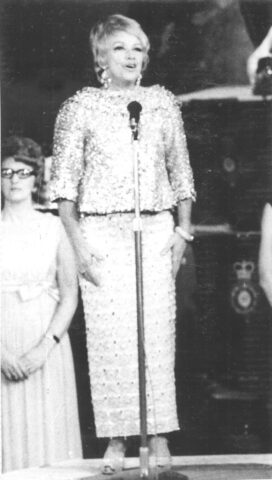
The Gibraltar Anthem – Rock of Ages – is included in the 1970 ‘live’ album by Dorothy Squires performed at the London Palladium. She had first performed it a month earlier at the 1970 Gibraltar Song Festival. It was so successful that on the night she encored it twice and the applause throughout was deafening.
The song had been born a year earlier when it was penned by Ronnie Bridges and Brian Willey and was entered for the 1969 festival amidst the growing tension of the anti-Gibraltar Spanish campaign which would lead to the closure of the frontier in 1969. When the organisers heard the anthem, it was felt it should be performed at the festival the following year in its own right. By then the frontier had been closed by Spain.
Bridges and Willey had been jurors at the festival in 1967 and 1968, and were aware of the ongoing dispute with Spain, getting together to write the anthem to help boost the morale of the Gibraltarians.
Telling me the story on one of his many visits to the Rock (his wife was one of the pioneers of Radio Gibraltar, Ana Maria Valarino) he told of when Bridges on returning from the1968 festival suggested they co-write a song with a patriotic feel. Bridges wrote the melody and Willey wrote the lyrics. When completed they entered the song for the 1969 festival but because both men were well known to the organisers, they gave themselves a pseudonym.
Willey was Director of The Songwriters’ Guild of Great Britain and would later serve as Vice-Chairman of BASCA, as well as chair the Ivor Novello Award Committee. A British songwriter, as a BBC producer who worked extensively in radio and television, producing music programmes like ‘On the Scene’ featuring artists such as Dorothy Squires, Rolf Harris, and The Bachelors.
London born Bridges was a musician, lyricist and pianist, who for many years was director of BASCA and penned more than 200 songs, including “You’re Closer to Me” (Matt Monro) and “Where the Bullets Fly” (Susan Maughan).
When the ‘Anthem’ was heard by the festival committee, they felt it should be performed the following year as part of the entertainment because as a ‘national anthem’ they believed it did not fit in with the international contest. The songwriters were approached by the committee and asked if they would consider this – as Willey said they were only too pleased to do this and promised a big name – a famous artist – to perform it on the night. It was Bridges who asked Dorothy Squires if she would sing it – and the rest as we so often say on these pages is history. Originally the song was going to be performed by Sir Harry Secombe, but he had been unable to perform it because of other commitments.
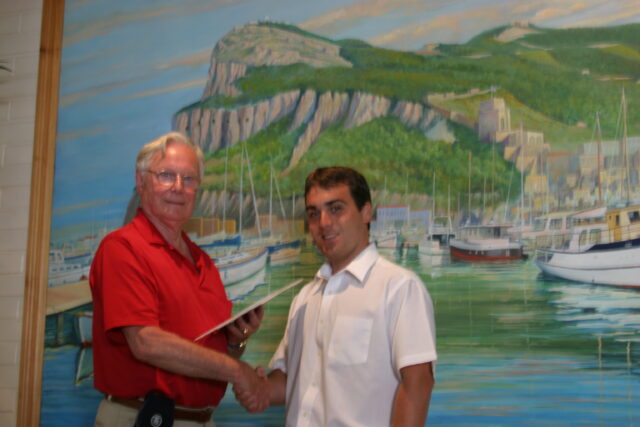
The Gibraltar Anthem ‘Rock of Ages’ lives on to this day. In fact, I was co-producer of the New Year tercentenary celebrations of 300 years of British Gibraltar and called on Nathan Payas to perform it on the night – which he did. That year Brian and his wife Ana Maria had travelled to Gibraltar in the summer months, and I introduced Brian to tenor Nathan Payas knowing he would perform the song during our celebrations. Brian and Ana frequently visited the Rock. Brian had already heard the anthem, in the voice of the tenor at a special Service in London earlier that year.
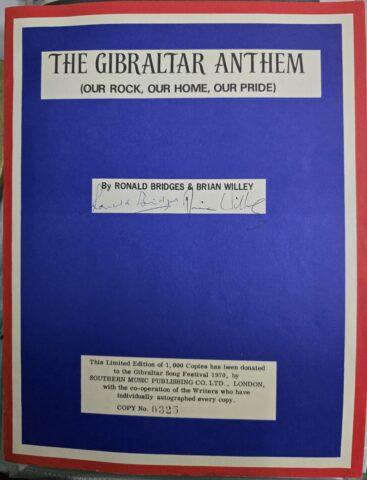
Brian was not prepared and the day proved to be a very emotional one for him, and he would hear the song again in the space of a short time – in the voices of the children of St Joseph’s First School and Nursery and later the Gibraltar National Choir. In 1970 some 1,000 song copies were printed and autographed. They sold out the minute they went on sale. Copy No. 1 was presented to The Queen while copy No. 2 was given to then Governor of Gibraltar Sir Varyl Begg. Brian presented Nathan with his own copy as well.


