


In continued praise of Gibraltar’s heraldry


by Anthony J. P. Lombard
The Coat of Arms which the Holy See has recognised in respect of the Rt Rev Mgr Charles Azzopardi, as Bishop of Gibraltar, and which includes the historic Arms of the See of Gibraltar to the left of the depiction of those Armorial Bearings and with Bishop Azzopardi’s personal Arms as to the right thereof, has resulted in a Sovereign confirmation of the latter.
Accordingly, such a Sovereign confirmation has thereby been added to the list of the legitimate heraldic Coats of Arms enjoyed by Gibraltarians, and, as I have previously dealt with in various articles, inter alia, in the 1998 Gibraltar Heritage Journal and in this column – [issues of the 29th October, 2012; and 11th to 14th August, 2015].
LEGITIMATE ARMS
As also explained previously, the importance in the possession of legitimate Arms lies in the fact such Ensigns Armorial are the true determinant of Nobility.
Whilst the use of hereditary charges, or devices, upon a shield first emerged in the 12th century, today, there is much confusion about the possession and consequent status of Arms.
Specifically, and contrary to public perception, not everybody possesses Arms; much less, do Arms automatically run with a surname, as is regularly further erroneously assumed and stated.
A legitimate Coat of Arms can only be granted, or recognised, by Sovereigns, as a “fons honorum”; that is, as a ‘Fountain of Honour’. Consequently, Armorial grants, or recognitions, are in the nature of a Dignity. Therefore, in order to legitimately possess Arms, an individual must prove a Sovereign grant or recognition, or descend, in the male line, from a person, who previously received such a grant or recognition.
In previous ages, such pre-eminence proved significant. To a degree it still does. For example, prior to marrying the former Prince Andrew, Sarah Ferguson sought Arms in her own right, selecting a very dramatic design of a Bee upon a Thistle and all displayed upon an lozenge-shaped shield of arms, with ribbon on top. The latter design is the traditional manner in which ladies display Arms.
Similarly, Catherine Middleton’s father also sought Arms ‘de novo’, prior to his daughter’s marriage to the then Prince William of Wales. Mr Middleton chose Acorns as his heraldic charges. Subsequently, those Middleton Arms were marshalled [that is: combined] with the Arms of Prince William, being the Royal Arms of the United Kingdom of Great Britain and Northern Ireland, subject to due differences, with the whole of both of those Achievements of Arms resulting in a typical display of the Arms of an armigerous couple, joined in wedlock.
Accordingly, up until recently, those who were either granted a Scottish Patent of Arms, or Matriculated [that is: registered] Ancestral Arms in Scotland, were unquestionably received into the Nobility of Scotland, as evidenced by the express wording in the Scottish Letters Patent granting or Matriculating those Arms.
To that end, the endorsement in question reads: “by demonstration of which Ensigns Armorial he and his successors in the same are amongst all Nobles and in all Places of Honour, to be taken, numbered, accounted and received as Nobles in the Noblesse of Scotland”. Regrettably, such wording is no longer employed. It was decided it expressed the obvious and was, therefore, unnecessary.
VATICAN ARMS
Canon Law requires Bishops to use a Seal with Arms.
In such circumstances, even if a Bishop’s personal Arms are adopted, upon such Vatican recognition those adopted Arms come to enjoy due legitimacy as a consequence of the recognition afforded them by the Popes, as Sovereigns of the Vatican City State, even though the Vatican no longer maintains a Heraldic department or office as it once did.
EPISCOPAL ARMS OF BISHOP AZZOPARDI
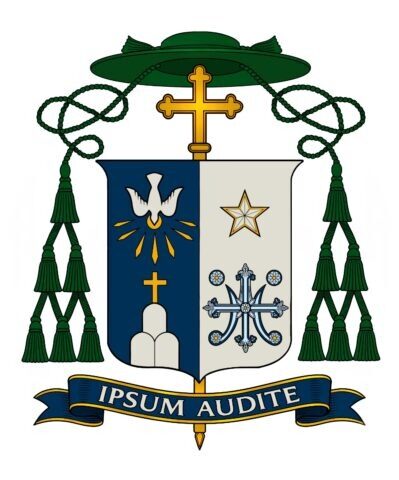
In the circumstances, the Papal recognition of the Arms adopted by Bishop Azzopardi, and which are composed of a Star charge previously associated with, or used by an Azzopardi family or an individual of that name, in Malta and which Mgr Azzopardi has also combined with the monogram of Our Blessed Lady, and being the Marian Emblem of Our Lady of Europa, Patroness of Gibraltar, and as to include a letter ‘M’, with a super imposed Cross upon the same plus with two single Floral Depictions on either side, has resulted in the sovereign grant of those Arms ‘de novo’ to Bishop Azzopardi.
As a consequence, as a British subject – [only the French are ‘citizens’] – Bishop Azzopardi should regularise that foreign sovereign recognition of his Arms by matriculating that Papal confirmation of his adopted personal Arms with either of the two Heraldic Deputies of the Sovereign of the United Kingdom; namely: the College of Arms of England, or the Lord Lyon of Scotland, and so they may be legitimately borne by Bishop Azzopardi and his heirs, as British subjects.
BISHOP AZZOPARDI’S MOTTO: IPSUM AUDITE [“LISTEN TO HIM”]
Bishop Azzopardi’s motto is taken from the New Testament – [Matthew 17: 1-9] – and reflects Mgr Azzopardi’s commitment to the Almighty. It occurs to me that in adopting the Biblical endorsement of: “Listen to Him”, Bishop Azzopardi, echoes the motto of the current Holy Father, Pope Leo XIV: “In Illo unon unam” [“In the One, we are one”] and which, according to Vatican News, the Holy Father explained as meaning: “Although we Christians are many, in the one Christ we are one. We are many and we are one - because we are united to Him, and if our Head is in heaven, the members will follow.”
Out of all the mottos of our Bishops, I have always found that of the late Bishop Rapallo as worthy of specific admiration. Bishop Rapallo readily appreciated the relevance and significance to his birthplace and See of Gibraltar, and of Our Blessed Lord’s famous edict, as also reported in St Mathew’s Gospel’s, when He chose Peter, as the “Rock” upon which He would build His church. As a result, Bishop Rapallo very appropriately chose part of that edict as his Episcopal motto, namely: “Super Hanc Petram”, that is: “Upon this Rock”, and which may be viewed upon a marble tablet on one of the columns of the Cathedral.
THE DIOCESE OF GIBRALTAR – 563 YEARS OF PROVENANCE
Whilst the Diocese of Gibraltar was ‘per se’ established in 1910, Gibraltar, as a territory, enjoys a much longer Episcopal provenance than 115 years and Bishop Azzopardi’s Episcopal Ordination provides me with an opportunity to re-muse on the subject of Gibraltar’s Episcopal provenance.
To that end, I should commence by observing that, in 1462, Gibraltar definitely came under the orbit of the sovereigns of Castile. As a result, on the 15th of December of that year, Henry IV of Castile [1425-1474], issued a Decree, wherein he was described as “Rey de Gibraltar” and in which he also, and importantly, donated to Gibraltar all of the territory which had previously belonged to “Las Algeciras” - [the latter so described in the plural, because of the division of that town, into two, by the Rio de la Miel].
Algeciras was so donated to Gibraltar, because it had been previously abandoned and lay desolate since 1379, following its complete destruction by Muhammad V of Granada.
As a consequence, Gibraltar’s limits were, thereby, enlarged and set as follows, namely: to the west, up to the river Guadalmesi and the river Almodovar, bordering the lands of Tarifa; on the north, by the boundary with Medina Sidonia, Alcala de los Gazules and Castellar; and on the north east up to the river Guardiaro, with the Mediterranean Sea being its oriental boundary.
In total, Gibraltar encompassed a surface area of 575 square kilometres.
JOINT EPISCOPAL SEES OF CADIZ AND ALGECIRAS
Importantly, in addition to presenting the aggregation of extensive and productive territories, the donation of Algeciras and its territory to Gibraltar also came to mean that Gibraltar inherited all of the rights and privileges then enjoyed by Algeciras.
One of those said rights and privileges was non-other than that of an Episcopal See, and given Algeciras was so. Namely: that of the Joint Sees of Cadiz and Algeciras.
In support of the above, it should be further explained, that following the capture of Algeciras, in 1344, by Alfonso XI of Castile [1311 – 1350, who died during that latter year at the Siege of Gibraltar], and in order to re-enforce the strategic importance of Algeciras, plus encourage its re-population, the latter King convinced Pope Clement VI - [Pierre Roger, son of the Lord of Rosiers-d’Égleton, who lived between 1291-1352 and reigned between 1342-1352] to transfer the Episcopal headquarters of the See of Cadiz, from Cadiz to Algeciras. Accordingly, on the 30th April, 1344, Clement VI issued a Papal Bull, ‘Guadeamus et exultamus’, erecting the Church of Santa Maria de la Palma of Algeciras into a Cathedral and instituting Algeciras into a Diocese, canonically linked to Cadiz. Therefore, from 1344, the Bishops of Cadiz were designated as being ‘Bishops of Cadiz and Algeciras’.
However, subsequently, in 1369, Algeciras re-fell into Moorish hands and, as mentioned above, by 1379 had been abandoned and destroyed, with the town and its territories remaining in such a forsaken state, for some 83 years, until it was donated to Gibraltar in 1462.
It follows that said donation of Algeciras to Gibraltar in 1462 carried with it the rights and status of the Episcopal See, which Algeciras enjoyed. As a consequence, that Episcopal status was, thereby, vested in Gibraltar. Accordingly, it must mean Gibraltar has enjoyed the rank of a Diocese, since the 15th December 1462. That is for 563 years, as opposed to 115 years, from 1910.
Furthermore such a claim, itself, also enjoys centennial provenance, in that it was so equally professed by, for example, the distinguished Gibraltarian historian and author Alonso Hernández del Portillo [1543-1624], an elected member of Gibraltar’s ‘Cabildo’ or municipality, in his Historia de Gibraltar, written between 1610 and 1620.
FRANCISCO BARTOLOMÉ PORRO [1742-1814], BISHOP OF LOUISIANA AND THE TWO FLORIDAS AND TARAZONA DE ARAGON
The Episcopal Coat of Arms of another Gibraltarian who became a Bishop, namely: Francisco Bartolomé Porro [1742-1814] may also be viewed to this day upon the façade of the old Episcopal palace of Calatayaud, upon the lintel of the door and on the dome above the stairwell, and which palace Bishop Porro arranged to be constructed on Gracián street, very close to the Collegiate church of Santa María, and upon the site of the former Muslim fortress.
As set out in an interesting article published in the 53rd issue of Almoraima, the journal of Campo de Gibraltar studies (November 2020), Francisco Bartolomé Porro was born in Gibraltar on March 14th, 1742, and became the Bishop of Louisiana and the Two Floridas, in 1801 and, thereafter, of Tarazona de Aragon in 1803.
Bishop Porro was the son of Tomás Porro and Sebastiana Reynado González-Luna, who were of Genoese origin, although having firstly resided in Valencia before relocating to Gibraltar, circa 1726. The couple had 12 children, including Francisco, and whose godparents were Don Bartolome Danino, Consul of Genoa in Gibraltar, and his wife Nicolasa Danino.
By the 1760s, Bishop Porro had become a member of the Congregation of Minor Regular Clerics, established in 1652, at the Church of San Gregorio Betico, in the lower part of the Albaicin district. Eventually, Bishop Porro moved to Rome and then became Superior General of his Order and Chamberlain to Pope Pius VII – [the latter was born Barnaba Niccolò Maria Luigi Chiaramonti; 14 August 1742 – 20 August 1823, and Head of the Catholic Church from 14 March 1800 to his death in August 1823. He ruled the Papal States from June 1800 to 17 May 1809 and again from 1814 to his death. He was a Papal Reformer and opponent to Napoleon who daringly escaped from Napoleon’s imprisonment in France, returning to Rome].
Pius VII wished to honour Bishop Porro and so appointed him Bishop of Louisiana and the Two Floridas on the 20th July, 1801, and consecrated him on the 15th November, 1801.
However, Bishop Porro never took up his post. Napoleon forced Spain to return Louisiana to France which, in turn, secretly sold it to the nascent United States for fifteen million dollars.
Nevertheless, Bishop Porro was not left without an Episcopal see and, on the 17th January 1803, he was appointed Bishop of Tarazona, and his portrait is also found to this day in the spectacular Hall of Bishops in the imposing Episcopal palace.
Alas, Bishop Porro suffered the ravages of the Napoleonic occupation of the Peninsula, and was forced to flee his see of Tarazona and take temporary refuge in the Moncayo region, sometimes celebrating Holy Masses in the poorest villages “so there would be no lack of shepherds, and since the foreigners were so intent on annihilating them”, as he was quoted to have stated, in the book ‘Sacred Spain’.
Unfortunately, just after the war ended, Bishop Porro died on the 3rd January, 1814, aged 74, and was unsurprisingly described in the previously mentioned book Sacred Spain as “very pious and zealous”.
CONCLUSION
In the circumstances, Shakespeare’s phrase: “a man ... glorious in arms ... nothing becomes him ill ..” comes to mind.
Most Read
Cross-Frontier Group to ask Spain’s political parties for their positions on treaty
Wed 7th Oct, 2026
Reduction in HPV vaccine uptake ‘worrying’, Director of Public Health says
Tue 6th Oct, 2026
Feetham raises gambling tax concerns as Badenoch pledges support for Gibraltar
Wed 7th Oct, 2026

Today's Paper
23rd February 2026
Read our latest newspaper by downloading our app from the link below.


