


The long hot summer months and some more facts and figures from Gibraltar’s rich past


A walk down Main Street last Saturday morning got me chatting about last week’s Alice’s Table and the year 1961. Why? Because I was stopped several times by some of our readers who enjoyed reminiscing and rediscovered some parts of our past that they had pushed away and forgotten. It never ceases to amaze me how much these guides, directories and colonial reports bring to our Table. So, let’s get back to them this week – over the past couple of months I have been looking through postcards and photographs to include in Alice’s Table – always popular as well because as the saying goes a picture paints a thousand words. This week I have decided to dip in and out of a number of stories from a variety of books.
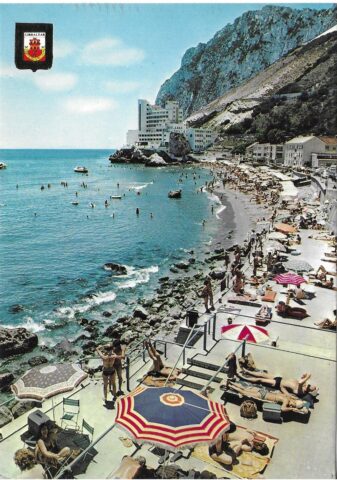
With summer well and truly here, our beaches packed to capacity, I found a postcard which reminded me of Catalan Bay and how it used to look when I was growing up - one in which our old sunshade and I feature. The Lido area, the rocks along the seashore teaming with sea life - an area I so often found myself snorkelling in with my blue flippers and black goggles. The white ‘barracas’ lined up across the entire beach right up by the walls. Just last week I bumped into an old friend of mine who reminded me of those days when as children we played in the sand and changed into our dry bathing costumes once the sun had gone in the back of the white ‘barracas’ which my father’s aunts hired for the whole summer – somehow those days always seemed much longer than they are now. I guess it is the same for children today.
So, I delved into an old Directory and Guide from just after World War II, to learn what it featured on Gibraltar’s beaches then. The year 1946 featured an entire section on Catalan Bay (like all other directories) with additional material. It described it as: “A small fishing village at the back of the Rock in a sandy bay to which there is a good road which extends to the end of Sandy Bay until it reaches the oil tanks erected by the Admiralty behind the Rock. It is inhabited chiefly by the descendants of Genoese fishermen. There is a small Catholic Church and a school.”
According to the Directory “the village was well worth a visit” and looked (as it still does today) “grand and imposing” with the backdrop of the Rock. The 1946 Directory also reports on the City Council’s Water Catchment (a feature in the area for many, many, years) and at Sandy Bay the Admiralty Water Catchments. The Directory of 1913 reports on its pages that a similar section on Catalan Bay Village featured how “during the summer months it has become a fashionable resort where many families proceed there for the day to enjoy the cool breeze and for the indulgence of sea bathing”. Goodness – how times change. As early as 1913 – “tea refreshments can be obtained”.
But some of the Directories also report on the possibility of rockfalls in the area – still an issue today. “The villagers are occasionally reminded of their close proximity to the Rock by big stones tumbling down upon their dwellings,” it informs us.
Historically it points out that during the French invasion many of the inhabitants of San Roque who had sought refuge at Catalan Bay had been victims of a large fall of stones from the cliffs. “In 1811 an immense stone detached itself from the part of the Rock which overhangs Catalan Bay and as it rolled down towards the sea crushed four sheds, killing 18 and wounding as many more.”
Then, sixty years later in 1870, how there was a very large landslip which fortunately fell on the road to North Front and “the villagers escaped” a bigger disaster but the road was destroyed. As it happened during the night no lives were lost. In 1875 there was a flood where the “little church was completely gutted” and a torrent of sand and stones washed from the rocks above and some of the outbuildings of the barracks were hit but thankfully there were no casualties. In 1917 there was another serious landslip which was produced by the tearing of part of the City Council’s water catchments and buried a large number of houses causing great material damage – and again fortunately there was no loss of life. The treacherous seas over the centuries have also affected the area with heavy seas damaging the road leading to the village. It will be recalled that troops were stationed at Catalan Bay during the Second World War from 1939 to 1945.
In all the Directories there is very little mention of Gibraltar’s other beaches – and just short references to the area of Rosia being used by forces personnel for swimming in the summer months. These would have been military areas and used for military purposes. Take for example the section in the 1946 directory called ‘Other Moles and Landing Places’ like Rosia and Rosia Mole which then formed a small harbour constructed and kept in repair by the Admiralty as a means of protection for lighters and discharging stores for the victualling yard. From here provisions were shipped as were other victualling stores for Her Majesty’s vessels.
In the Directory of 1913, there is a reference to ‘Rosia and its Surroundings’ and “situated below the South Barracks and facing the west”. The Directory reported that it contained “some of the best private residences on the Rock; they being large and commodious with good gardens attached. It is entirely sheltered from the east wind. The houses belong to the Admiralty. It was the residence of naval celebrities in old times, before the present official residence of the senior naval officer was devoted to that purpose.” And as to Rosia Bay itself in the Directory of 1913 there is a short note which reads that “by permission of the Admiral Superintendent a wooden shed was erected annually at the end of the mole for the convenience of offices of the Garrison bathing there”. It determines that the area housing the military has always been used for summer recreation over the centuries. And you will recall that back then as we have featured on these pages “a mixed bathing pavilion” was also available and was opened in 1930 by the then Governor Sir and Alexandra Godley. The pavilion cost some £9,000 and was more commonly referred to as the very popular Montagu Sea Bathing Pavilion. For many years this was where Gibraltarians spent their summer months – opening from July to September – until all the beaches were opened up and became the places to go in the summer.
CLIMATE
So now that summer is here let us look at the temperature in the summer months. Let’s begin 96 years ago in 1930. The general climate in Gibraltar in the Colonial Reports is always described as “mild and temperate, though somewhat hot and oppressive during the months of July and August”. Sounds familiar? Well, maybe today we can add June and September to those long summer months.
In the summer of 1930, the Meteorological records showed 22 degrees Celsius as the mean maximum temperature and the highest shade temperature being 33.8 degrees Celsius on the 12th of August and 8th of September. The lowest temperature was recorded on the 9th and 20th of February 1930. It was 4.4 degrees Celsius. Earlier reports say that the mean minimum and maximum temperatures in the summer varied greatly from 80 years ago in 1946, the top temperature in the summer reached 29.4 degrees Celsius. This remained the same in 1950 and again in 1963 and 1965.
GATES AND MORE GATES
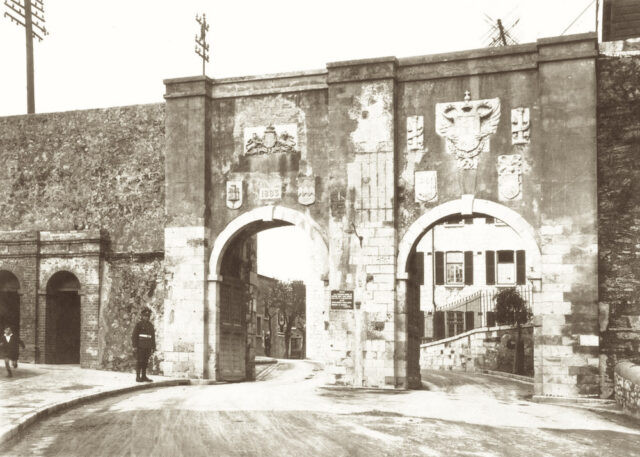
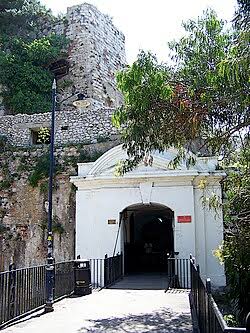
Have you ever realised how many gates there used to be in Gibraltar? At different periods in time these were used to keep people out especially at night and would have been closed from sunset to sunrise. The gates are highlighted in the Directory of 1913 with Land Gates at the Bayside Barrier at the entrance of the Causeway into Spain. The Landport and Grand Casemates on the north side of the town and the Prince Edward and Southport Gate on the South side. There is also a reference to Watergates - Waterport and Old Mole Gates on the South side of the town, and the New Mole and Ragged Staff Gates outside of the town – did you know that the Ragged Staff was a badge of the Burgundian Charles V?
The directory points out that the Southport, Grand Casemates, and Waterport Gates were single gates until around 1883 - 1884 when double gates were opened in the walls for the convenience of traffic.
EMPLOYMENT AND WAGES 1950 AND 1951
Last week we briefly looked at employment and wages in 1961. This obviously proved popular with some of our readers. One gentleman told me how at the time as a young man he was working at the Rock Hotel as a Bell Boy where he earned £1 a week but took home £5 in tips every week! Today, I am taking us back 10 years to 1950 and 1951 – and to the Colonial Reports. But first let us recall why 1950 was such an important year for Gibraltar. It was the year in which the inauguration and establishment of Gibraltar’s first Legislative Council inaugurated 23 November 1950 by His Royal Highness the Duke of Edinburgh. The Cost-of-Living Index figure which had stood at 191 in December of 1949 had risen to 199 by April 1950. It would remain “substantially stable” until the end of the year.
The rise in the Index Figure, according to the Report, was followed by increases in the Cost-of-Living allowances payable to wage employees of the Government, the Armed Services and the City Council. Basic wages however would remain substantially stable. The Colonial Report highlighted how unemployment among British subjects remained negligible during 1950 and 1951. The Employment Exchange found employment for 16,200 people during the period.
A new Education Ordinance was enacted in 1950 on which the Educational System of Gibraltar was remodelled to conform substantially to that of the UK. Compulsory education in Gibraltar was introduced in September 1951 and the number of children in Government schools rose considerably during this time. “Figures of attendance were very satisfactory. Examination results also continued to be satisfactory and the staff position improved.”
Many of our readers will recall that the year 1951 saw the explosion of the naval vessel the Bedenham. The explosion occurred when ammunition was in the process of being unloaded from this armament vessel. 13 people were killed and many more injured and considerable damage was done to property throughout Gibraltar. As we know from these pages this was a moment in Gibraltar’s history which has remained in the minds of many in our community who witnessed the explosion as children. During 1950 and 1951 a total of 4,823 and 5,633 vessels respectively arrived in the port. Air Services to and from the UK via Madrid and Bordeaux and communications with Tangier were maintained throughout this time.
As we look at wages during the period under review – 1950 and 1951 – we learn that slightly more than half the wage earners in Gibraltar were employed by one or other of the Service departments, the Colonial Government, or the City Council. But not surprisingly the largest individual employer was still the dockyard where the bulk of the civilians employed were engaged in ship repairing or occupations connected with it. The minimum basic weekly wage of adult unskilled workers in official employment was 40 shillings. Skilled workmen received from 51 shillings to 72 shillings compared to trade and charge hands who earned from 57 shillings to 80 shillings.
In January 1950 all industrial workers in official employment received a cost-of-living allowance of 32 shillings per week in the case of Gibraltarians, and of 16 shillings per week in the case of aliens. According to the Colonial Report “these rates were regarded by official employers as being subject to review if the cost-of-living index rose or fell by 10 points or more, and if such rise or fall was maintained for three consecutive months”. Casual labour employed in commercial stevedoring were engaged by the day “on a time basis” and received 20 shillings for an eight-hour day for piece work - the rates paid were from six shillings to 10 shillings per ton of merchandise moved by gang work.
Temporary clerks in the service of the Colonial Government, City Council, and the Services Department were granted revised rates of pay in January 1950 in a scale commencing at - 52 shillings and five pence per week at the age of 16 and rising to a maximum of 123 shillings at the age of 29.
 In April 1951 temporary clerks were granted a cost-of-living bonus on a sliding scale at the rate of seven and a half percent on the basic salary, and which was subject to a minimum bonus of £30 if over 19 years of age and of £15 if under that age. The total number of employment placings made through the Employment Exchange during the period was 16,200 compared with 15,100 during the two previous years. Of the former 3,617 notified vacancies were filled by Gibraltarians. The remainder was filled by aliens as there were no suitable unemployed Gibraltarians available. The number of British subjects registered as unemployed in any one week inclusive of men, women and juveniles averaged 78 in 1950 and 69 in 1951. “The average unemployment amongst adult male British subjects was nought. In 1950 it was 46% and 84% in 1951. Average unemployment amongst adult females varied from 2 to 3%. Industrial grade employees of the Colonial Government, City Council and local Service Departments continue to work the 44 hour 5-day week which was introduced in 1947.
In private industrial employment the normal working week varied from 47 to 50 hours and was spread over five and a half days. Under the provisions of the Shop Hours Ordinance the maximum hours of shop assistants were limited to 48 hours per week. Visits of inspection paid to premises under this Ordinance disclosed a small number of cases where shop assistants had been employed in excess of 48 hours per week. In these cases, the issue of Contravention Notices followed by checks and were effective in securing compliance with the ordinance.
Employees in hotels and catering establishments which were not within the scope of the Shop Hours Ordinance worked 48 to 56 hours and domestic servants from 48 to 58 hours per week. There was little systematic working of overtime by persons engaged by official employers except in the case of building workers engaged on the repair of premises damaged after the Bedenham explosion in the dockyard. The agreed rates of overtime paid by official employers were gross hourly rates plus 50% on weekdays and double ordinary rates for time worked on Sundays and public holidays. In 1950 and 1951 the Director of Labour and Welfare continued to be the registrar of trade unions. At the end of 1949 there were 11 trade unions registered under the Trade Unions and Trades Dispute Ordinance 1947.
Let us remind ourselves of the great number of trade unions in Gibraltar at the time: the Gibraltar Confederation of Labour. the Transport and General Workers Union, the Gibraltar Civil Service Association, the amalgamated Engineering Union (Gibraltar), Dockyard Ex Apprentices and Apprentices Union, the Civil Service Clerical Association (Admiralty Branch Gibraltar), the Civil Service Clerical Association (War Department Branch Gibraltar), the Society of Technical Civil Servants (Gibraltar Branch) the Gibraltar City Council, Staff Association of Scientific Workers (Gibraltar Group), the Institute of Professional Civil Servants (Admiralty), Supervising Technical (Officers Branch), the Gibraltar Master Bakers Association, and the Gibraltar Master Builders Association.
The largest union was the Gibraltar Confederation of Labour with membership from 1000 to 5000. The only unions that came close then were the Transport and General Workers Union and the Gibraltar Civil Service Association – both memberships between 250 to 1000. The total estimated paid up membership of the workers unions there was 2500. But regardless of how much people earned, where they worked and which union they belonged to they still played the lottery! Here is a random but interesting statistic from 1950 and 1951 when the Gibraltar Government Lottery yielded profits of £80,316 and £84,203 respectively.


