


Freight disruption as Government and businesses grapple with new customs system
Photo courtesy of GBC.


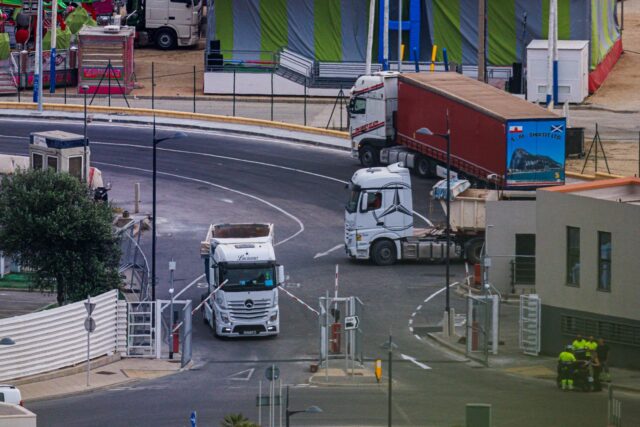
Delays processing imports including pharmaceuticals and fresh produce caused significant disruption on Tuesday as Customs and businesses grappled with the new arrangements at the frontier.
The Chronicle understands that some freight had been unable to cross into Gibraltar since last Thursday when the changes took effect, resulting in concerns in the business community about stock levels and perishable goods.
Chief Minister Fabian Picardo and the Minister for Business and Health, Gemma Arias Vasquez, said the problems reflected the challenges of introducing a completely new system and stressed that Customs was dealing with the issue, liaising with both the local business community and Spanish authorities.
Speaking to the Chronicle last night from the Customs post at the border, Mrs Arias Vasquez confirmed a truck carrying GHA pharmaceuticals was waiting to cross the frontier but would likely clear customs within the next 24 hours.
Mrs Arias Vasquez said she or a member of her team would be at the land frontier again on Wednesday to ensure the backlog continued to be tackled and to help iron out any issues.
Customs officers will also be providing training to private clearing agents and ensuring they are fully aware of the new procedures.
Some 170 trucks passed through the border on Tuesday, the minister said.
The Chronicle spoke to local pharmacies who said their goods had also been on hold, which included thousands of doses of medicines.
One pharmacist was concerned about refrigerated pharmaceuticals such as insulin and weight-loss jabs and whether shipments had been kept at the correct temperatures.
Any break in the cold chain could mean the medicines having to be disposed of, though such losses would be covered by insurance.
Another pharmacist said there were mixed medicines in trucks with room temperature and refrigerated drugs. If those trucks were left waiting at the frontier, the refrigerated drugs would need to be disposed of.
The pharmacists stressed, however, that there was currently no issue with stocks held locally but that they felt “left in the dark”.
Mrs Arias Vasquez told the Chronicle that ensuring the flow of pharmaceuticals was a top priority and that all lorries carrying medicines would be cleared in the next day or so, adding that these goods were exempt from tax and that this should make the process simpler.
But despite the Government's focus on resolving issues that were perhaps inevitable given the scale of the treaty changes, many affected businesses remained deeply concerned about the current disruption and hoped it would be resolved swiftly.
One agent at a freight company said there were “major issues” with bringing goods into Gibraltar but that the situation was not a complete breakdown, adding the delays were compounded by the La Linea fair as lorries could not wait near the commercial gate and instead had to queue along the main road in Spain.
He said there were vehicles that would need to stay overnight and try again to get Customs clearance tomorrow.
The issues were also being closely monitored by business organisations here.
John Isola, the president of the Chamber of Commerce, said these challenges were "inevitable" given the changes in procedures and that the freight volume on Tuesday was greater due to the public holiday in Spain earlier this week.
He said Customs officers were working very hard and closely with traders to resolve the situation and that fixes were being rolled out.
The Gibraltar Federation of Small Businesses said it believed problems were being caused in part by “groupage” transfers where one truck has goods from multiple clients, adding complexity to the clearance process.
A spokesperson for the GFSB reflected a “significant sense of frustration” from businesses but said Customs and the Government were working hard to resolve the issues.
“We acknowledge, nonetheless, that there are considerable issues that need to be overcome,” the spokesperson said.
“Hopefully sooner rather than later.”
Restaurateur Bryan Zammit told this newspaper that these issues needed to be resolved "as a matter of urgency".
Mr Zammit said he currently has three separate deliveries waiting to cross and had been informed that one shipment was on hold in a Seville depot.
“While it is understandable that major changes can bring initial teething problems, these are not minor inconveniences,” Mr Zammit said.
“Every day that goods remain delayed creates a larger backlog. That backlog doesn’t just affect courier companies, it affects retailers waiting for stock, restaurants waiting for supplies, workshops waiting for parts, construction companies waiting for materials, and countless other businesses that depend on reliable deliveries to operate.”
He asked for authorities to streamline this process to remove the massive bottleneck that has already been created and continues to grow.
“Every additional day of delay makes the situation more difficult to resolve,” he said.
“Gibraltar’s economy depends on the smooth and efficient movement of goods, and resolving these bottlenecks quickly is essential to restoring confidence and ensuring that businesses can continue operating without unnecessary disruption.”
The Chief Minister acknowledged the problems that had arisen at the border but said they had to be viewed in the context of the shift in Gibraltar's relationship with Spain and the wider EU.
He was speaking to the Chronicle after a reception at City Hall to thank the operator of the ferry that linked Gibraltar to Morocco and recently was stopped now that the treaty has entered provisional implementation.
“What's happening here is exactly the same thing that happened in the United Kingdom at the time of the TCA [UK/EU Trade and Cooperation Agreement],” Mr Picardo said.
“We've issued a lot of technical notices. We think we've covered all the bases.”
“A lot of the people who are having difficulties with the importations have not acted in accordance with the technical notice criteria."
"Some have, and there are some issues that we have also now identified need to be dealt with which haven't been dealt with in technical notices."
"This is a new system, and getting to grips with the new system has been harder [than expected].”
“We have been, I hope, very generous in the approach that we're taking as we're helping people [and] holding their hands through the new system. I understand the same is also happening on the other side."
"I realise, of course, it's creating angst for traders and it's creating angst for importers and customs agents.”
“It's also creating angst, believe me, for customs officers, for senior customs officials and for government officials because we all want to get this right."
"In particular, we don't want to penalise somebody who's making a mistake because this is a new process. I hope that we are all working together to resolve these issues.”
Mr Picardo added that Gibraltar is well supplied and that he hoped these problems would be resolved soon.
“These first few days will be a bad dream that we can all get over,” he said.
Mr Picardo said there are instances where there have been issues from the private sector filling out forms and in others the issue has been on the Customs side.
“In some instances, people have done all the right things, but our customers' codes have not uploaded in time."
"I'm not blaming the private sector. I'm not blaming the public sector."
"I'm saying we are all dealing with these issues that the first few days would produce, and we're doing so generously, with tact and good humour, and helping everybody over the hurdles that a new relationship creates with the European Union.”
“We believe that these will eventually be seen to be lower hurdles than the ones that we've suffered from in the period of Brexit, and certainly much lower hurdles than the ones that we would have suffered had we not done these arrangements.”
The issues at the border are also causing unease on the Spanish side, where freight forwarders and customs clearance agents have for weeks complained of a lack of clear information on managing the changes arising from the treaty.
On Tuesday, Spain’s Agencia Tributaria, the customs agency, issued two technical notices setting out contingency plans in the event of IT issues at La Linea and Algeciras.
It was not clear if the notices were in response to current disruption but the plans aim to ensure continuity in the event of computer or communications failures and involve working with manual procedures if electronic systems are unavailable.
Paper declarations, physical checks and direct communication between officials and operators would replace normal digital processing, with the information to be entered into customs systems once services are restored.
A key element is the requirement for Gibraltar Customs to be informed should emergency arrangements be activated, though normal processing times are not guaranteed.
Urgent cases may be prioritised and some procedures could be delayed where essential checks, guarantees or financial controls cannot be completed safely without access to the relevant systems, the technical notices said.
The plans provide officials and operators with a defined process for managing disruption while maintaining customs controls and recording transactions for later electronic processing.
Most Read
Local man arrested on suspicion of assisting illegal immigration after port incursion incident
Fri 4th Sep, 2026
Potential for new flights prompts Gib to discuss airport parking with La Linea
Mon 24th Aug, 2026

Today's Paper
21st July 2026
Read our latest newspaper by downloading our app from the link below.


