


Children explore the Gibraltar National Museum


Children taking part in the Walks Through History programme visited the Gibraltar National Museum last week, where they were guided through the museum’s exhibits by Phil Smith and Naomi Fa.
At the doorstep, Mr Smith explained that the Gibraltar Museum was founded following a public initiative launched by the Governor, General Sir Alexander Godley, in 1930 after “including an advertisement in the Gibraltar Chronicle asking for artefacts among the local population.”
Gibraltarians responded by donating artefacts that formed the museum’s first displays. The collection later grew, as it continues to do now, to reveal not only Gibraltar’s history but the traces of human development particularly through the Neanderthal era’s discoveries.
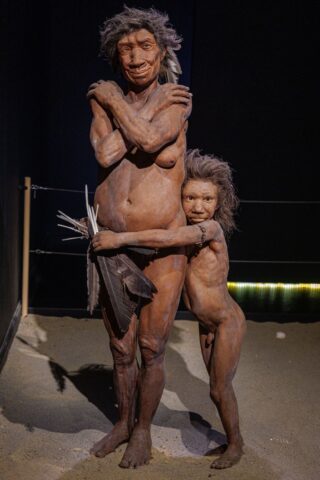
Inside the building, Flint and Nana received them. These are forensic reconstructions of the Gibraltar 1 and Gibraltar 2 Neanderthal fossil skulls, dating from 1848 and 1926 respectively, done by the twin artists Kennis and Kennis. A video showed the detailed reconstruction process with DNA, forensic science, and artistic skills.
“You can see here a lot of remains from the Neanderthal era, such as bones of animals living in Gibraltar that do not exist anymore,” Mr Smith explained while pointing to exhibits in a big display cabinet.
A mural shows how Gibraltar’s marshlands once extended towards the Strait.
“These lands had natural water which fell from the Rock, and Neanderthals were living with and hunting animals such as hyenas, wild wolves, leopards, lynxes or large mammals,” Mr Smith said.
THE FIRST BUILDING
Later, the children were shown the remains of the 13th-century building, which Mr Smith explained has the longest known historical sequence of any building in Gibraltar. It is also the only building where every period of Gibraltar’s urban history is represented, he said.
He highlighted the importance of the double archway and related structures, which were used to carry water from the Upper Rock before the system was changed and a pump system was installed.
The remains are the only existing ones of Almohad construction in Gibraltar, the Almohads controlling the Rock from 1160 to 1309.
Then, the children were guided to the Moorish Baths, which are in a well-preserved state. The guides explained how the Moors enjoyed the baths, and the hot and cold rooms, and how that was the best way of socializing at that time.
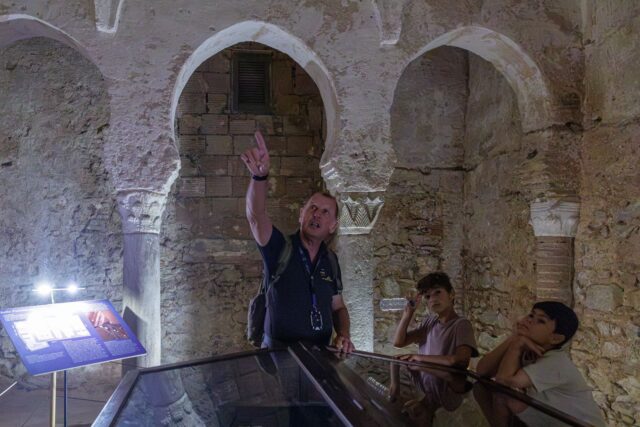
“As that time there was no tv, no films and baths were a way of amusement and socializing for people,” Mr Smith said.
During the Great Siege of Gibraltar (1779–1783), contemporary chronicler John Drinkwater recorded that the staff quarters located at Bomb House were directly hit and heavily damaged by an enemy artillery shell that burst on the building on September 18, 1781.
“If you look at the ceiling, you can see different bricks; the reason is that, during the Great Siege, a bomb fell here and it had to be reconstructed,” Mr Smith said.
CALPEIA AND YANTAR
The children then visited the room of Calpeia and Yantar, where Mr Smith continued to explain Gibraltar’s prehistoric history.
Calpeia was a woman aged around 35 who lived in Gibraltar around 7,500 years ago. Her face was reconstructed using forensic techniques and DNA tests from a human skull found near Europa Point in 1996. Most of her DNA was from Anatolia.
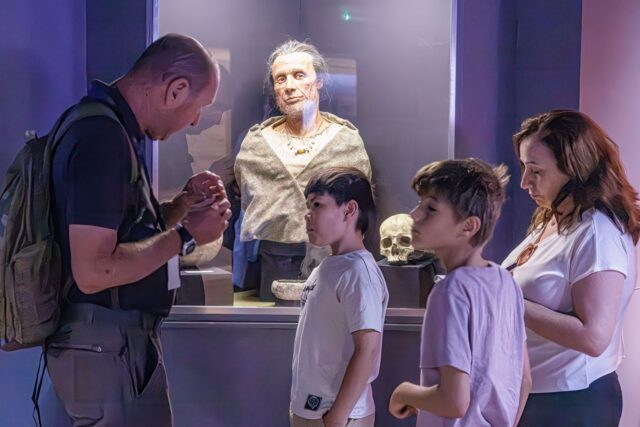
Yantar, displayed opposite Calpeia, has DNA from the Russian steppe. Mr Smith explained that his name came from the amber stone in his necklace, as amber is pronounced “yantar” in Russian. The kids were impacted by the realism of the reconstructions.
The ground floor produced with more suprises for the children, when they saw more artefacts on display, including the non-magnetic diver’s knife.
“I found it,” Mr Smith said. The wide-eyed kids started to ask how the adventure happened, and Mrs Smith got into details.
Mr Smith, who was a member of the Underwater Research Unit at that time, found the knife on a wreck in 2003. Despite it having been underwater for more than 60 years, it retained its coating of non-reflective black paint.
The 20th-century knife was found near the trawler HMS Stella Sirius. This type of knife was issued to mine-clearance divers during the Second World War, one of whom lost it while dispersing its remains.
THE SCALE MODEL
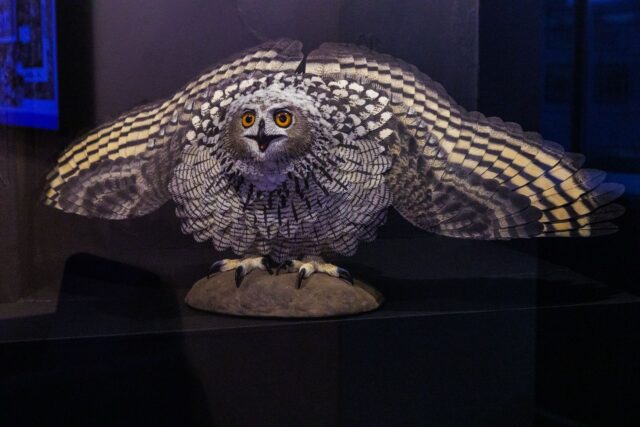
On the first floor, the Flint Gallery contains further displays about the Neanderthal era, including a sculpture of a juvenile eagle owl in a threat posture and a video stream showing a nest of migrant birds on the museum’s roof.
In the following room, the children were also shown a scale model of the Rock depicting Gibraltar in 1865.
“This is one of my favourites,” Mr Smith said, pointing out the museum on the model.
“Here, you can see Devil’s Tower. It was demolished in the Second World War; it gave its name to Devil’s Tower Road.”
The final room, focused on the Great Siege, was among the children’s favourites due to the display of weapons and artefacts from that time.
The visit on the first floor also included watercolours and paintings depicting Gibraltar in the 18th and 19th centuries, showing the city, its buildings, customs and traditions.
Most Read
6,000 appointments annually and 20 new referrals a month at Cancer Relief
Mon 12th Oct, 2026
UK and Spain welcome treaty at UN amid familiar sovereignty differences
Mon 12th Oct, 2026

Today's Paper
26th August 2026
Read our latest newspaper by downloading our app from the link below.


