


Bridge simulators ‘a game changes’ for university’s Maritime Academy
Photos by Johnny Bugeja


The University of Gibraltar held the official opening of its Maritime Academy Simulation Centre on Monday morning, featuring two training suites financed by industry partners Peninsula Hercules Tanker Management and Boluda Towage.
Each company invested £200,000 on the simulators, which when in use are paired so that the student can see the other vessel in their simulation scenarios and react accordingly.
The facility directly supports both the Maritime Academy’s professional courses and the BSc (Hons) Maritime Science, Nautical with Cadetship degree.
It was opened by Vice-Chancellor Professor Catherine Bachleda, who addressed the guests which included the Governor, Lieutenant General Sir Ben Bathurst; Minister for the Port Gemma Arias-Vasquez; Minister for the University Pat Orfila; and fellow ministers Sir Joe Bossano and Christian Santos.
Also present were other dignitaries including Ken McClean, Chief Operating Officer at Peninsula Petroleum Limited; Elias Tapiero, Director of Boluda Towage; Aaron Lopez, the Head of the Maritime Academy; and Captain Dr Behbood Issa-Zadeh, Head of School (Maritime).
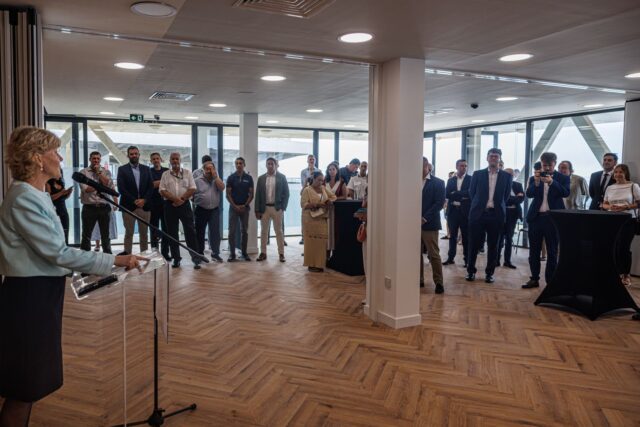
Professor Bachleda said the simulators provided “a significant enhancement” of the university’s maritime training capability, aligning with its vision to produce graduates with both academic knowledge and practical skills for a “demanding and highly regulated global industry”.
She said the Peninsula Hercules Tanker Management Simulation Suite will deliver the mandatory simulation training required by the UK Maritime and Coastguard Agency for cadets working towards their Officer of the Watch certificates, while the Boluda Towage Simulation Suite is designed to build skills in bridge management, ship handling and emergency response in a fully immersive environment.
She noted that effective maritime education “cannot be delivered through classroom theory alone” and that there was a need for students and seafarers to practice decision-making and respond to challenging situations in a safe setting where they can “learn from both their successes and their mistakes”.
The new facilities will support not only undergraduate cadets but also the continuing professional development of serving seafarers and maritime professionals.
She thanked the industry partners for what she described as an “extraordinary level of support”.
“Today, I want to place on record a sincere gratitude to Peninsula Hercules Tanker Management and Boluda Towage,” she said.
“Your generosity is an investment in our cadets, in the safety of our global workforce, and in Gibraltar's standing as a maritime center of excellence.”
“On behalf of the university, our students, and our community, thank you for your support and for your partnership.”
Representing Peninsula, Mr McClean apologised for the absence of founder and CEO John Bassadone, who was unable to attend the event, and spoke of the company’s pride in helping create what he called a “cutting-edge facility for the future of the maritime world” in Gibraltar and the wider region.
“The reason it's an investment is because one of the biggest challenges we have in the world of shipping today is crew, and if we can bring facilities like this to the fore and train future mariners and seafarers in the right way, then we will be prepared for the massive advances that we're going to see in shipping technology, and from Peninsula's perspective, the variability of future fuels as well,” he said.
“So, a big, big thank you from Peninsula as well to everyone who made this simulator happen.”
“It's been a lot of hard work over many years, actually, and it's wonderful to see it come to fruition today…massive well done to all of those of you who've been involved, and a massive statement of pride for us in creating this amazing facility here today,” he added.
Mr Tapiero said the opening was “a proud day” for the company which, he noted, operates over 800 vessels, employs around 10,000 people and is present in five continents and more than 200 ports.
He also announced that Boluda will open 10 training vacancies at its Gibraltar site to use the simulator for seamen, captains and other maritime professionals.
He said Boluda saw Gibraltar as a bilingual, international training hub, and confirmed plans to bring personnel from Mexico, Spain and other regions to train on the Rock.
He also suggested this would be “one of many investments” the company intends to pursue with the university, alongside other maritime partners.
“It’s an exciting moment for Boluda in Gibraltar at present,” Mr Tapiero said.
“So I would like to thank everybody for this, especially Aaron [Lopez, head of the Maritime Academy] who’s been pushing us to achieve this goal, and I think that it will be one of many investments that we'll be doing in the university with Boluda and MSC shipping as well in Gibraltar.”
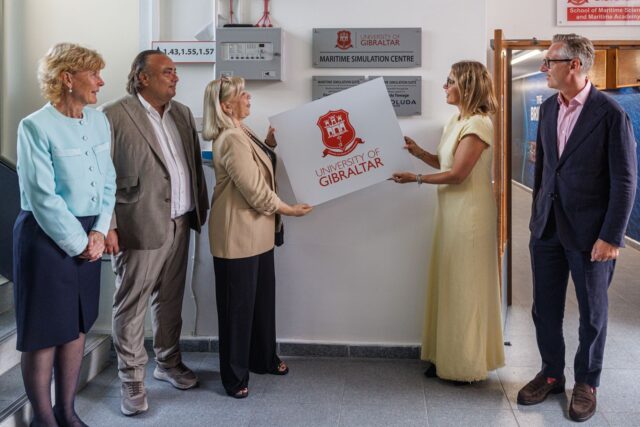
Following the speeches and a plaque unveiling, guests were invited on guided tours of the simulation suites.
At the Peninsula suite, Aidan Carroll, a marine superintendent for Peninsula, introduced the simulator.
The simulator has a touch-screen which allows full control of the helm and can safely simulate crashes without real-world consequences.
The simulator is connected to the Boluda simulator, enabling interaction between the two.
A realistic radar and electronic chart display shows vessel position, speed and movement, mirroring real-ship instrumentation.
It also reproduces changing weather - such as rain, wind and rough seas - that not only appear visually on the screens, which mimic the motion of the ship, but also affect maneuverability, reinforcing the importance of training in adverse conditions.
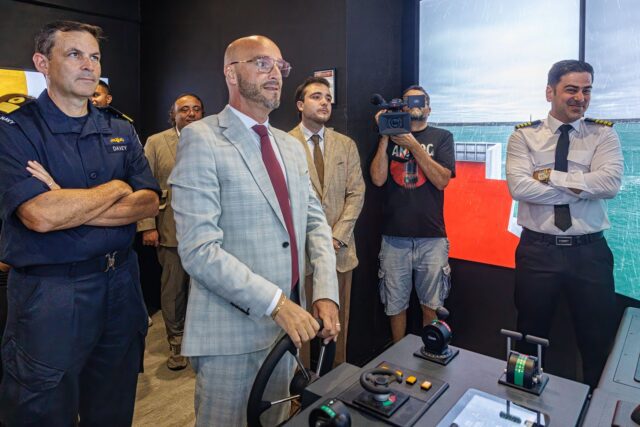
In the Boluda simulator, Mr Santos took the helm as Dr Issa-Zadeh explained ship-handling terminology and cautioned against excessive forward movement in confined waters.
He explained how large vessels accelerate and decelerate slowly, contributing to real-world accidents when actions are taken too late and vessels cannot be controlled in time.
During the briefing, he changed the weather in the simulator for Mr Santos to experience just how dangerous and difficult conditions at sea can be.
Ahead of the launch of the simulator, the Chronicle spoke to Dr Issa-Zadeh, who said that the simulator will enable students and professionals to apply classroom learning in a realistic, controlled environment.
“Maritime programmes are only complete when students can apply their education in industry,” he said.
“One of the most important parts of this programme is going to be the simulators to have subject-matter experience.”
The simulators, which cost around £200,000 each, are primarily designed for nautical studies but can also support engineering training and wider maritime education.
He explained that they will be used to teach beginners how to steer a ship, as well as to upskill captains and key personnel who need to familiarise themselves with new technologies and operating conditions before returning to work on board.
Beyond this, he said the facility can also be used to recreate real-life incidents and analyse accident cases, allowing trainees and professionals to review data and improve safety practices.
Dr Issa-Zadeh expressed his gratitude to the sponsoring companies.
“I have to appreciate both companies, Peninsula and Boluda, for this facility,” he said.
“This facility can help them and can help the maritime industry of Gibraltar for upskilling the people in the maritime industry, as well as the employees in those two companies, and we appreciate it. I hope this kind of collaboration will continue.”
Mr Lopez also spoke to the Chronicle and called the new bridge simulator a “game changer” for both cadet training and the wider maritime industry.
He said the simulator is a core element of the modernised cadetship scheme, introduced in September 2025 under the UK Maritime and Coastguard Agency (MCA) approval for Officer of the Watch certification.
“The curriculum has changed and been modernised because there’s been a lot of change in the maritime sector in regards to navigation, and there’s a lot of digitalisation in that space,” he said.
“The next generation of officers need to be aligned to what they’re going to find on board the bridges of the vessels they’re going to work on.”
Because vessels have a working life of 25 to 30 years, he added, training has had to catch up with the technology already in use across the global fleet.
Mr Lopez said the system will reduce the mandatory sea time of 12 months for cadets by about a month, while giving them realistic exposure to the conditions they will face on board.
He saw the new equipment as part of a wider, Government-backed strategy to build a maritime “ecosystem” in Gibraltar and attract more high-value business to the Rock.
Although geographically small, Gibraltar is “very big” in shipping terms, he said, acting as one of the world’s most strategic ports and drawing top global players in bunkering and maritime services.
“This is a game changer for Gibraltar. It’s not just a game changer for our programme and the cadets, but also for industry,” he said.
“We’re capitalising on the fact that our cadets are not just on Gibraltar business vessels. They’re also now in the international trade, and we’re working very closely with top players globally.”
The University of Gibraltar, he added, now ranks among a small group of leading institutions worldwide providing this level of maritime training.
Industry partners guarantee placements, with cadets required to complete 12 months at sea as part of their qualification.
Beyond this, he said the simulators are expected to play a role in port development and operational planning.
Mr Lopez said high-end bridge simulators are routinely used to model new port infrastructure and trial manoeuvres for large vessels, including major cruise ships, before they call at a port.
“When port infrastructure is going to be developed, it’s actually simulated in one of these bridge simulators,” he said.
“If, for example, one of the big Royal Caribbeans is going to come in, before coming into a port they simulate it in a simulator.”
The new facility will allow such simulation work to be carried out locally, opening up new commercial opportunities and reinforcing confidence in Gibraltar’s maritime capabilities.
Although students have already begun using the simulator on a limited basis, the facility was officially launched on Monday in the presence of the Maritime and Coastguard Agency’s Chief Examiner, who is overseeing the approval process.
The academy expects formal sign-off from the MCA within the coming weeks, after which the simulator will be fully embedded into the cadetship scheme.
Most Read
Hospital capacity rises to 98%, but Director General assures no risk to patients
Thu 22nd Oct, 2026
Govt raises concerns with Taxi Association over weekend service outage
Fri 23rd Oct, 2026

Today's Paper
8th September 2026
Read our latest newspaper by downloading our app from the link below.


