


Between borders and belonging, the voices of Gibraltarian women writers


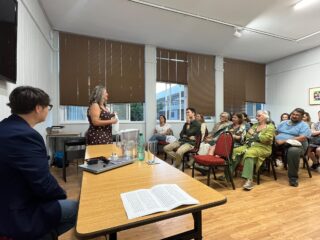
A seminar celebrating Gibraltarian Women in Literature took place at John Mackintosh Hall on Friday, highlighting women’s writing, followed by a recital of readings.
The conference opened with an overall review of contemporary Gibraltarian writing from Giordano Durante, a writer and editor of Patuka Press. He reviewed the most important works published by local authors since 2019, describing this as a start of an “explosion of writing” in local books.
“The main themes of recent years have been identity, belonging and home, sometimes coloured by a nostalgia that may stem from the rapid changes Gibraltar has undergone,” he said, and highlighted the use of varied languages as more works are written in “Spanish and Llanito as well as English.”
Mr Durante also examined the challenges facing local authors, such as the limited opportunities for publication that sees writers taking on the “more complex process of self-publishing.”
“Like writers elsewhere, they must now also contend with the challenges posed by AI,” he said.
Professor Rafael Velez Nuñez of Cadiz university, who is leading the project with Professor Castillo Garcia of Castilla La Mancha university, detailed the results of a survey of Gibraltar’s women writers.
He started the seminar by saying this is “not a typical academic event,” but rather a “meeting point between availability and visibility,” hoping that the locals would appreciate these talented writers more.
“The writers’ answers showed that women's literature in Gibraltar is not a monolithic movement, but a dynamic mix of individual perspectives influenced by different backgrounds, genres, and generations,” he said
“Their work often explored domestic routines, family recipes and everyday phrases”, with stories passed down by mothers and grandmothers “treated as vital sources of cultural heritage.”
‘Prof Velez communicated a perceived “frustration regarding the lack of local publishers and formal literary networks”, and noted how the writers placed “high value on peer support and mutual encouragement”.
This study also showed the differences between the writers, including how far they are influenced by the Llanito idiom whether they viewed their works as examples of a feminist point of view, and whether the genre of their work influenced how they chose to self-edit.
“Although Gibraltarian women writers reject the idea of a unified literary canon in favour of independent voices, their work is collectively bound by shared engagements with border identity, multilingual code-switching, and the urgent preservation of domestic ‘herstory’ within a historically patriarchal landscape,” Professor Velez said.
The seminar was joined by local writers Jackie Anderson, Amy Montegriffo, Marisa Salazar, Natalie Montegriffo, Sheridan Povedano, Sonia Golt and Tessa Rosado, each reciting a number of their poems.
Jonathan Teuma joined them to read an extract by Jackie Villa and Rebecca Calderon recited a poem, accompanied by Stephane Dominicy on the piano, and also sang one of her songs.
Each poem offered a snapshot of women’s perception of their lives in Gibraltar and the influences and experiences that shaped them, such as love, birth, memory, and grief.
Most Read
New group to plan healthcare jobs and placements for returning graduates
Tue 13th Oct, 2026
Gibraltar treaty marks ‘new era of cooperation’ with EU and Spain, UK tells UN
Wed 14th Oct, 2026

Today's Paper
15th October 2026
Read our latest newspaper by downloading our app from the link below.


