


Andy Baker: “Adults living with dementia are still adults”


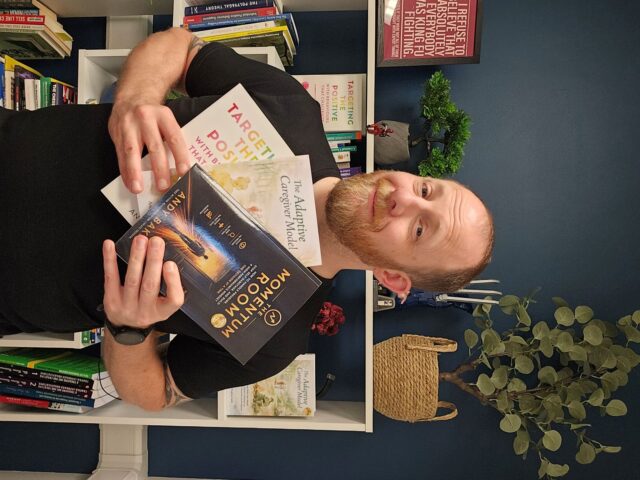
Andy Baker will be speaking at this year’s Gibraltar Literary Festival 2026 on Saturday November 14, 2026, discussing his book The Adaptive Caregiver Model: Walking With, Not Ahead: A Practical Guide to Dementia Care That Adapts to the Person, Not the Diagnosis. Mr Baker spoke about his approach to dementia care with our reporter Manar Ben Tahayekt.
Q. The title of your book includes the phrase ‘Walking With, Not Ahead’. What does that phrase mean in practical terms, and why did you feel it captured the heart of your approach to dementia care?
A. It means meeting a person where they are and adapting our support around them, rather than expecting them to keep up with where we think they should be.
One of the inspirations for the book was a woman my co-author, Megan, knew. She lived with dementia and, when she died, she had a book in her hand. She could no longer read, but she still loved books. That really made me think about how easily we might dismiss something meaningful because someone can no longer engage with it in the way they once did.
I thought about our relationship with books as children. First, books might be about colours, textures, and pictures. Later, we engage with sentences, stories, and increasingly complex ideas. We instinctively adapt to what we offer.
The Very Hungry Caterpillar can be just as valuable as the complete works of Shakespeare, depending on who is holding it and what they need from it. If a young child cannot read Shakespeare, we do not conclude that books have nothing to offer them. We find a different way for them to enjoy books.
I am very clear that adults living with dementia remain adults. Their life experience, interests and dignity must be respected throughout. The lesson from that comparison is about our willingness to adapt.
For someone who loves books, that might mean sharing a story, enjoying illustrations, or simply holding a familiar book.
Too often, conversations about dementia centre on what someone has lost. I want us to notice what they can still do and adapt our communication, activities and surroundings to support their abilities and wellbeing.
That is the heart of ‘walking with’: helping someone be the best they can be in that particular moment.
Q. Dementia is often discussed in terms of memory loss, but what do you think the public most misunderstands about the daily reality of living with the condition?
A. I think the biggest misunderstanding is how much dementia can affect a person’s experience of everyday life.
We often reduce it to forgetting names or misplacing things, but even memory itself is much more complicated than that. We draw on different kinds of memories to make sense of situations and carry out everyday tasks.
Dementia can also affect communication, concentration, motivation, mood, and the ability to regulate emotions and behaviour.
It can change how someone processes information from their senses and understands the world around them.
Everyone’s experience is different, but the impact can reach far beyond what most people imagine when they hear ‘memory loss’.
We take so much of what our brains do for granted. When those abilities change, something that seems straightforward to us may become confusing, frightening, or exhausting for someone else. If we understood that better, I think we would respond with greater empathy.
We also need to be careful that recognising those difficulties does not become the whole story.
Understanding what a person finds difficult should help us support them, while still noticing their abilities, preferences, and the things that bring them enjoyment.
Q. Your book is rooted in real-world caregiving experience. Was there a particular person or moment that changed the way you understood dementia and ultimately inspired you to write this book?
A. There have been many people and moments. The woman Megan knew, who died holding a book, was an important inspiration, but my understanding has also been shaped by my family, my work in care and conversations on The Able to Care Podcast.
Both my gran and my uncle lived with dementia. I helped support my mum through my gran’s journey. My uncle was sectioned when his distress and changes in behaviour became particularly severe. Those experiences showed me how difficult dementia can be for the person and for the people who love them.
Some of the biggest challenges to my own assumptions have come from meeting people living with dementia at an earlier stage. Much of my experience in care had been with people whose dementia was more advanced. Without really noticing it, that had shaped my picture of the condition.
People such as Pete Middleton and Michael Booth have helped broaden that picture. Hearing how they adapt, continuing to create and advocate for others has been inspirational.
There are times when people live well with dementia and times when they are simply doing their best to cope.
Listening to those experiences has reminded me how much we miss if we only see someone through the lens of their diagnosis.
Q. You’ll be speaking at the Gibraltar Literary Festival about dementia care, a subject that affects countless families but is often difficult to discuss openly. What do you hope audiences in Gibraltar will take away from your event?
A. First, I hope we can move away from the shame and silence that can surround dementia.
According to the latest Office for National Statistics figures, dementia and Alzheimer’s disease were the leading cause of death in England and Wales in 2025. This affects so many families, yet it can still be something people struggle to talk about openly.
I want to acknowledge that there are real challenges. Dementia can be hard, and caring for someone can be hard. At the same time, there is hope and a growing community of people sharing knowledge and supporting one another.
I hope people leave with a better understanding of what their loved one may be experiencing and some practical ways to improve their quality of life. I also want carers to understand themselves better and feel more able to cope. Their wellbeing matters, too.
Q. What opportunities do events like the Gibraltar Literary Festival create for raising awareness about dementia and encouraging more open conversations about care?
A. They bring the conversation to people who might never attend a care conference or dementia training session. Someone may come because they enjoy books and find themselves hearing something that relates to their own family or community.
When we talk about care, we often think of professional carers. We can forget the unpaid carers: partners, sons and daughters, and people supporting ageing parents while also bringing up their own children. Caring can be a lonely experience, particularly when people around you do not understand what it involves.
Events like this give us a chance to make those experiences more visible and help people feel less alone.
My aim in my work is to help people better understand themselves and others, so that we can improve wellbeing, connection, and the support we give.
A literary festival offers a different way to reach people with that conversation.
Q. As a first-time guest at the Gibraltar Literary Festival, what are you most looking forward to about engaging with audiences here, and what conversations do you hope your book will spark?
A. I’m genuinely excited. This is a new experience for me. I’ve spent years teaching and working my way forward, and I never expected my book to have the meaningful impact it has had. To be invited to the festival is something I’m really looking forward to.
Most of all, I’m looking forward to meeting people and having conversations. I want to hear their experiences, the questions they have and what caring looks like in their own lives.
I hope the book encourages people to want to understand more and explore what they can contribute. That might be changing how they support a loved one, or thinking about how they can help someone in their wider community.
I would love the conversations to continue beyond the event and lead people feeling better supported.
Q. Looking ahead, what gives you the most hope when it comes to the future of dementia care, and what are the biggest changes still pending?
A. The people give me hope. There are some incredible people working in dementia care and living with dementia who are asking important questions, challenging assumptions and trying to make things better.
I also take some hope from Prime Minister Andy Burnham speaking openly about his father’s experience of Alzheimer’s disease.
Whatever someone’s politics, I believe personal experience can bring a deeper understanding of why health and social care need to improve. What matters is whether that understanding leads to practical change.
One of the biggest changes we need is a cultural shift in how we value carers. Fair pay matters, but feeling valued also means being listened to, having support and carrying a workload that is manageable. Too often, we ask people to provide compassionate care while placing so much pressure on them that they struggle to cope. Unpaid carers need recognition and practical support as well.
I think technology offers opportunities if we use it thoughtfully. Let it do the things it is good at, such as reducing administrative work, so that people have more time to do the things humans can be good at: supporting, nurturing and caring for each other.
That only helps if the time saved actually returns to care. Used that way, technology could make a real difference.
Most Read
PP MEP says ‘things will change’ on Gib treaty with right-wing govt in Madrid
Tue 27th Oct, 2026
HMS Queen Elizabeth sails into Gibraltar, strengthening long-standing links
Sun 25th Oct, 2026
Govt raises concerns with Taxi Association over weekend service outage
Fri 23rd Oct, 2026

Today's Paper
28th October 2026
Read our latest newspaper by downloading our app from the link below.


