


The Calpe Conference 2026 - A personal view: part two
Dr Matthias Meyer.


 By Dr Alex Menez
The second day of the Calpe Conference began with a lecture by Professor John Shea from Stony Brook University, New York.
He noted that “Neanderthals evolved and survived in cold climates, but even so, they needed clothing,” adding that “a naked Neanderthal was a dead Neanderthal… bone cut-mark evidence shows European Neanderthals collected bear hides, presumably for use as clothing.”
He described how The North American Contact Period offers valuable parallels for studying how Later Pleistocene Neanderthals and Cro-Magnons, Homo sapiens, interacted in Europe 35,000 to 45,000 years ago.
“Differences between the Contact Period and Later Pleistocene European evidence suggest encounters between Neanderthals and Cro-Magnons may have been too rare and fleeting for these hominins to have influenced one another in ways similar to those in which Native Americans and European Colonists did.”
After A coffee break, Professor Mina Weinstein-Evron from the University of Haifa explained that Mount Carmel holds one of the richest and most intensively studied Middle Palaeolithic records in the Levant.
With nearly a century of research uncovering dense occupational sequences, varied habitats, and abundant human remains, the region serves as a crucial reference point for investigating human evolution, population dynamics, and behavioural change.
“The division of the Levantine Middle Palaeolithic into discrete cultural phases is increasingly difficult to sustain,” but no alternative framework fully accounts “the variability in lithic technology, subsistence, and settlement behaviour, or processes underlying change.”
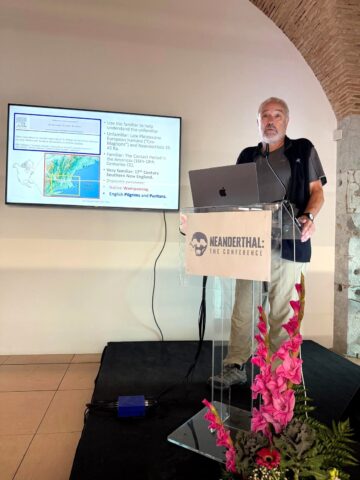
Professor John Shea.
“Recent reassessments suggest gradual, complex developments that may reflect prolonged interaction, population connectivity, and possible admixture rather than abrupt replacement.”
Next was Professor Tom Highman from the University of Vienna.
He noted that “chronology is key in archaeology, but Palaeolithic archaeologists have grappled for decades with radiocarbon-based chronologies that are often contradictory and imprecise.”
Accelerator Mass Spectrometry dating “has seen significant improvement,” there have also been technical improvements, including a calibration curve now available that stretches back to the ~55,000 calibrated years BP (before the present) limit of radiocarbon.
Most importantly he said, “improvements in chemical pretreatment and sample decontamination have resulted in superior purification of bone proteins and charcoal samples; the main items targeted for dating the Palaeolithic.”
Next was Dr Grégory Abrams from Ghent University, Belgium, and co-authors.
He informed that “Neanderthal remains from northwestern Europe remain rare, limiting robust reconstructions of their population dynamics during the Late Pleistocene.”
New data “from Neanderthals recovered at Scladina in Belgium,” Scladina 21 and Scladina 22, include that “despite close chronological proximity, the two individuals belong to two deeply divergent maternal lineages.”
Newly reconstructed mitochondrial genomes “of the Scladina Neanderthals suggest a higher diversity of MIS 3 (Marine Isotope Stage 3) Neanderthals than previously suggested.”
Following was PhD candidate Mr Tristan Dedrie from Ghent University, Belgium, and co-authors.
“Middle Pleistocene deposits in Belgium remain limited in number and unevenly documented… Although evidence for human presence in Northwestern Europe dates back at least 800,000 years, the Belgian record remains largely concentrated in the late Middle Pleistocene.”
“Scladina provides a rare, well-stratified archive combining faunal, palaeoenvironmental, geological, and archaeological evidence.”
All this contributes “to broader discussions on human occupation at the northwestern margins of Europe during the Middle Pleistocene.”
Following lunch, Professor Katerina Douka from the University of Vienna noted that over the past 20 years, “genomics, Palaeoproteomics, and other biomolecular approaches are transforming our understanding of Neanderthals, Denisovans and their wider evolutionary context…proteins are increasingly providing an important complement to ancient DNA, extending molecular research to specimens where DNA is poorly preserved or considered difficult as a first approach.”
Studies from Western Europe to Siberia and China “covering the past 200,000 years demonstrating the potential of ancient proteins to identify highly fragmented hominin remains and guide subsequent molecular investigations.”
Next was Dr Matthias Meyer from the Max Planck Institute for Evolutionary Anthropology.
Methods developed by his group enabled the reconstruction of the first high-quality ancient hominin genome, retrieved from a Denisovan.
Additionally, his team recovered DNA from the ~430,000-year-old Sima de los Huesos hominins, the oldest human DNA sequences known to date.
He noted that “ancient hominin DNA can be recovered from Pleistocene cave sediments,” they extracted DNA from impregnated sediment blocks from bone, coprolites, and minerals, adding that “more recently, we showed that hominin DNA is also preserved on cave walls.”
After a tea break, Dr Grégory Abrams from Ghent University, Belgium, and co-authors described “new zooarchaeological and technological evidence for the deliberate transformation of cave lion bones into multifunctional tools by Neanderthals, based on material recovered from Scladina Cave.”
Detailed analyses revealed “clear evidence of anthropogenic modification,” including fracturing, bifacial shaping, and surface polishing. The findings “also contribute to ongoing debates regarding the cognitive and cultural capacities of Neanderthals.”
Next was Dr Jordi Rosell Ardèvol from the Universitat Rovira I Virgili and Institut Català de Paleoecologia Humana I Evolució Social, and co-authors.
“The Middle Palaeolithic marks the period in which the regular use of fire became widespread,” this leading to the “development of an unprecedented diversity of well-organized settlements in caves and rock shelters, ranging from very short-term occupations to long-term residential bases.”
A feature is the “relatively similar anatomical representation of consumed animals reported at many of these sites,” the apparent ‘uniformity’ is often explained as “the result of anthropogenic activities.”
Their SCAVENGERS project, however, “aims to demonstrate that this ‘uniformity’ was largely produced by the ravaging activities of carnivores.”
The final lecture of the day was by Dr Gabriel Cifuentes from Universitat Rovira I Virgili and Institut Català de Paleoecologia Humana I Evolució Social, and co-authors.
Exploring further research under the SCAVENGERS project, he noted that “while temporal uncertainly is widely acknowledged, the impact of carnivores is often underestimated, despite their capacity to significantly alter archaeological patterns and obscure the main aim for archaeologists: human behaviour.”
Replicating Middle Palaeolithic campsites, they generate models on impacts from carnivores.
“Using high-resolution spatial recording and camera traps… tracks bone displacement and compares initial and final assemblages after scavenger activity across different ecosystems,” the aim being to “compare these neo-taphonomic results with the European Middle Palaeolithic sites.”
Most Read
RGP apologises to James Levy for ‘procedurally flawed’ Op Delhi search warrants
Sat 7th Nov, 2026
Former Gibraltar International Bank premises in Main Street set for alterations
Fri 6th Nov, 2026

Today's Paper
8th November 2026
Read our latest newspaper by downloading our app from the link below.


