


The Calpe Conference 2026 - A personal view (Part Three)
Professor Peter Sahlins.


By Dr Alex Menez
The third day of the Calpe Conference began with a lecture by Professor Robert Foley from the University of Cambridge.
He shared that when he “learnt about human evolution for the first time in the early 1970s, I only had to know the names of five species of hominins; students today must remember around thirty species,” adding that “whole new fields have opened up which in particular have linked palaeoanthropology more fully to the broader field of evolutionary biology,” including macroevolution, phylogenetics, speciation and extinction, evolutionary patterns, and the evolutionary ecology of diversity.
He spoke of the “expansion of hominin diversity,” and how it is “shaping current issues and approaches.”
Biology is crucial for the understanding of natural history, and biologists in the audience, I think, were happy to hear Robert invoke Hennig in saying that “a species is just something that has what we technically call an autapomorphy; in other words, a distinct derived trait defined to make it distinguishable from something else.”
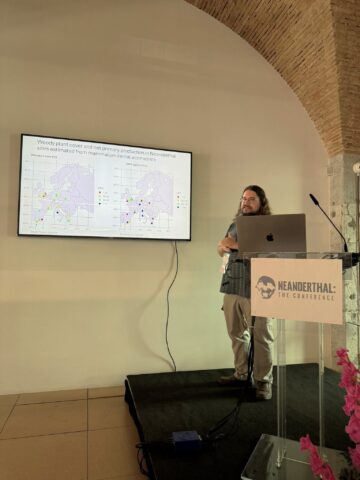
Professor Juha Saarinen.
After the coffee break, Professor Christoph Zollikofer and Marcia Ponce de León, both from the University of Zurich, noted that “since Johann Carl Fuhlrott identified human-like fossil remains… in 1856,” there are four questions that “have dominated research on Neanderthals,” these being “how they related to us? What were their cognitive abilities? Where did they come from, and why did they become extinct?"
They added that “following Dorothy Garrod’s 1926 discovery of Neanderthal remains at the Devil’s Tower site,” further questions emerged including “how did Neanderthals evolve, develop and live? And how did they move around and interact with their environment, including other human populations.”
“Overall, Neanderthals, their Late Pleistocene human contemporaries, and present-day human populations appear as almost equidistant clouds in the morphospace of human evolution.”
Next was Professor John Hawks from the University of Wisconsin-Madison.
He explained that excavation practices of “the first century of archaeological practice tossed away critical context.”
“Low-resolution sedimentological and palynological data of the 1950s through 1990s often invited anthropocentric speculation.,” in addition, “preservation and recovery biases skewed the record by age and sex, rendering the best-knownstories unrepresentative.”
He noted that “a modern convergence of fossil discoveries and high-resolution science can rebuild our understanding of Neanderthal lives... biomolecular data including ancient DNA and proteins are opening unprecedented windows into community structures, kin relationships, and the cyclic persistence or turnover of populations across landscapes.”
Following was Dr Miki Ben-Dor from Tel Aviv University who noted that “the extinction of Neanderthals in Europe at the end of the Middle Palaeolithic remains one of the most debated questions in palaeoanthropology.”
He argued that Neanderthal disappearance was primarily driven by the loss of their preferred large prey during the Late Quaternary Megafaunal Extinction. Consequently, their extinction is just one of several major biological and cultural transformations triggered by this ecological upheaval.
In addition, “Neanderthals appear to have maintained large-prey-focused subsistence strategies late into the Middle Palaeolithic, with prey-size decline documented prior to their disappearance.”
Following lunch, Professor Juha Saarinen from the University of Helsinki explained that “Palaeolithic sites are typically associated with abundant assemblages of large mammal fossils.”
By analyzing large mammal communities, ecometric and palaeoecological studies provide vital insights into the Pleistocene environments inhabited by early humans.
Recent ecometric studies have “indicated a stepwise broadening of human niche during the Pleistocene, with expansion to different environments outside Africa during the Early Pleistocene, and a further expansion of climatic and biome range of humans, including Neanderthals, during the Middle Pleistocene.
Next was Professor Ian Tattersall from the American Museum of Natural History, New York.
He explained that “histories are written by the victors; and the vastly varying images of the vanished Neanderthals as living, breathing participants in the human evolutionary drama have accordingly always depended much more on current states of mind among the Homo sapiens interpreting them than on the record left by Homo neanderthalensis itself,” adding that “we are able today to see the Neanderthals as what they were: a distinctively differentiated group of skilled, resourceful and highly social hominins who exploited the wide range of environments they inhabited with deep insight and knowledge.”
“They did things that we thought were exclusively within our purview; but nonetheless, what we cannot convincingly do is to reconstruct them as routinely symbolic creatures, who, as we do, habitually dwelled in the worlds they re-created in their minds.”
After a tea break, José Antonio Solano-García from the Universidad de Granada, and co-authors spoke of Solana del Zamborino, located in the Guadix-Baza Basin, southern Iberia, an open-air Middle Pleistocene site excavated in the 1970s.
“Despite its archaeological significance, the site remained largely unexplored for almost half a century,” now “new investigations integrate stratigraphic, sedimentological, micromorphological, geochemical, magnetic, palynological, faunal, isotopic, and geochronological evidence with the study of lithic technology and raw-material economy”.
“The site provides a valuable counterpoint to occupations in caves and other more spatially constrained habitats, allowing comparisons of site function, settlement organization and resource exploitation across different ecological and occupational contexts in southern Iberia.”
Next was Professor Peter Sahlins from the University of California. He explained that since the discovery of the Feldhofer Neanderthal in 1856, “the public reputation of Neanderthals has shifted dramatically.”
“From brutish ape-men without culture and language, immortalized in Marcellin Boule’s 1911 monograph, and Franz Kupka’s illustration, their humanity has been restored.”
“Beginning about a century ago, Neanderthals were slowly ‘hominized,’ first by creationists, then by science fiction writers, and then a handful of anthropologists before World War II. Fast forward to today, when most workers and much of public opinion considers them symbolically capable, affective beings ‘just like us,’ or perhaps differently human.”
He drew on evidence from media coverage of human origins debates, commercial and science fiction, television documentaries and commercials to “show how Neanderthals were repositioned and rehabilitated even before the fields of archaeology, palaeontology, and palaeogenetics began to further support their humanity and symbolic capacities.”
The final lecture of the day was by Professor Chris Stringer from the Natural History Museum, London.
He noted that his and Clive Gambles’s 1993 book, In Search of the Neanderthals “which is still in print”, received several requests to update for subsequent editions.
However, he and Clive declined “as time and science went on, it would have needed a very substantial rewrite.”
“The book was very much a reflection of its time, at the height of conflicts between the evolutionary models of a Recent African Origin and Multiregionalism, and of Lew Binford’s influential views that Neanderthal adaptations were essentially based on satisfying immediate needs, while those of modern humans involved planning and forethought,” adding that “things look different and less polarized 30 years on, although some workers continue to argue for the inclusion of Neanderthals in the species Homo sapiens, and for recognition that there were no significant differences in behaviour or behavioural potential between the Neanderthals and contemporaneous sapiens populations.”


