


My Lorca Pinecone


Ninety years ago today, Federico García Lorca, arguably Spain's greatest and most influential 20th century writer, was being held prisoner in a windowless office in the Civil Government building in his hometown of Granada. In the black hours before dawn, the 38-year-old poet was bundled into a car and driven out of the city toward the foothills of the Sierra Nevada where he was later shot at the side of the road. 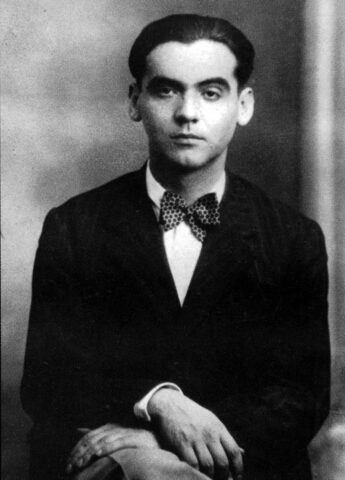
It was the very early days of what would soon morph into a grotesque Civil War following a failed coup, a few weeks earlier on 18th July 1936. Franco’s nationalists captured Granada and after initial street clashes and a stand-off in the Albaicín, there began a wave of brutal executions targeting prominent figures of the democratically elected Republican Government. They were arrested, given a quick ‘trial’ then shot against the cemetery wall. Soon these time-consuming sham trials were dispensed with and truck loads of ‘reds’ were simply captured and ferried up the Carril de San Cecilio towards their doom.
On a recent visit to Granada, I wandered around the Alhambra and marvelled at the tiles, fountains and ingenuity of the Arabs. The sounds of breeze through the trees, running water, and birdsong would have been the same in 1936 but interspersed with the rat-a-tat-tat of gun shots coming from the nearby cemetery the tell-tale pock marks still visible on its walls today.
The composer Manuel de Falla and his sister lived in the neighbourhood. The Casa Museo Manuel de Falla, is a traditional Granada ‘carmen’, with a walled garden perched in the Antequeruela Alta. I knocked on the front door and a face identical to Don Manuel’s suddenly appeared in a tiny upstairs window. The man motioned for us to wait but then soon appeared down at the entrance. We were beckoned inside by this local guide who had an uncanny resemblance to the composer; bespectacled and diminutive he spoke in hushed tones and kept repeating how this family were “muy, muy religiosa y muy, muy católica”.
The interior is simple and unpretentious and our eccentric host led us around each tiny room opening doors to pantries, larders and medicine cabinets still containing the original items, (I was momentarily amused by the thought of the great composer draining vegetables through his white enamel colander). Falla has always fascinated me and in my kitchen, I have a framed original 100 peseta note with his image on it.
Born in Cadiz he spent years in Madrid, then Paris before settling in Granada. He never married and lived with his sister until he died. He was indeed known to be “muy, muy religioso y muy, muy católico”, however his home served as a vibrant meeting place in the 1920s and 30s for prominent artistes such as Lorca, Juan Ramón Jiménez and Gibraltar’s very own Gustavo Bacarisas who designed the iconic stage decor and costumes for Falla's ballet El Amor Brujo.
The carmen is preserved exactly as Falla left it in September 1939 before exiling to Argentina. Amidst his modest furniture and piano is a collection of drawings, paintings, and handwritten letters gifted to him by the era’s greatest figures including Picasso. I noticed a couple of pictures of Rossini on the wall and was not surprised. The mild-mannered, conservative Falla was obviously a fan of the flamboyant Italian and the influence on his music is clear. One look at Don Manuel and you’d never think he’d team up with Lorca and organise the historic 1922 Concurso de Cante Jondo (song contest), which laid the foundation for modern flamenco festivals in Granada. Never judge a book by its cover.
I ran my hand across the wooden circular dining table and imagined all these people sitting around chatting, planning poetry and music nights, gossiping about the avant-garde Granada ‘scene’. These men and women would have been excited about Spain’s new democracy and the Second Republic, finally they could express themselves freely. Who would have thought that such violent terror lay just around the corner?
Franco’s forces, with the help of Hitler, Mussolini and the ‘Army of Africa’, took swift control of most of Andalucia and operated a detention centre known as "La Colonia" outside the village of Víznar, north of Granada. The Catholic Kings drove out the last of the Moors from this very spot in 1492 only to have right-wing rebels bring them back in to murder their own people.
When he found out Lorca had been arrested, Manuel de Falla risked his own life to intervene. He went to the government building where the poet was being held and argued passionately for his release, using every ounce of his prestige. The authorities cruelly lied to Don Manuel saying the case was under military review when in fact the death warrant had already been signed.
Before sunrise on 19 August 1936 Lorca and three other prisoners were driven from Víznar to Alfacar. The firing squad executed all four men, and their bodies were thrown into an unmarked trench. Shortly afterwards, Juan Luis Trescastro, a Falangist thug walked into a local café and loudly bragged: "I fired two bullets into his arse because he was a queer."
The morning we left Granada it was pelting with rain and the long journey back to Gibraltar loomed. Every free tapa had been relished; every glorious landmark enjoyed. The Cathedral with its shocking-white interior, the caves of Sacramonte, the Lorca family home at Huerta de San Vincente, the excellent Centro Federico García Lorca and many more. But there was one final place I had to visit, and I knew it would not give me the same sensation as all those others.
Lorca’s assassination took place beside an olive tree at Fuente Grande a natural spring originally called Aynadamar by the Moors, meaning "Fountain of Tears". In 1936 it was open countryside but today it is a dense pine forest purposely planted by the regime. Pines are fast-growing and their roots bind the soil burying bones deeper. They block out light and alter the topography, making it visually impossible for people to locate the macabre dips in the earth that indicate a mass grave. Despite decades of searching, Lorca’s remains have never been found.
The lone olive tree now stands amidst a sea of pines and beside it there is a simple stone monument engraved with the words: "To the memory of Federico García Lorca and all the victims of the Civil War." I took a moment and shed a tear then knelt down and picked up a pinecone from the ground. I took it home and tied a ribbon to one end, it was a Republican ribbon that I was given at the Casa de la Memoria La Sauceda in Jimena but that’s another story…


