


The Cauldron Barefoot Old Men


I like wine. If you don’t like wine then this article will still be interesting as it tells a story of what a small parcel of land can do if treated with care. When my husband and I travel we like to accompany our food with the local wines and until relatively recently this was not possible in Andalucía. The southern part of Spain, with its sweltering heat and bleached summer landscape, is historically associated with the sweet, fortified wines of Malaga and Jerez. These are delicious of course but not what you’d necessarily drink alongside a meal (although the jury is out on that now especially in Jerez). It has long been assumed impossible to produce decent red and white wines in Andalucía.
As far as Spain is concerned Ronda is my first love and I have a long-standing relationship with the town which means I must get a fix every so often. As a consumer I have seen a change on wine lists which now boast a huge selection of local wines, which are superb. Over the last 20 years there has been an explosion of epicurean shops selling wines, cheeses, olive oils and all that delicious local fayre. Ronda has a 2-star Michelin restaurant, Bardal, and many top eateries which has made it the foodie capital of the region. So, how come Ronda has managed to defy the sun gods and produce incredible wine suddenly? Well, the answer is that it was capable all along…
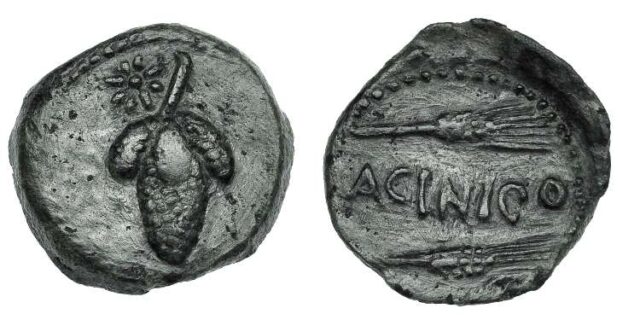
A visit to the ruins of Acinipo will tell you all you need to know. Acinipo is a major Roman archaeological site situated on a hilltop 20 km from Ronda. In the 1st century AD, it housed up to 5,000 people and even minted its own coins, underscoring its regional importance. The design on the coins featured a bunch of grapes confirming that the area was significant in the golden age of wine growing which continued up until the phylloxera insect pest arrived from North America.
In the late 19th century, a phylloxera epidemic destroyed most of the vineyards in Europe. It was introduced when avid botanists in Victorian England collected specimens of American vines in the 1850s. The remedy involved grafting American rootstock to the European vines a complicated and expensive process. The farmers of Ronda had no choice but to focus on other existing agriculture like olives, almonds, pork products and cheese causing the demise of the vineyards and the disappearance of the traditional knowledge and culture of wine production.
Fast forward to 1982 when a young German, Friedrich Schatz, visited Ronda and bought a redundant plot of land which was formerly used for growing vines. Schatz introduced new techniques to the viticulture, using different grape varieties to produce red, white, and rose wines. The results were truly spectacular producing wines of excellent quality, whilst original, fresh and aromatic. The Serrania de Ronda has now been repopulated with over 20 small bodegas, and I have embarked on a mission to visit all of them.
A previous article in this newspaper, ‘I Went To A Vineyard…’, details my 2021 visit to the unique Antigua Real Fábrica de Hojalata San Miguel just outside the blue village of Júzcar. I have returned to Fábrica many times since then and have now ticked off several vineyards on the list. My latest being DV: Descalzos Viejos which is walking distance from Ronda town centre in an incomparable setting down in the gorge.
We arrived mid-morning on a sunny January day and were greeted by the owner Flavio and his dog Flaca. As we waited for the other guests to arrive, I looked out over the vineyard which stretches across the lower part of the estate among old olive trees and farmhouses. It was a spectacular setting and one deep breath brought in the glorious scents of vines, citrus trees, earth and woodsmoke. Ronda is beautiful in winter. The winery itself is housed in a 16th-century Trinitarian convent an ancient building nestled beside the old walls.
Flavio an architect Argentinian by birth and Italian by heritage came to Ronda in the early nineties and was drawn in by its spell. Being surrounded by medieval splendour which needed a lot of care and attention made it impossible for him and his wife to leave. In 1998 they purchased the neglected plot and began a comprehensive restoration process.
Our tour began with a walk along the path above the vineyards then up to the terraced gardens with fruit trees, fountains, ponds and a natural spring. We were then joined by the bodega cat Dmitri.
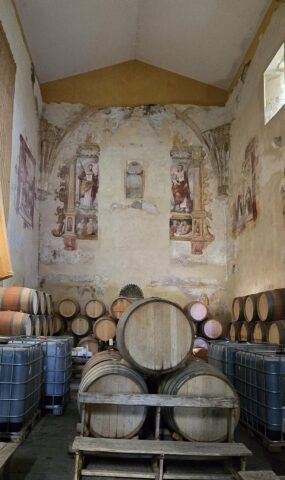
Here Flavio showed us the water systems passed down from the Moorish era and still in use today. The old monastery building is impressive. Of particular interest were frescoes on the main altar, which have miraculously survived beneath numerous layers of lime, flaking paint, and dampness. I applaud people who take on projects like this as it is they we must thank for many preserved properties; governments, sadly, do love to bulldoze things.
The monastery was partially abandoned by the monks themselves back in 1664 when they moved to the city centre. The oldest Trinitarians remained on the land in charge of the orchards and would wander around the estate wearing only sandals, hence the name Descalzos Viejos, a name that Flavio and his team have cleverly used for the new bodega. The restoration is meticulous, reintegrating and consolidating all the original architectural and artistic elements that could be recovered. Imagine entering through huge doors, that pungent whiff of the wine barrels, the oak, the grape, and knowing you would soon be supping the divine nectar.
Winter is a great time to visit vineyards as the groups are always small, it was us and a family of four adults from Moldova (of all places) which shows how important and lucrative wine tourism is. We sat in the courtyard while Flavio served generous portions of wine alongside a charcuterie board of local chorizo, sausage, cheese and bread.
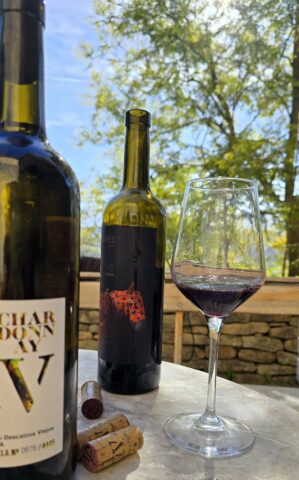
This man clearly loves what he is doing and told us the story of his life and all its fascinating coincidences which led him to where he is now. His philosophy is simple: eating, drinking, conversation and we discussed the British mentality of drinking to excess and forgoing the eating (and by consequence the conversation). Flavio is very much part of the Ronda gastro scene and produces exclusive wine bottles (featuring Dmitri the cat) for restaurant use only. Upon hearing this I recalled a meal at Bardal where the exceptional olive oil was served in a clear glass bottle. I asked the waiter where it was from and he replied: “A special, secret place. It is not for sale”. Ah, the mysteries of Ronda!
We left Descalzos Viejos with a box of mouth-watering wine giddy with alcohol and drugged by the atmosphere of the old monastery.
Most Read
Nine in 10 who reach out to EV Foundation are women, mostly struggling single mothers
Mon 23rd Mar, 2026
Introducing Elysium Bayside: A New Landmark of Elegance on Gibraltar’s Skyline
Fri 20th Mar, 2026

Today's Paper
23rd March 2026
Read our latest newspaper by downloading our app from the link below.


