


The mystery of the Courtyard of the Orange Trees, finally solved
The Orange Tree Courtyard.


By Martí Crespo
Ever since my first visit to Gibraltar, in the early 2000s, one of the places I have returned to most frequently is the small courtyard of the Cathedral of St Mary the Crowned. There are several reasons for this.
On a personal level, the so-called Courtyard of the Orange Trees is home to the entrance to the ecclesiastical archives, where I spent many hours preparing my study of the Minorcan community on the Rock.
From a historical and religious perspective, the courtyard also provides access to the small chapel dedicated to Our Lady of Lourdes, while the geometric-patterned tiles on the walls remind us that the church was built on the site of Gibraltar’s former mosque.
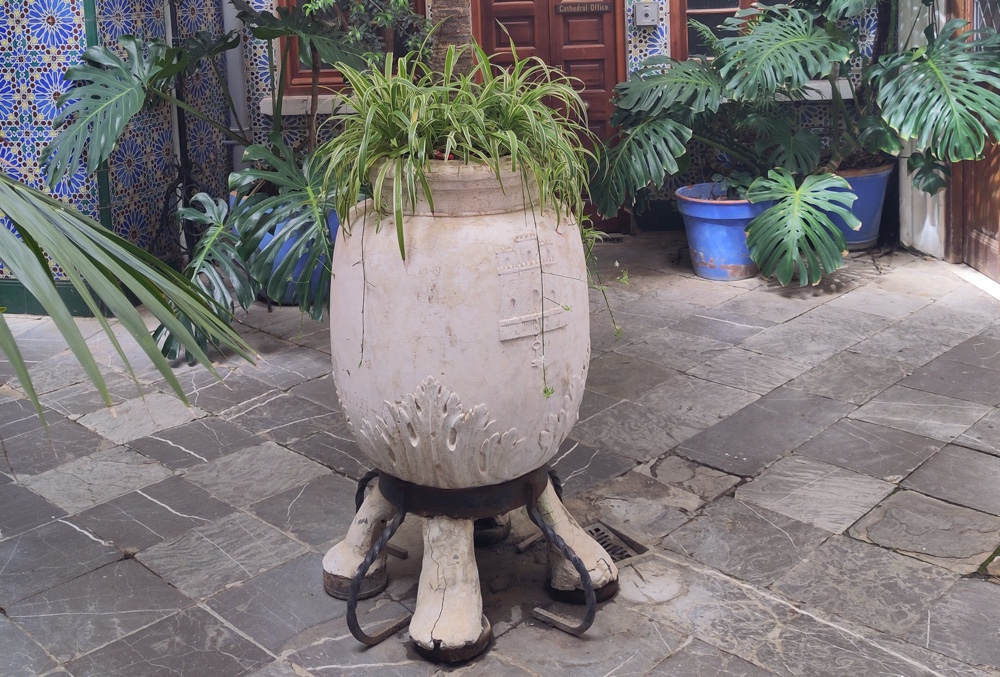
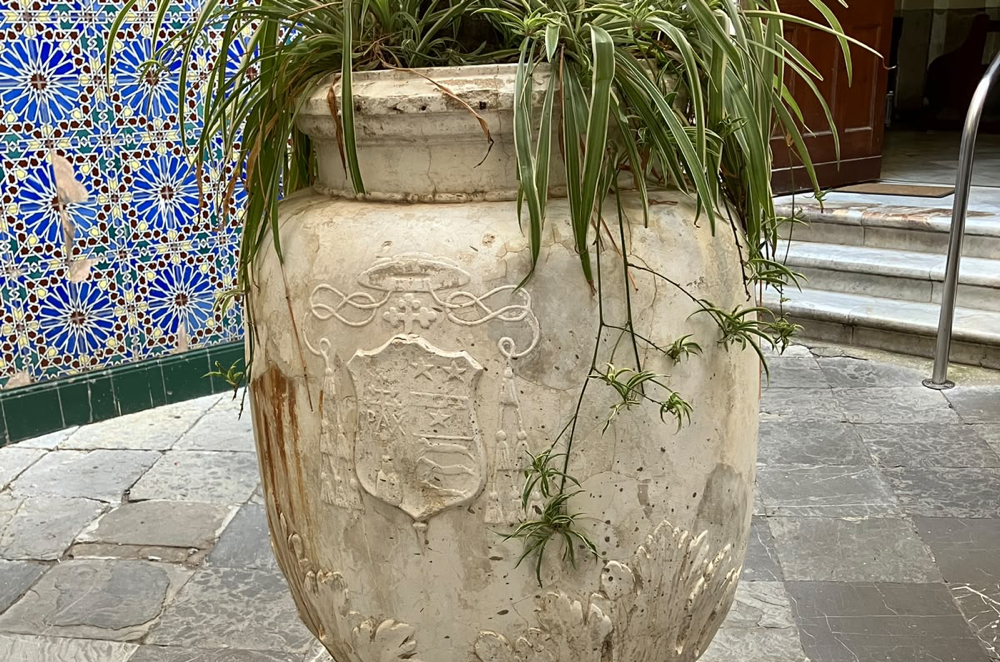
And there is one more reason, a small one perhaps, but one that had intrigued me ever since I first learned of it: right in the middle of the courtyard stands a huge, rather unusual four-footed urn, bearing the carved coats of arms of Gibraltar and of the Welsh bishop Henry Gregory Thompson, who headed the diocese from 1910 to 1927.
What intrigued me most about this large pot was the signature and date near its base: Ana Piquet, 1923.
As local historians such as Manolo Galliano and Richard Garcia had rightly pointed out, both the surname and the date matched the presence in Gibraltar of the Barcelona-born sculptor Josep Piquet Catulí, the artist responsible for the sculptures that have stood at the Gibraltar War Memorial on Line Wall since 1923. I wrote a fairly extensive biographical article about this enigmatic Catalan artist, of whom very little was known, in 2019, subsequently reproduced by Gibraltar Chronicle.
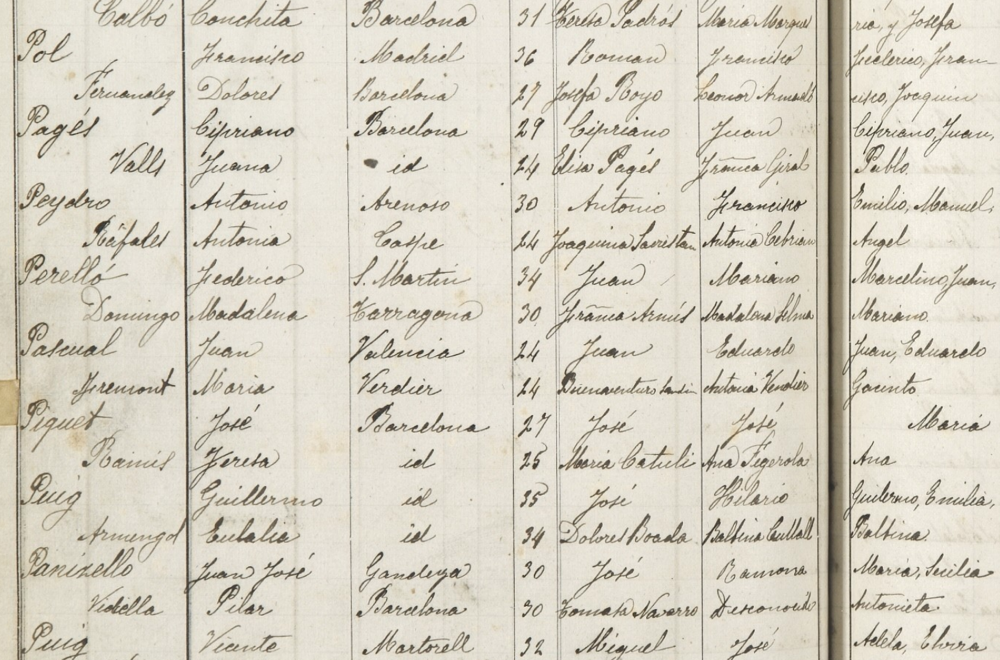
Among many other details, I mentioned that he had had a daughter with Teresa Ramis, named Maria.
So who could this Ana Piquet in the Courtyard of the Orange Trees of the cathedral have been?
The years passed—and so did repeated visits to that corner of St Mary the Crowned—until, this summer of 2026, my friend Tony Lombard included me in a three-way email exchange about the coat of arms and the mysterious name.
Almost as an epiphany, I began searching Barcelona’s digitised civil records for the possible birth of Josep Piquet and Teresa Ramis’s daughter in the Catalan capital, where they were both from. And luck was on my side: within a few hours I had my answer. On 6 January 1897, Epiphany Day, Ana Maria Piquet Ramis was born in Barcelona.
Mystery solved!
It is reasonable to assume that when Josep Piquet was commissioned to create the memorial to the British soldiers who fell in the First World War, he did not travel to Gibraltar alone.
It is quite possible, for instance, that his daughter accompanied him. She was twenty-six at the time and, if she had inherited her father’s artistic talents, she may even have helped him in the workshop where he worked on the Rock between 1922 and 1923.
Whatever the case, there can be little doubt that the carved coats of arms on the cathedral’s great planter were the work of her hand. At the time, it is worth remembering, the cathedral was also home to several monks from Montserrat Abbey, including the Valencian Bernat Adell and the Catalans Bonifaci Soler and Ildefons Vilaplana, the latter serving as Bishop Thompson’s secretary.
We might therefore imagine that, through one of those Catalan friars and through their direct contact with the bishop, Ana Maria Piquet Ramis was commissioned to reproduce the two coats of arms in stone for the cathedral during her stay in Gibraltar alongside her father.
The object at the heart of this story, shrouded in mystery for so many years, can still be found today at the centre of the Courtyard of the Orange Trees.
Most Read
Rock’s digital security system sends warning beyond Gibraltar, Parliament told
Fri 16th Oct, 2026
New group to plan healthcare jobs and placements for returning graduates
Tue 13th Oct, 2026
Fourth Committee welcomes Gib treaty as UN approach to decolonisation faces US criticism
Fri 16th Oct, 2026

Today's Paper
3rd September 2026
Read our latest newspaper by downloading our app from the link below.


