


The Neanderthal story and UNESCO, a story that always keeps on giving


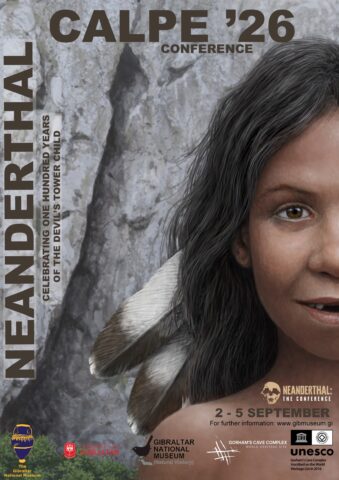
This year - 2026 - is a very significant year in the ever-evolving story of the Gibraltar Neanderthals. A story that keeps on giving. Firstly, it is the 100th anniversary of the Neanderthal child skull discovery in Devil’s Tower Road by archaeologist Dorothy Garrod in 1926 - a child we know today as Flint. His story, and our growing Neanderthal story, will be fully explored later this year in the annual Calpe series of conferences celebrating 30 years in early September bringing leading scientists in the field including our own world expert Professor Clive Finlayson.
But this week Alice’s Table looks back on another birthday also being celebrated this year. It is the 10th anniversary of the day the Gorham’s Cave Complex was inscribed as part of the UNESCO World Heritage sites family. It was on a day very much like today in July 2016 - when Gibraltar’s most famous cave and its surrounding caves was granted world heritage status. A major accolade. A day I will never forget. As a journalist I have covered many events over nearly five decades but for me this story ranks high on my list of best moments in my career. I have always been interested – and those of you who read this Alice’s Table column on a weekly basis know this to be true – in many different aspects of our history – but especially the living history of our people. And the Neanderthals were the first of our people to roam these shores and find a home.
10 years ago, 15 July 2016 – I was on the phone with the Director of the Gibraltar National Museum and soon to become Director of the UNESCO site – my good friend - Professor Clive Finlayson (as friends we will remain on first name references in this column). I have asked him to return to our table this week to both reminisce on the day, look at the last 10 years, and look ahead as we enter a second decade as part of the UNESCO family. I do not think I have spoken to Clive as many times in such a short period of time as I did on that day 10 years ago. I was closely following the proceedings taking place in Istanbul that hot July day– the internet was not as fast as it is today – accessibility was limited. Our computers constantly on go slow. Getting the right connection and the right website seemed an eternal wait. But Clive was in constant touch with the UK delegation as he had not been able to travel there. It was on that day- 15 July 2016 – that a rebel group from the Turkish military launched an attempted coup to overthrow the government. But the vote in UNESCO went ahead anyway.
So, there were many telephone conversations as we waited for the vote. I recall it as a very intense day which moved into the afternoon. It was a very long and tedious day in the heat of the summer – I do not believe the Chronicle office had air conditioning then. There was a quiet excitement all day, but it was frustrating as we waited to hear if the vote had gone in our favour.
It did. And when it came it certainly felt like the greatest feeling in the world – what an achievement. What a joy to be the one to report on this momentous occasion which surely put us on solid ground firmly placed as part of the overall Neanderthal story on a global scale.
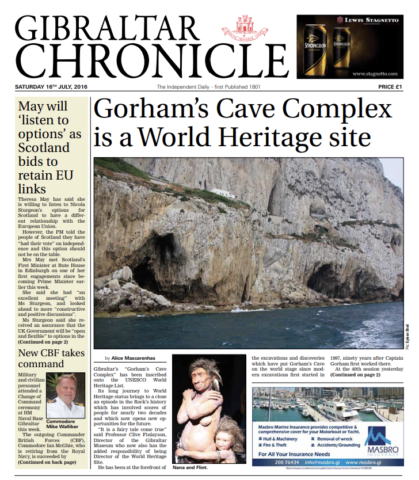
My story on the front page of the Chronicle the next day (16 July 2016) read: “Gibraltar’s Gorham’s Cave Complex has been granted World Heritage status. In Istanbul the 40th session of the World Heritage Committee the cave complex, incorporating Vanguard, Bennett’s and Hyena caves, has been inscribed into the UNESCO World Heritage List. Gorham’s is the last known site of Neanderthal survival, some 28,000 years ago, and has been a major contributor in providing a clearer picture on the world stage of the story of the Neanderthals as well as presenting evidence of climate, sea-level and ecological change.”
Today, new advances place the last known site of Neanderthal survival at 32,000 years. It was at the start of the proceedings that we learnt from the UNESCO World Heritage Centre representative that the name of the nomination had been changed from Gibraltar Neanderthal Caves and Environments to the Gorham’s Cave Complex (incorporating Vanguard, Bennett’s and Hyena caves), after Spain had raised concerns. The nomination received support from Finland, Jamaica, Portugal, Peru, Tanzania, Kazakhstan and Vietnam. It had been a long six-year journey for Gibraltar, but excavations had restarted in the 1990s and remain ongoing. Clive I reported said: “I am delighted Gibraltar’s heritage has its rightful place on the world stage.”
The Gorham’s Cave Complex had also joined a select club of UK sites which included the Palace of Westminster and Westminster Abbey, the Giant’s Causeway, Stonehenge and the Tower of London.
Sitting down with Clive 10 years on I remind him that on the day he had also said how it had felt like ‘a fairy tale come true’ – Is that still how he feels, and what does he remember of that day?
“I remember a lot of tension, a lot of phone calls both within Gibraltar and externally with the UK delegation. We were confident we had a very good product and that it would get its status, but having been at previous world heritage conferences myself, understanding how much gets debated at the last minute in corridors between ambassadors - the politics - there was always the possibility that something could have gone wrong,” he explains.
When the vote finally came there was great relief that Gibraltar’s caves were now on the UNESCO List - a fantastic achievement which Clive acknowledges “only comes maybe once in a lifetime”.
Today the UNESCO World Heritage List includes over 1,200 cultural and natural sites deemed to have ‘Outstanding Universal Value’ to humanity. The Gorham’s Cave Complex remains one of them.
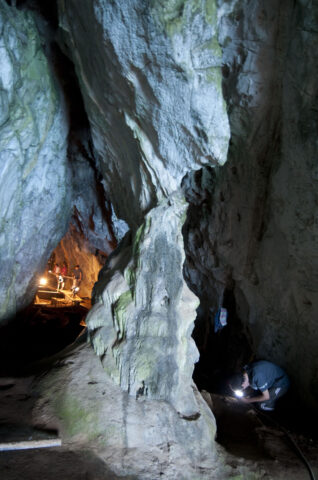
Clive is keen to point out that we must not forget that the World Heritage Site is not just Gorham’s and its surrounding caves – there are now five caves in total with the recent finding of the Neanderthal Grotto (inside Vanguard) and includes the whole of Med Steps right up to the top of the rock also providing evidence.
Our UNESCO site, he says, is “unique and there is no other like it in the world”. It is unique because of all that the site has revealed even after its inscription. How it keeps on adding to the Neanderthal global story.
“The site keeps on giving. This is very important for understanding its uniqueness. Not only in what it has given already, but in the huge potential it has for the many generations to come to carry on researching. I certainly accepted a long time ago that I won’t see the end of the project. The cave will beat me to it, but that’s fine. It keeps on producing results, and for me the potential of the site is as important as what it has already given.”
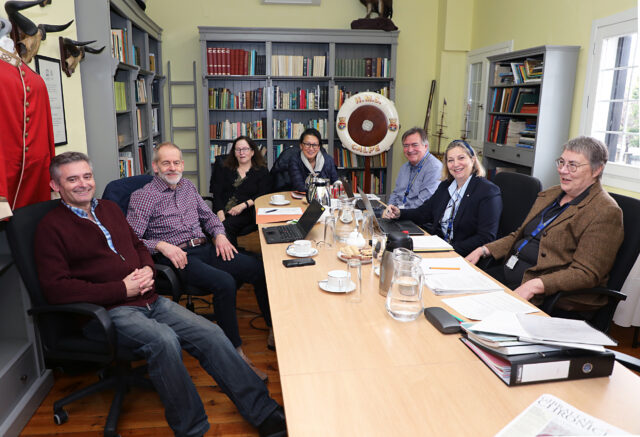
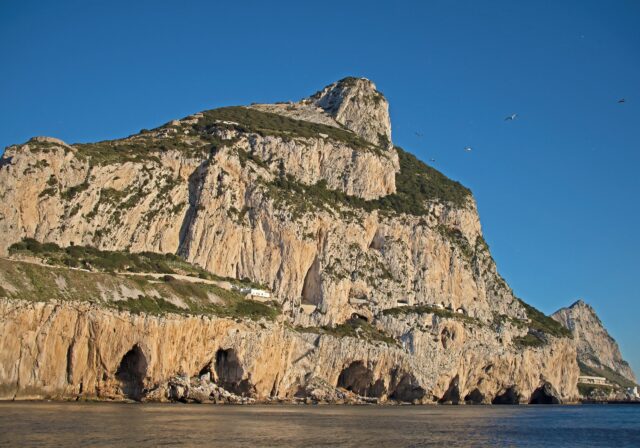
Clive agrees with me that to date Gorham’s has exceeded all expectations: “When I first started the last thing I imagined was that it would be declared a World Heritage Site. Already in 1999 there had been an attempt to do something with the Rock of Gibraltar as a whole, the Fortress of Gibraltar, I was involved in that. We had UNESCO community meetings, got to know people to understand it more but unfortunately it did not go through. Gibraltar decided not to proceed. When the next opportunity came 10 years later to get on the UK tentative list we decided to focus on the Gorham’s complex.”
The process leading up to 2016 would be long and laborious. It took six years to complete the documentation, get the site on the UK list, and then get the UK to nominate the Gibraltar site.
Gorham’s, he explains, fitted perfectly into what a world heritage site should be – “it is not just about outstanding universal value but the integrity of the site”. A tense moment he recalls was the day UNESCO sent an evaluator to visit the caves and check out the site: “He was an expert in the field, and he gave nothing away, so we had to wait. He carried out a full-scale evaluation and spent several days here, and thankfully it went in our favour.”
In March of 2016 I had already written that Gibraltar was on target to achieve World Heritage status – it was a story which looked ahead to the meeting in Istanbul. I wrote how Clive believed the nomination to be ‘right on target’ and if recognised would allow the Rock to use Gorham’s Cave as a flagship to work on other sites which were also significantly important. And judging by the findings in the last decade he was proven right. Clive believes that even if all the discoveries in the last 10 years had not happened, the value of the site would still be there. If Gibraltar/UK were bidding for it today, he says, the case would be even stronger because all the recent discoveries would act as an accumulation, and all adding to our knowledge of these remarkable people. Even now he believes - the evidence Gorham’s and its Complex of Caves can give - is quite simply “limitless”.
“We did not know four years ago we would have a new site that we would call – The Neanderthals Grotto. It was only by chance. What is there at the back behind Vanguard – who knows? We have a handle on the chronology, the stratigraphy, what it keeps producing, but let’s look at it this way, there could be more to discover in a corner of Gorham’s or Vanguard. Somebody a family buried there 80,000 years ago. We might find it, or it might never come to light, or it does in 10 years’ time, it could even be tomorrow, or we never find it. But in terms of possibilities and new discoveries it is I repeat limitless.”
Even today, he admits, it is sometimes difficult to believe that we achieved World Heritage status. With many hurdles along the way getting on the UK List was not a guarantee and proved competitive. The nomination dossier alone numbered 1800 pages of technical information put together by the small hard working in-house team at the Gibraltar National Museum. Gibraltar once ready wanted to go early but by UNESCO rules the UK could only put forward one site a year. The Fourth Bridge was due to go first but Gibraltar fought to be next one and won. It was a week after Gorham’s was inscribed on 17 July, just two days after the vote, and whilst visiting the caves in the presence of Acting Chief Minister at the time Dr Joseph Garcia, Museum team and the media, and myself, that Clive uttered the words ‘Welcome to the UNESCO World Heritage Site’. He admitted he had been waiting a long time to say that. Gibraltar was now in the UNESCO family, and it was real.
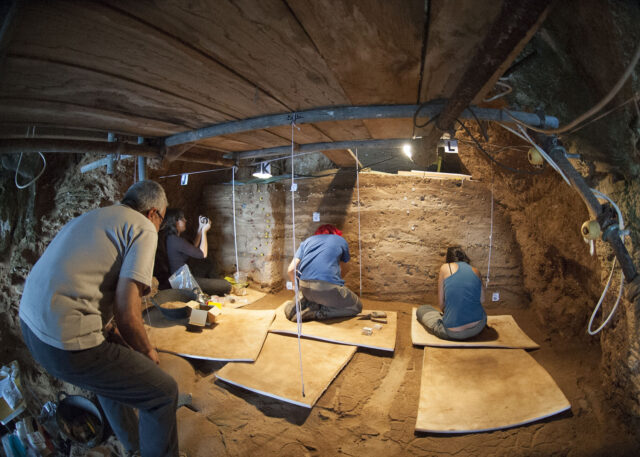
Gorham’s, was now one of the official wonders of the world. A recognition which was to bring with it great responsibility. Today the challenge facing the UNESCO World Heritage Site remains the same as a decade ago – conservation is paramount. As a natural site it remains open to all the elements, so managing the site requires constant observation – rockfalls, storms, the rains and sea levels. Monitoring of the area is 24 hours. The World Heritage Advisory Forum meets several times a year and is chaired by the Minister for Heritage. There are also working groups in place. Communication with UNESCO remains open at all times with a detailed report compiled every few years where everything from erosion to water quality, air quality, to developments, staff, number of visitors, etc. comes into play.
“I have had many sleepless nights especially during winter storms. You have no control over the elements, and you worry what might be happening but it is out of your control,” he says.
The last 10 years has seen great development of our understanding of Neanderthals because of the findings at Gorham’s and its Complex of Caves. There has been a huge surge in our understanding of Neanderthals based on genetic work but also based on our understanding of their abilities and cognition: The latter has come from Gibraltar. Clive says the opportunity to see how far we have come is going to be seen in September at the Calpe Conference when we will have all the leading world experts here – “that says a lot”.
“If we combine Calpe, the Museum, and the World Heritage Site, we have what I would regard a Centre of Excellence at world level for the study of Neanderthals – at the moment we are looking at further ways of enhancing the experience locally by using modern technology.”
The Gibraltar National Museum is appointed by the Government to run the World Heritage Office on the Rock. Clive’s role as director is to maintain or improve the site and make sure it does not deteriorate – so that the site remains well protected. As part of the team, he also works with Professor Geraldine Finlayson who is the Co-ordinator of the site. He accepts it is a huge responsibility. The status needs to be maintained, the area protected as a World Heritage Site. Any changes to the surrounding area could have a negative impact on its status – but Clive is certain its future status is safeguarded.
Gorham’s, he tells me, has been sitting there quietly for tens of thousands of years. People have come and gone.
“I cannot see any immediate challenges. If ever – God forbid anybody would ever want to reclaim the whole of the East side in front of the caves - then that would be a challenge. But I can’t see that as a problem in any immediate future.”
As we look to the future the first priority of a successful World Heritage Site is not visitor numbers: “People seem to think that if people don’t visit a site, then you might as well not have one. But the first priority is the conservation of the site. If we look at the Lascaux Cave in France or Altamira in Spain, both renowned for their caves, it is interesting to point out that access to both is zero. Nobody is allowed in. We have to understand where we are in this game and these are not my rules, nor the Governments, nor the UK Governments but UNESCO, and they are for the protection of the site.
“With Gorham’s, we started this idea of a quota of 120 people a year, and we monitor every visit, because every time people go down including the archaeologist, you’re stepping on heritage, which you can potentially destroy, and we monitor that. That’s just the reality. But to judge the value of Gorham’s, by the number of people going down, is a huge mistake, and we would then probably be talking of it as a worthless site. And we all know that it isn’t. I think that’s a very, very important message that we must all understand and which applies to all other heritage sites.”
But the team wants access to remain open to all and are presently exploring other alternatives using technology – and enhancing the overall experience of our Neanderthal World: “We want people to be aware of the site we want people to know, but we don’t want to be the ones who destroyed it,” he says adamantly. Therefore, the challenge is to always monitor. To keep a tally on the annual deposits retrieved. To keep on working on the research.
“We need to continue to try and find the right balance between accessibility and conservation, with conservation, always being first. Those are the challenges we face today, and to continue to make as many people as possible in the world aware of the site. To keep ourselves up there and show the world that together the Gibraltar Museum and the World Heritage Site is a centre of excellence. Years ago, that was what we set out to achieve. A centre of excellence for the study of the Neanderthals. For a place with a population of over 30,000 people, I don’t think that’s too bad, really. To have achieved that, I think is something we should all be proud of.”
For more details on the Calpe Conference and this anniversary year check out: https://www.gibmuseum.gi/ and https://www.gibmuseum.gi/world-heritage/gorhams-cave-complex


