


Speakers take stage at Gib Talks PART 2
Photos by Johnny Bugeja


Liam Byrne opened the afternoon talks, sharing his journey to becoming an “adopted Gibraltarian.”
Gibraltar gave him the platform to pursue athletics, and his competitive nature (especially at tablitas) drove him to excel.
He competed at the 1993 Island Games and the 1994 Junior World Championships, later winning a scholarship to study in Kentucky. Returning to Gibraltar, he met his wife, Nicole, and began a fulfilling career at the Fire Brigade, while remaining curious about the other “50% of his DNA.”
Reaching out to the TV show Long Lost Family, he was able to connect with his biological father, gaining closure while recognising his step-father as “irreplaceable.”
Liam also reignited his love for athletics, competing at the 2019 World Championships in Sevilla. Despite not being allowed to, he flew Gibraltar’s flag at the finish line as a gesture of loyalty - of standing up to “bullies” and returning the same loyalty to Gibraltar as it has shown him.
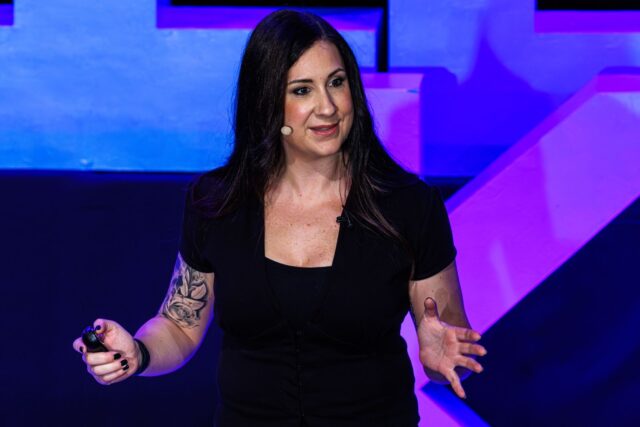
Next up, Dr Kat Aguilera delivered a compelling talk on the importance of mental health support for veterans.
She noted that, on average, it takes fourteen years after leaving service for veterans to seek help for issues such as PTSD, asking: “why are we waiting until people break before we act?”
Frontline workers often hide behind “I’m fine,” which can mask a reality where “the world is burning around you,” and she stressed the value of early intervention, when “the brain is flexible,” warning that otherwise it becomes “years of trying to rewire a brain that sees nothing but darkness.”
Dr. Aguilera highlighted the need for training, routine psychological screening and innovations such as intensive trauma therapy, which condenses six months of treatment into two weeks – “two weeks of treatment or two decades of slow collapse.”
She urged veterans to heed the warning signs and encouraged loved ones to support them in seeking help.

From the frontlines of mental health, the focus shifted to the future of civic engagement, as the next talk explored the role of young people in politics.
Giovanni Origo, the youngest member of Parliament, questioned why “age earns access,” joking that many may simply know him as “el niño joven del GSD.”
He recalled that, when he first entered parliament, he was asked about his age, not his background. It was important to him that he had earned his seat at the table, particularly given that young people only “make up 3% of Parliament,” despite being the generation that will live longest with political decisions.
Origo challenged the notion that young people are politically disengaged, arguing they are simply “disengaged from politics that do not engage with them.”
He urged young people to “act on their vision” and “have courage to speak up,” emphasising that youth participation is “not symbolic, it is essential.”
For him, the question is not whether young people want to be “at the table, but whether those already there will make space for them.”
He also highlighted that, despite his age, he was “no less experienced than other Parliamentary first-timers” and called for generations to “come together” in upholding democracy.
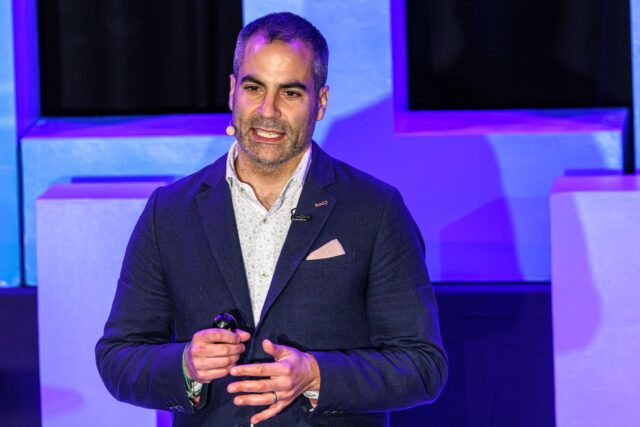
Julian Santos turned the conversation to another crucial issue affecting younger generations: children’s right to privacy.
Referencing Richard’s talk on serendipity, Julian noted a moment he felt was his first big break at 5RB, when he worked with David Sherborne on Weller v Associated Newspapers, which resulted in the pixelation of the faces of children in publications.
After quips about Weller’s PR agent responding that Paul Weller was not “One Direction” and his opposing counsel not being aware of the band after asking whether Weller had made his children part of his brand, the court held that Associated Newspapers had breached the private life of Weller’s children.
He said that children are not in a position to choose whether they’d like to be photographed, and that a lack of parental consent carries weight.
“Children shouldn’t suffer because adults are curious,” Julian said, highlighting that “privacy is about protection not just secrecy.” He also cited PJS, another case which placed a duty on parents to protect children.
He shared his concerns about “sharenting” and “digital childhoods,” highlighting how social media is opening doors to grooming, harassment and stalking.
“We are no longer watched,” Julian said, but “monetised.”
Parents, he said, must be on the “front line” as the “law can only do so much, and once you get to court, the damage has been done.”
He welcomed the introduction of phone-pouches at school and noted interesting developments in legislation about social media usage among young people in the UK and Australia.
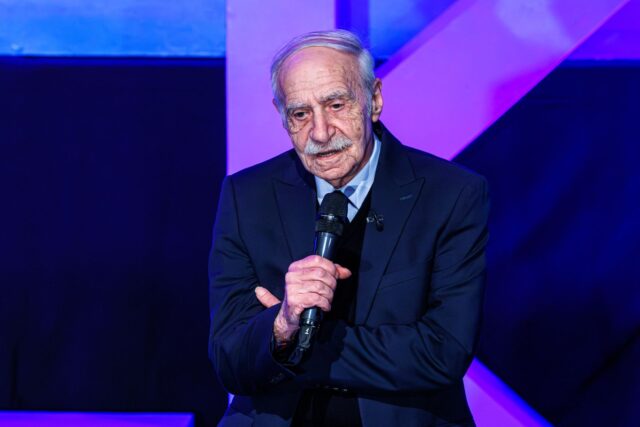
This edition of GibTalks featured both the youngest member of Parliament and the oldest.
During his talk, Sir Joe Bossano spoke about “who he is.”
Sir Joe does not believe he is a result of “what he has done,” such as serving as Chief Minister. Instead, he is a “result of [his] DNA”: he struggles to understand why people like colour, sees music as noise, cannot draw (because of the way he is wired, he claimed), and while he did not consider himself a bolshy child, he “certainly became so” after the Christian brothers gave him the strap.
He also spoke about his fascination with scientific discoveries and the nature of reality.
When someone asks him what colour he likes, he responds by asking “what does it mean to like a colour?”
Sir Joe said questions like these will be explored by artificial intelligence and quantum computing, technologies he said will rage a revolution faster than the industrial one.
His reflections reminded the audience that curiosity to understand the world knows no age. After all, at “86 years young,” he hopes “he will be granted a few more years” to witness it.
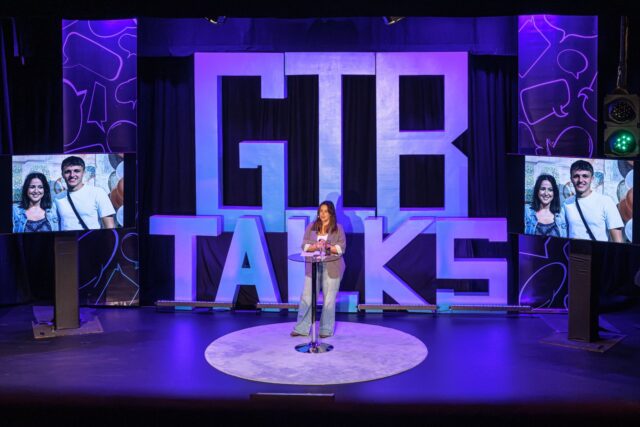
From reflections on a lifetime of curiosity, the stage turned to Louise Busto’s personal story, showing how adversity can inspire action and support for others.
She began by describing herself as “a mother of three,” holding “two in [her] arms and one in [her] heart.”
Louise explained how becoming a step-parent first helped prepare her for what would later “change the course of [her] life.”
At 27 weeks, she gave birth to extremely premature twin boys, Leon and Owen, who each “weighed less than a packet of sugar.”
She described how premature births turn “cribs into incubators” and life into a state of “living suspended between fear and hope.”
The experience split her life into “before and after,” but it also sparked an unexpected resolve: she was determined to help other parents facing similar crises, co-founding the charity Baby Steps.
“No parents should have to research for help in a crisis,” she said, reminding parents that support is just a message away.
She reflected that “pain does not ask for permission” or simply “go away,” but purpose is a choice - and it was that choice that brought her to the stage.

Manuel Enriles then took the stage, advocating for the importance of language in Gibraltar. Although Manuel speaks five languages, his favourite remains Llanito, his mother tongue.
His interest was sparked as a young child, when he and his cousin discussed the correct pronunciation of the word for finger as “dedo” or “deo”. After studying linguistics, he realised they were both correct in their respective varieties.
Manuel has carried this interest throughout his career and, in retirement, turned his focus to the phenomenon of language loss.
“Multilingualism has started to crumble,” he said.
To address this, he and Dale Buttigieg co-founded Multilingual Gibraltar, a charity aim to “rebuild and cover up the cracks in the system.”
He called on the audience to get involved: “everyone has to be involved: parents, grandparents, educators, politicians, and institutions. We must have a common aim.”
Highlighting the myths surrounding multilingualism, Manuel stressed that Llanito is a treasure unique to Gibraltar: while we can’t “take the castillo with us when we go away, we can take Llanito.”


