


The Theatre Royal still a part of our living memory, let us meet one of its ushers


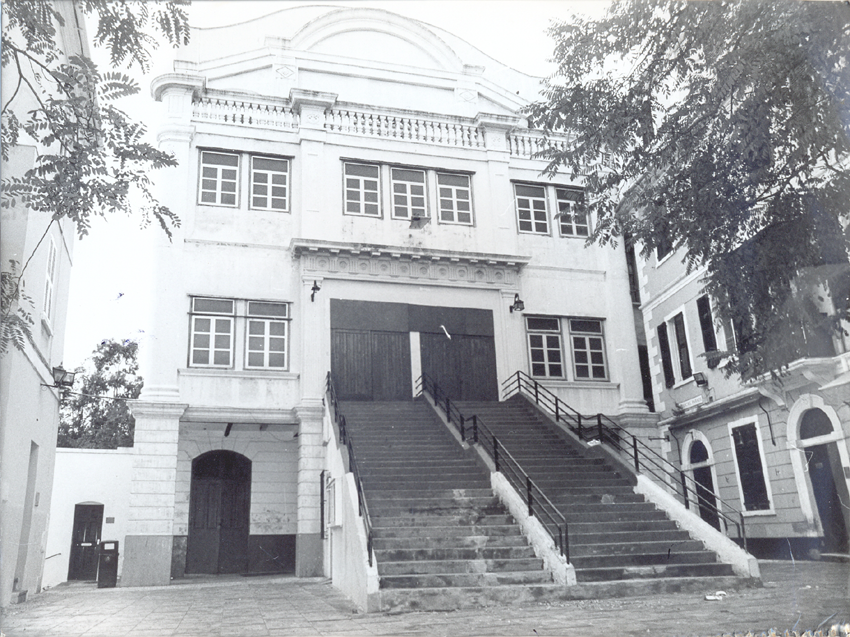
The Theatre Royal – no longer with us - is a world away. Many years ago, it was a major part of the collective identity of life in Gibraltar. All social classes formed part of this collective. It will come as no surprise to many of my own personal interest in this area.
The Theatre Royal remains in the shared memory of many families on the Rock whose parents (like mine) and grandparents performed at the Theatre Royal or attended many performances. My family was linked to the formation of the Agrupación Artística Calpense for example and was originally called La Agrupación Perez Mascarenhas created by my father’s uncle Gustavo Mascarenhas with Perez. Several Alice’s Tables have been dedicated to this theatre where actors, singers and musicians have shared their stories – many as children. So, when someone approaches me offering a story that will add to the greater picture of the life of the Theatre Royal, I simply cannot say no.
A phone call from William Bear got me interested and got me listening.
William’s father Jose was an usher at the Theatre Royal in the early 1960s. The theatre would continue until early 1970s but by then it was running as a cinema. I arranged to meet William because every job in the theatre is an important one – and an usher would have a very different insight into the life of the theatre when compared to those on stage or those in the wings.
So, let’s meet Jose Bear (William’s father), a man who worked throughout his life in the Dockyard, but who was passionate about theatre and worked a second job as an usher in the Theatre Royal. I will also bring some of the history of the theatre into this column.
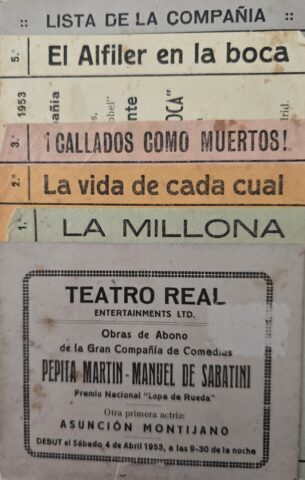
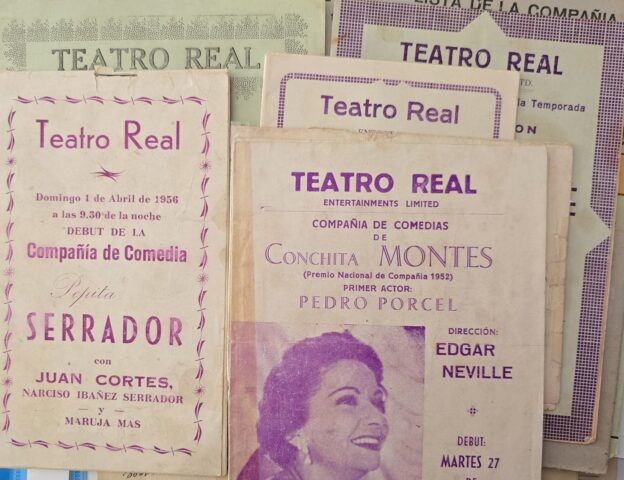
Jose Bear really became an usher at the Theatre Royal because of his love of the zarzuela which had a great following on the Rock both before and after World War II. The Agrupación Artística Calpense mostly performed zarzuela and was born as early as 1923 and became a firm favourite with the Gibraltarian public at a time when families would have season tickets for all the performances; often buying a full row of seats for all family members. This included the many performances from companies outside our borders and local performances. The Agrupación had as their members some of our most talented and well-known singers of the day. The Theatre Royal – even though no longer in existence – somehow remains one of those cultural landmarks whose story is both grand and bittersweet — for it was a place which once stood at the heart of Gibraltar’s artistic life.
For many years now it has slipped into memory – those who performed on its stage or those who experienced the great variety of performances.
So strong was its influence that even now its importance in this community still echoes and holds a place within our cultural identity.
Its story begins in the mid-19th century. It was built in 1847, at a time when Gibraltar was growing its civic and cultural infrastructure.
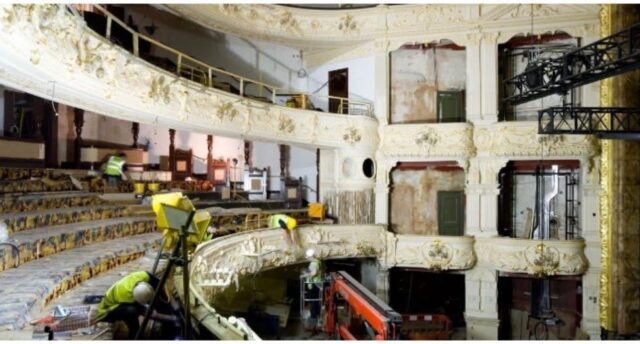
When it first opened its doors, the fact that it featured Verdi’s opera Nabucodonosor was an indication of the high hope in the community of what they imagined could come from it; always in grand fashion built on Governor’s Parade in an area where there was much public activity then. Its original design was that of traditional European playhouses, with tiers of seating, a proscenium arch, and an auditorium which held 1,000 seats.
It is no wonder it very soon became the Rock’s main entertainment venue which saw many touring companies from Spain and all over Europe, and especially from Italy when opera companies to and from America sailed into port.
Then there were the amateur military theatre groups and the local amateurs who often performed on its stage - military bands, orchestral concerts, zarzuelas, opera, drama and comedy and finally cinema screenings, as films became popular. The wonderful variety of performance was a reflection of Gibraltar’s exceptional position coupled with its links with Britain, Spain, and the Mediterranean — with a crossroads of languages, tastes, and artistic influences.
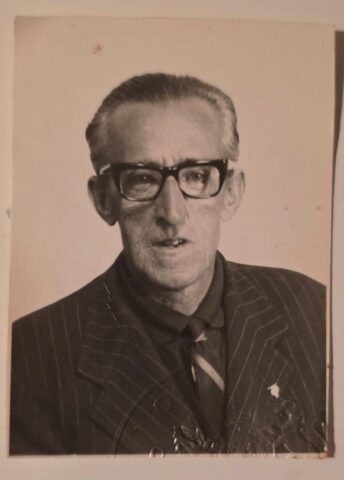
I met with William Bear (Willie to his friends) who was keen to chat about his father who had been born in February 1914. Jose Bear worked as a labourer in the Dockyard. Like so many of his generation, his son tells me, his education growing up was limited and his choices were few. From a young age he had always been interested in zarzuela and in the theatre.
William born in 1944 tells me the story of how his family, his great grandfather came to be in Gibraltar. He arrived here with his brother from Kent in the 1880s. They were civilians working for the Forces who would work in the bakery which then existed in Town Range – where the Senior Citizens Club is today. The brothers soon settled and married locally.
Jose Bear would work at the Theatre Royal as an usher from 1947 to 1962. These were the years following the war (he mostly ushered in the
1950s) when there was much theatrical activity from local groups writing for local audiences, zarzuelas presented by the Agrupación, and the many theatrical companies coming in from Spain and beyond.
Those were the days when famous Spanish singers such as Antonio Molina and Pepe Blanco and Carmen Morelle performed on the Theatre Royal stage – William Bear was a teenager then and becomes nostalgic recalling these performances with a smile and a little excitement in his voice – and although he was still a child it all obviously had a profound impact on him.
“I always remember my father carrying the torch to take people to their seats. As a young boy – by then the theatre was also a cinema, I was always able to see the westerns and gangster films which I really liked. But he would always tell me what films were on, and because of him I was able to always find a seat and see many films.
But when companies came to Gibraltar to perform at the theatre, I would go to see them with my mother as well. The comedies and plays by Chipolina, Bruzon and others. The zarzuelas from the Agrupación Artística Calpense and I still recall the local performances from Pepita and Leo Martinez, and Maruja Hook, and so many others in the ‘veladas’
organised by the theatre.”
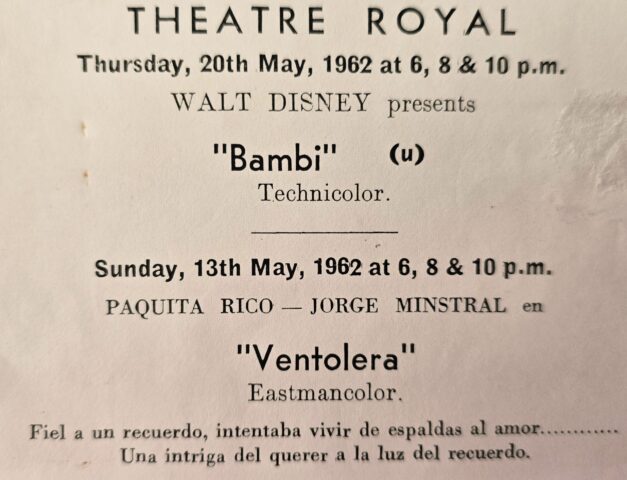
Jose worked in the Dress Circle area almost every day as an usher and earned around one pound and ten pence a week. In the times of cinema there were two sessions – one at 6pm and one at 8pm. His son remembers how in between both sessions he always found the time to make it home for supper. But there was a third session nightly as well from 10pm to midnight. Films were definitely shorter then with top films lasting about 120 minutes.
“Those were the days when before every film started everyone had to stand on hearing the National Anthem. There was also Pathe News before the film began,” he says.
The family then lived in a one room flat which was divided by a partition (bedroom and living area) at 51 Flat Bastion Road. This was patio living with shared toilet facilities like so many other patios across Gibraltar. Water was only accessible from the pump in the patio area.
Like many from his generation the Bedenham Explosion of 1951 was a moment in time which remains with him to this day. He was at school that day in St Bernard’s and when his teacher Miss Peralta told them to close their books the explosion happened – William tells me of the black spots of debris that hang in the air and landed on their books, and they all went running home. Small metal fragments had even landed in the partitioned room.
As we head back inside the Theatre Royal, I wonder how much he remembers of the inside.
“I remember it as a luxurious theatre which was not that big. It had a beautiful grand staircase and a large foyer. There was a tuckshop in its premises. It was always very popular, and it was not only popular with local residents but with the military personnel as well – sailors who were in port – attended the films. The boxes were on the side – and when there were films young people would go up to the “gallinero” the upper tier which was always full and each seat cost nine pence. My father was responsible for the Dress Circle area where it was three shillings and three pence. In the stalls, if I recall correctly, it was one shilling and sixpence. For us, going to the theatre then was like an adventure.”
As a boy, it will come as no surprise that he very much remembers the basket sellers just before entering the foyer of the theatre. These sellers would place their baskets selling peanuts and goodies for consumption in the premises just outside under the stairs leading into the piazzella, he tells me.
William – like his father would also work in the dockyard joining as an apprentice in 1959 and eventually becoming a clerical officer for most of his life. He tells me how much the fact that his father had worked in the Theatre Royal rub off on him – always enjoying theatre and the world of entertainment. He also went to the Rialto Cinema where the film ‘Quo Vadis’ really impressed him. There was, he says, no television in the home then and even a radio needed a licence.
“I remember the day my father bought a small radio called a ‘Pilot’.
He had to get a licence before he bought it and the licence cost 10 shillings. We listened to Spanish radio at the time (the 1950s) but I also remember taking down the football results on shortwave radio. At the time I bought a magazine called Football Monthly. At the Gibraltar Technical College, I was in the football team – our goalkeeper was the well-known singer/songwriter Albert Hammond.”
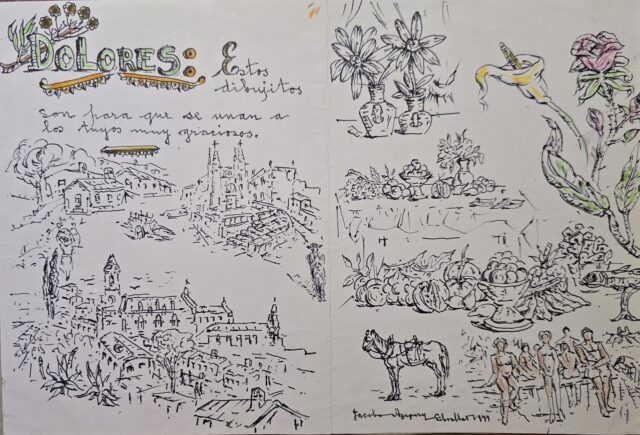
As we chat William takes out the goodies he has brought from the Theatre Royal which we can see on these pages. But there is one item that stands out. Amongst his papers is a sketch by the artist Jacobo Azagury dedicated to his parents Jose and Dolores. Azagury of course, whose work can be seen in the Mario Finlayson National Gallery, was well known for constantly sketching local figures and others who visited our shores. But the artist knew his parents, and this was his special sketch for them. It is always a real find when you come across such items, and I sought permission from William to feature it as part of our Alice’s Table today – take a look. It is a wonderful sketch.
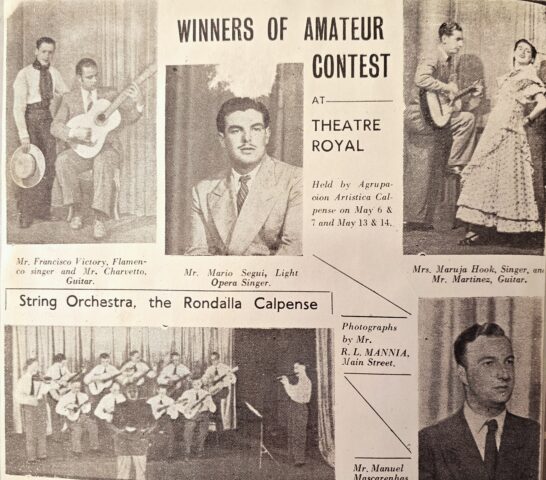
Amongst his leaflets is one which features my father Manolo Mascarenhas who often performed at the Theatre Royal and entered competition reciting poetry. The leaflet from May 1948 features all the entries for the competition and includes others same may recall and who left their mark on this community – the well-known accordion Arturo de la Paz, Mary Chiappe and her brother Tony Loddo, the Rondalla Calpense, comedians Balloqui and Mosquera, Maruja Hook and Victory and Charvetto. The competition was won by the local tenor Mario Segui with 3,905. My father came second achieving 3,844 votes - a difference of just 61 votes.
William is clear that what made the Theatre Royal very special was the great atmosphere once felt and experienced within its walls.
“I can still recall entering the foyer and seeing all these posters with the stars. The ticket office was just there – the porter was also close by – opposite the door which led to the dressing rooms. The beautiful stairs leading to the theatre…”
As a final nostalgic note William again smiles and says, “… as the curtains opened you always knew it was going to be special”.
Performances that you remember more than seventy years later had to be very special indeed.
Most Read
New group to plan healthcare jobs and placements for returning graduates
Tue 13th Oct, 2026
Economic Crime Unit’s new offices unveiled, alongside a call for further investment
Tue 13th Oct, 2026

Today's Paper
26th February 2026
Read our latest newspaper by downloading our app from the link below.


