


New research explores how coal fuelled Gibraltar’s economy and the Campo’s labour relations


From the late 18th and 19th centuries the world increasingly ran on coal, with steam-powered ships carrying raw materials sourced from around the globe to feed factories, and navies patrolling the sea lanes.
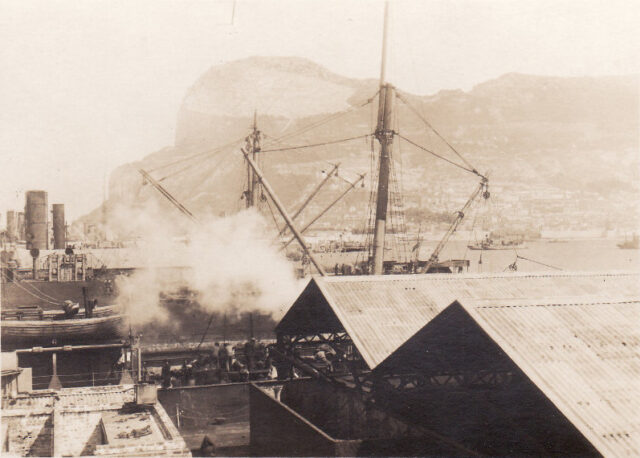
The Rock, with its strategic location where the Atlantic and Mediterranean meet, was ideally placed to fuel vessels travelling to and from the Suez Canal or bunkering before a transoceanic crossing.
Coal heavers played a central role in sustaining Gibraltar’s economy and the Allied war effort during the First World War, with thousands of workers labouring under harsh conditions to keep naval supply lines moving, according to new research by the La Línea-based historian, José Martín León de Alda.
His work focuses on the period between 1917 and 1923, when demand for coal surged and the Rock became a key distribution hub for the British Empire.
Coal became a critical resource during the First World War as demand surged to sustain the Allied war effort.
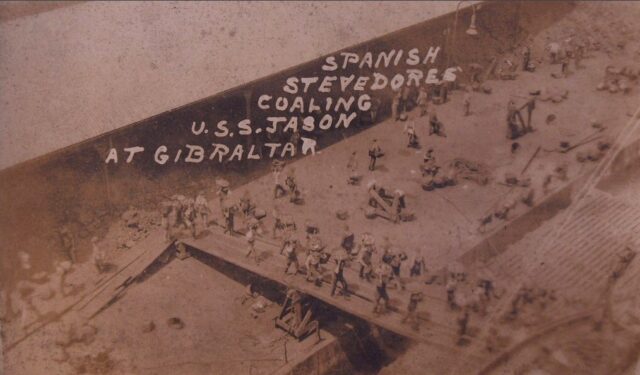
At its peak in 1918, more than 8,000 Spanish and Gibraltarian workers were employed in coal handling in the port, forming a large and organised labour force that would go on to play a significant industrial and social role during and after the conflict.
Mr León de Alda’s research has examined the importance of this workforce between 1917 and 1923, highlighting both its economic contribution and its growing labour organisation.
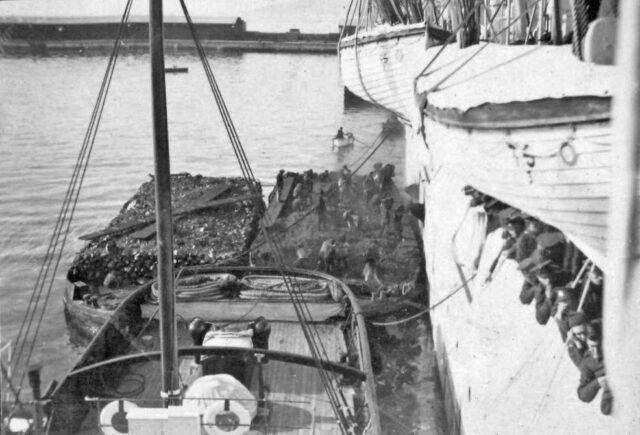
Coal loaders carried out physically demanding work under difficult conditions and long working hours.
Mr León de Alda said: “They went to the pontoons [hulks anchored in the bay used as cargo space], took the coal, loaded it onto barges, or up the ramp, and lifted it onto the ships to fuel them. That was their job.”
As they worked primarily with their arms, these labourers were also known as ‘braceros’.
He explained that his research sought to address a gap in local historiography, which has traditionally focused on more affluent sectors of society.
“I noticed that the history of La Línea has focused heavily on the bourgeoisie, but very little on the lower classes and, specifically, on the proletariat at the start of the 20th century. The information available is barely anecdotal.”
“I decided to address the coal worker in La Línea. I was interested in why coal was important to the economy, not only locally [in La Línea] because of wages, but also to the economy of Gibraltar,” he said.
Existing research shows that coal imported into Gibraltar during the 19th century originated largely from the United Kingdom, mainly from Glasgow. During the First World War, Gibraltar formed part of a wider British imperial energy network extending to Malta, a strategic base in the Mediterranean and a key point on the route to the Suez Canal.
Demand for coal increased significantly from July 1917 following new directives issued by the Admiralty in London on June 27 that year. These measures aimed to regulate distribution, guarantee fuel supplies, and ensure the efficient movement of wartime convoys.
Under these rules, Gibraltar was required to maintain sufficient coal reserves to avoid delays, maximise storage capacity, ensure competition within the sector and regulate sales by companies operating in the port.
The impact was immediate. Gibraltar’s port reached unprecedented levels as a distribution hub, requiring what Mr León de Alda described as “thousands of arms [put to work].”
Workers arrived not only from Gibraltar and La Línea, but also from other parts of Andalucía, including Cádiz and Málaga, as well as from Barcelona. Many brought with them established traditions of labour organisation and trade unionism.
Employment rose rapidly during the war. From around 2,000 Spanish workers in 1915, the number increased to 8,000 by the summer of 1916, with a further 1,000 recruited in December 1917.
Coal throughput also rose sharply. By late 1917, more than 22,000 tonnes were being loaded each week. Between January and June 1918, approximately 730,000 tonnes were recorded, with estimates for the full year reaching two million tonnes.
Within this context of intense industrial activity and difficult working conditions, the coal heavers became increasingly organised at a time that coincides with what historians call the ‘Trienio Bolchevique’, the three-year period during which the influence of the Russian revolution was felt most keenly in Spain.
Mr León de Alda said: “The trade union movement of the coal heavers runs parallel to the Andalucían anarchist tradition, especially in the province of Cádiz.”
In 1918, the coal heavers formed a trade union, the Sociedad de Obreros del Carbón Mineral Linense, marking a significant step in labour organisation in the Campo de Gibraltar.
“The Sociedad del Carbón is a trade association in Spain that emerged at the end of the 19th century and evolved alongside political and social movements until it became a trade union.”
“In La Línea, the presence of workers’ clubs has been documented since the 19th century, which gives an idea of the strength of the labour movement in the town.”
The development of trade unionism in La Línea had been shaped by earlier events, including the Sucesos de las Pedreras on October 9, 1902, when protests following the closure of a workers’ social centre led to violent clashes, resulting in five deaths and numerous injuries.
“Due to the repression of that event, the violent and revolutionary trade union tendency in La Línea was radically curtailed,” León de Alda said.
From that point on, labour groups sought reform, focusing on wages, living conditions and labour rights through largely peaceful means.”
However, ideological divisions remained. While some unions aligned with the Unión General de Trabajadores (UGT), others were influenced by the more radical Confederación Nacional del Trabajo (CNT).
“There was a struggle between UGT and CNT supporters. Within the Sociedad de Obreros del Carbón Mineral Linense there were two souls, two hearts, two tendencies,” he said.
Mr León de Alda added that this reflected broader developments in Spain: “We can clearly see here a reflection of trade unionism in Spain.”
“This Sociedad del Carbón went from being a simple 19th-century trade association to becoming a class-based union that identified with the UGT but ultimately became aligned with the CNT.”
Spanish workers also faced competition from Gibraltarian labourers, who were better paid and more organised.
“Workers from La Línea had to organise themselves alone, without union backing. They began to demand wage improvements, labour rights and, above all, the role of the shop steward. These were their three pillars,” he said.
Although precise membership figures are not available, Mr León de Alda said there is evidence that most workers were now organised, with meetings in La Línea attracting between 800 and 1,200 attendees, these figures being discovered in Spanish police documents (by a law of 1833, a police presence was mandatory at all workers’ assemblies in Spain).
The strength of the movement was demonstrated in late 1918, when the coal heavers called a strike to demand better wages, recognition of workers’ delegates, and equal treatment with Gibraltarian workers.
“During their worst strikes, the Admiralty in London or employers in Gibraltar would call in Galician coal heavers or Moroccan labour to replace the striking Spaniards,” Mr León de Alda said.
Tensions within the labour movement were also evident. In 1917, an individual drew a weapon during a workers’ meeting, an incident Mr León de Alda described as reflective of wider unrest in Spain at the time.
“Although there were no injuries or deaths here, there was a very extreme expression of that violent revolutionary tradition,” he said.
Some workers also acted as political agitators, travelling across Spain to promote anarchist ideas.
Among them was Miguel Delón, who was monitored by police and intelligence services.
Mr León de Alda said: “He was tracked by the police, and British and Spanish intelligence services, for inciting revolution in one of the cafés on Calle Real, shouting ‘death to the bosses!’ and similar slogans.”
Despite these tensions, labour organisation in Gibraltar was, according to León de Alda, “more or less tolerated,” reflecting the presence of labour movements on the Rock itself.
He pointed to Jose Netto as a key figure, son and father to trade unionists, who was influenced in part by Republican refugees arriving in Gibraltar after 1936 during the Spanish Civil War.
But all these developments, Mr León de Alda said, have to be placed within the broader context of Spain’s political and economic transformation during the Restoration period between 1875 and 1923.
“Spain was undergoing profound changes, transitioning from the first to the second Industrial Revolution, with a traditional regime in a very turbulent country,” he said.
“For this reason, the State sought to control any dissent, especially next to a territory governed by another country, such as Gibraltar.”
He concluded that the role of coal heavers from La Línea, and their relationship with Gibraltar, remains under-researched.
“This is new ground for [La Línea’s] local history. I believe the figure of the labourer should be recognised and studied, because La Línea is a working town, and that is deeply rooted in its identity,” he said.


