


Renowned classical cellist and pianist perform at the Convent
Photos by Joachim Knodt.


Renowned classical cellist Bruno Delepelaire and pianist Kim Barbier recently performed in Gibraltar Philharmonic Society’s recent recital. Mr Delepelaire, First Principal Cellist of the Berliner Philharmoniker since 2013, has established himself as one of the most distinguished cellists of his generation and he performed alongside Ms Barbier, an internationally acclaimed French-Vietnamese pianist. Joe Adambery spoke to Mr Delepelaire and Ms Barbier ahead of their concert at the Convent.
Cellist Bruno Delepelaire
Can you name a personal favourite piece in this concert?
I think it’s difficult to name a favourite because there is a difference in what I enjoy playing and what I enjoy listening to.
I like the three pieces tonight equally for different reasons, and the one that I most enjoy playing is the Greig Sonata, maybe also the Arpeggione Sonata from Shubert, I love his music, it’s very touching but it’s also very difficult to play, so maybe that’s why it’s easier to enjoy the Greig, where you feel more the dialogue with the piano in the upper registers.
The companion role with the piano is much more equal and it’s a more outward expression of feeling. The Piazzolla Grand Tango is the first time I will play it [in recital] so I don’t know yet.
To what would you attribute the cello’s popularity, is it the instrument’s voice or is it the repertoire available for it?
For me, why I love the cello is the tone of the instrument, the way you can shape the sound. You can modulate the sound.
I started playing piano originally and I still love playing it today because I enjoy the harmonies, but what I like most about the cello, like a singer, you can shape its sound and its note duration.
It’s not just a simple note which decays on its own.
Does the cello’s mournful voice also captivate you as the player?
For sure. Its melancholic voice is a favourite with composers on slow melodic lines and it’s the same for me. It’s a good instrument for me.
I think you need to love the instrument and I’m really grateful to my first teacher who gave me a deep love for the cello.
He transmitted to me his passion for the instrument and without this I would probably not be a musician today.
I wonder if playing at top level like you one still needs to practice much?
Practice for me is to reach a deeper level of expression on my instrument and it’s extremely satisfying when you reach a new stage, and then you constantly want to move on further and further.
You need to practice to retain a certain muscular shape.
Nowadays I get less time to practice because you need more rehearsals with orchestras, so I need to use my time more intelligently. I concentrate more on the mechanics and on what I need to achieve.
Which part of your career is your favourite, is it playing solo, playing chamber music, or playing in orchestras?
I like all three and what I enjoy most is that, in my career, you get to enjoy all three of them.
In the Berlin Philharmonic, you get the chance to have amazing colleagues so it’s very easy to play chamber music with them.
We also have a group of 12 cellists within the Berlin Philharmonic and we are doing a lot of concerts together and also we explore different repertoires, so that is a lot of fun.
I also enjoy playing solo and I think I would be quite sad if I didn’t do all three things or only one thing a lot and not the rest.
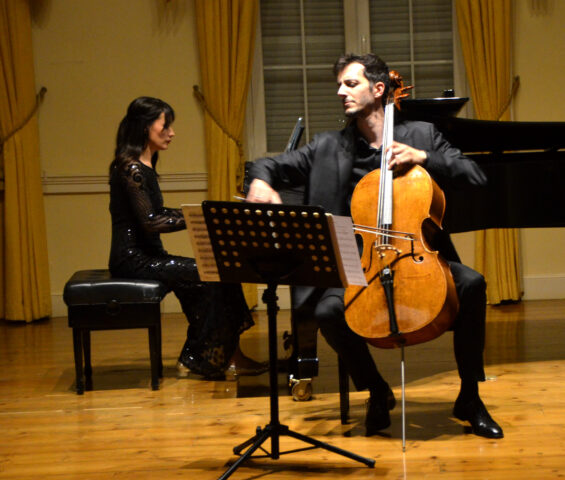
Pianist Kim Barbier
In which setting are you most happy to play, would that be a concert hall, a small venue like this one here at the Convent or a church for instance?
Sometimes the composers wrote for a duo and the two instruments complement each other and have a dialogue.
For example, tonight, the Arpeggione by Schubert is more accompaniment but it’s mostly sonatas so we duet more.
Acoustically of course, a church is more difficult to play because of reverberation. The acoustics are important - wherever there are nice acoustics is the easiest to play chamber music.
This is a nice room although, unlike Bruno, I have not played here before.
Do you have to rehearse a lot together as a duo for a concert or can you rehearse your parts separately and then come together near the concert date?
The second option is what usually happens.
I need to practice by myself first of course, because I have a lot of notes, then we both come together before the concert.
Tonight there will be a lot of dialogue between the two instruments, always supporting each other’s parts. I have to modulate my volume more often than the cello because the piano is more powerful and has a lot of notes.
I have polyphony so I have to play at lower volume sometimes to hear the other instrument clearly.
Most of the time, my response is automatic and what makes it easier is when the acoustic sound is not muddled and the other instrument can play without having to restrain its volume.
To play and hear my sound clearly is the best solution for me as I don’t have to restrain myself.
What I enjoy about playing with Bruno is that he doesn’t take the light all to himself. I’m very shy and Bruno is very humble and we both enjoy ourselves without having to fight for the light. It’s really a combination of bringing our forces together for the benefit of the music.
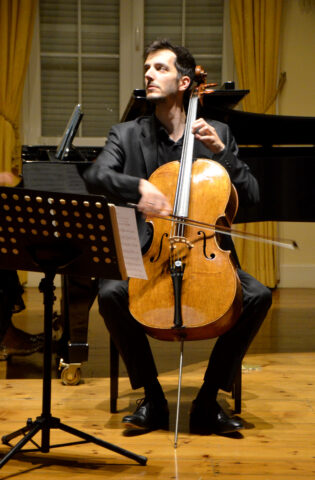
Floating on Delepelaire
Philharmonic Review by C.Wall
Bruno Delepelaire’s ascent to the Convent Ballroom — building works confined his previous visit to the King’s Chapel — brought us the craggy directness of Grieg’s Cello Sonata.
It’s not an obvious choice of repertoire: Delepelaire’s sensitive lyricism, his mastery of miniature detail, turned to capturing broad emotional landscapes, often variations on reworked themes. But the style is wholeheartedly Romantic, with pretty melodies idiomatic on both cello and piano, drawing soloists into its intricacies.
There was little restraint in the emotive opening, where Kim Barbier’s effervescent piano threatened to overwhelm Delepelaire’s introspective response. The cello glowed with the hopeful warmth of the second theme, before entering a proper dialogue with the piano, continued across different keys, turns of texture and tempo, ending with a coda straight out of Grieg’s own Piano Concerto.
Barbier entered the andante with an expressive serenity, to which Delepelaire progressively layered colours. Here the storms rose gradually, the feelings more brittle, though the closure was more organic.
The third movement began with a timeless cello haunting, interrupted by folksy dance. There was less tension here, resolution always within sight, but there was a colour to the playing that looked beyond the age of composition.
Schubert’s D821 Arpeggione Sonata has become far more familiar than the obscure instrument it was originally written for.
Barbier’s tender opening was lifted by Delepelaire’s sympathetic embrace, cello spinning piano into a carefree coupling. Barbier’s lines remained graceful against Delepelaire’s encroaching darkness, a conversation frequently interrupted by more dance and culminating in a moving sostenuto from the lamenting cello.
The Adagio, one of Schubert’s wordless songs, was played sympathetically enough, though I missed some of the undercurrent emphasised in other interpretations.
The joy in the Allegretto was unmistakable, as was the elegant virtuosity from both Barbier and Delepelaire, more urbane than Alpine, and a rising arpeggio that seemed to vindicate the Sonata’s promise.
Piazzolla’s Le Grand Tango added thunder to the rain that unexpectedly graced concertgoers before the recital.
The opening rhythms may have sounded sufficiently Porteño, and there was sufficient vibrancy to suggest a whole tango band, but this piece rises and falls on a challenging chromaticism, and Delepelaire’s compelling cello could have flown over the Andes.
Philharmonic Society audiences are always grateful for an encore, and de Falla’s Jota and Saint-Saëns’ Swan offered a pleasing conclusion to a finely judged programme


