Elio’s ‘La Lola’ at 60 and what she still represents to us today


It has been 60 years since the character of ‘La Lola’ entered our lives. 60 years since the play ‘La Lola se va pa Londre’ by Gibraltarian playwright Elio Cruz was staged for the first time at the John Mackintosh Hall by Group 56 directed by Cecil Gomez. This article was meant to have gone out several weeks ago but as National Day drew closer, I could not help but wonder that, if ‘La Lola’ had not been a fictional character, she would have led us all - dressed in red, white and blue – down the Main Street and onto Casemates for our National Day September 10 celebrations – which this year falls next Thursday. La Lola would love the traditional bunting and flag display on our streets that give way to the party atmosphere on the day itself.
La Lola, Elio Cruz’s larger than life fictional character - a sharp tongued, witty, and deeply Gibraltarian woman - would undoubtedly have been at the front of any parade. I can imagine her boldly and passionately carrying the self-determination banner, and she would have done it on her own had she needed to. At times it is hard to imagine La Lola is a fictional character. She is not real – well, that’s not quite true because for many generations of Gibraltarians she has been a symbol of our identity as a people, and in that respect, she was made real by this community back in the mid-sixties when the play was first staged.
This week Alice’s Table pays tribute 60 years down the line to this Gibraltarian persona – this woman who has encapsulated the aspirations, spirit and soul of the people of Gibraltar. I have often wondered if playwright Elio Cruz, on writing his first lines for La Lola and his first Llanito play ‘La Lola se va pa Londres’, had any notion of what he was creating, and all that La Lola would one day represent.
For many, who saw all three or at least one of the productions of the play, La Lola became and was a real person.
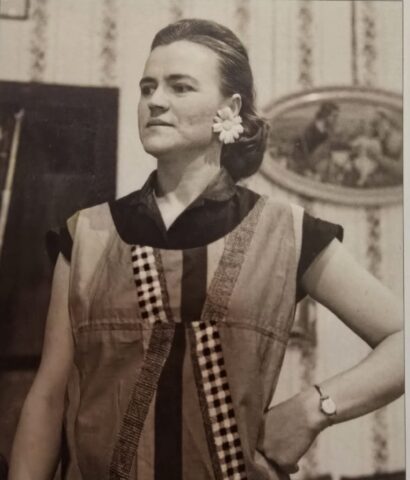
Often, the late Aida Barea, who played the character of Lola all three times on the local stage was known as and would be called Lola (not Aida) by the many she came into contact with. For them Aida was La Lola - the fiery, determined and resolute woman who gave life to this rich and wonderful character, who even with all her flaws you could not help but love.
Audiences instantly identified with her. And Aida, well, she took on this persona and made La Lola her own - she always delighted in taking on – becoming and bringing to life this wonderful character (and perhaps not so fictional)- bigger than life and who represented everything about Gibraltar and the Gibraltarians in the Gibraltar of the 1960s. Sadly, Aida passed away recently, and today we also pay tribute to her on these pages. Today the play ‘La Lola se va pa Londres’ forms part of our written social history. It depicts a very real situation in the Gibraltar of the 1960s and patio living itself. The late Elio Cruz himself once said he was not trying to write a Spanish play, but a Llanito play which was based on Gibraltar and the Gibraltarians.
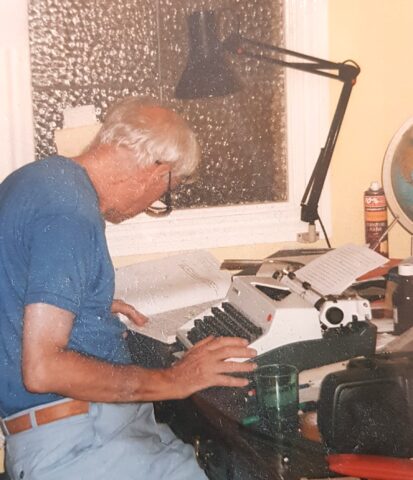
Many years ago, in an interview, and quoted in my book on Elio Cruz ‘One Man Many Talents’, the playwright said he was thankful that the play and ‘La Lola’ helped to spread the idea that “we are a people in our own right – I was trying to write a Llanito play, something for us” he said.
Even though Elio lived for most of his life in London he followed all the goings on in Gibraltar closely throughout his life and never forgot his Gibraltarian roots.
My father, Manolo Mascarenhas, in writing in the Gibraltar Post in his Focus Column wrote about this man who by then had been living in the UK for close to 10 years. “He is a Gibraltarian playwright, a man a thousand miles apart, who has never forgotten the Rock. The amazing thing is that after years of absence Elio Cruz can still write about Gibraltar. Even more surprising, too, that he writes with authority about present-day life in the place he once lived”.
I was very fortunate to know Elio Cruz when he had already retired. I got to know him when I stage managed his evacuation play ‘L.M.N.O.P.’ in 1992.
It was an honour for me to work with two giants of our Gibraltar theatre world - Cecil Gomez and Elio Cruz, and to then form part of the production of the third ‘Lola’ in 1995 which I co-directed with producer Cecil Gomez. I would go on to share many theatre moments with Elio in London – he never lost his love or passion for theatre. Elio also wrote many one act plays for the Gibraltar Drama Festival which were hugely successful. His other full-length plays were: The sequel to La Lola ‘Cuando baje la Lola’, ‘Connie Con Cama Camera en el Comedor’, ‘Librada al Aire Libre en La Alameda’ and ‘Duermete Daddy Joe’. But it is La Lola which has survived the test of time. In her, Elio created a woman who effectively rules the roost.
In Lola’s world everyone does what she says in every given situation. In a patio life of open doors with no secrets. Always speaking her mind, she remained at odds with her neighbours. Yet, they all got on with supporting each other’s lives good and bad times.
One of my favourite quotes from La Lola is: “El mundo dará muchas vueltas. Pero ciertas cosas no cambian. La reina siempre será reina, y ahí abajo, el gobernador da las ordenes. Pero, ahí, ahí en casa, quien las canta clara soy yo. En el número seis, la que manda es Lola (The world will always keep on turning. But some things don’t change. The Queen will always be Queen, and down there, the Governor will give his orders. But there, there at home, I am the one who calls the shots. At number six, Lola always rules).”
This full-length play was written to celebrate the tenth anniversary of Group 56. In the book ‘One Man Many Talents’ three times producer of the play in 1966, 1979 and 1995, play director extraordinaire Cecil Gomez recalls reading the play for the first time and liking it instantly and knowing Group 56 could make it work. He said: “Remember that in any play written by Elio, it is our way of speaking, and the danger in it is that you can easily adlib, and if you made a mistake, you could still carry on. But I feel the reason why his plays worked so well onstage was because he gave us a free hand and everyone enjoyed being in them.”
Although a comedy in two acts, Elio always referred to the serious side of La Lola. He described it as a play about a working-class girl in the Gibraltar of the 1960s, which has as its backdrop the patio culture of the day which was widespread across Gibraltar.
“At the time generations of Gibraltarians lived under one roof, in cramped conditions and where neighbours lived in each other’s lives very closely, with no life privacy. Everyone knew what everyone else did. Everyone kept a watchful eye on life in the patio,” he said. He always insisted that the character and story of ‘La Lola’ is born out of the title of the play itself, ‘La Lola se va pa Londre’.
“I just thought of the title – the alliteration, it just runs off the tongue. The title sells it. The idea was that the title was the hook and it would hook you, so, La Lola se va pa Londre, just rolled beautifully off the tongue and it got you thinking about what it all meant.”
And with that said there can be no doubt it has meant a great deal to generations of Gibraltarians. ‘La Lola’ lives 60 years down the line. And in this we must pay tribute to all those who contributed and performed in all three productions. Elio himself, the producer/director Cecil Gomez (and always behind the scenes Humbert Hernandez), and of course Aida Barea. But I cannot leave out the cast formed out of many of our most loved and talented performers. Maribel Cumming who played the role of Titi Toti in the original production in1966 and again in 1979. In the 1995 production the role was played by Vivian Azzopardi. As to the neighbours in 1966 there was Violeta Golt, Josephine Rodriguez and Marie Davis. In 1979 they were played by Araceli Latin, Olga Zammitt and Marie Davis.
In 1995 the neighbours were Araceli Latin, Elizabeth Pinna and for the third time Marie Davis. Other names associated with La Lola were Frank Dellipiani who played the part of Avelino, later played by Denis King, and in 1995 by Nicky Guerrero. Ernest Latin was the original Winston, and in later productions the role was taken on by Derek Perez and later Timothy Cumming. In 1966 Marie was played by Rosemary Vinales, and in later productions by Tessa Gomez and Jean Lavery. Denis was first played by Tony Frost, then Richard Garcia and in the third Lola by Colin Skinner. The boy Willie was played by Hector Cerisola, then John Reyes and finally Michael Adamberry.
‘La Lola se va pa Londres’ always played to packed houses, in 1995 for seven consecutive nights at the Ince’s Hall Theatre. The first two productions were staged at the John Mackintosh Hall. The audience always received it with tremendous enthusiasm; it quite simply touched the hearts of the Gibraltarians. Cecil Gomez in ‘One Man Many Talents’ makes a reference to audiences recognising situations because they had lived them, characters being so well defined that they spoke for themselves. He said: “You see, La Lola, ticks most of the boxes – the way we are, the way we speak, the way we relate to one another. You must understand that the Lola characters were not played or written as caricatures but as human beings.”
And in that respect La Lola will always be that endearing, clever and versatile character who we all laughed with because in her we all recognised our Gibraltarism – her strength and resolute determination.
In my mind ‘La Lola se va pa Londres’ remains Gibraltar’s most iconic theatrical work about a time in our history which coincided with the theme of the time leading to the Referendum of 1967 - British We Are British We Stay.
Elio, without knowing, and those who produced and performed it, also without knowing, created a part of local history which would have been lost forever had it not been for his pen and insight into our Gibraltarian make-up.
Aida: Always La Lola
A few weeks ago – a friend who I had shared the Ince’s Hall backstage with on many occasions – sadly passed away at the age of 91. Aida Barea – La Lola – was a tour de force. Aida carried ‘La Lola’ with pride wherever she went. And amazingly, she always answered to the name of Lola – in fact many people thought her real name was Lola. She made the character her own in 1966 when director Cecil Gomez gave her the part which she was to play several times – three times in ‘La Lola se va pa Londres’ in 1966 (John Mackintosh Hall), 1979 (Ince’s Hall) and 1995 (Ince’s Hall), and in 1967 in ‘Cuando Baje La Lola’, the sequel to La Lola.
La Lola as a character was born out of the pen of the late Gibraltarian playwright Elio Cruz.
I could never have imagined Aida was already in her early 90s. I always remember her with so much energy, and much younger than her years. I worked with Aida on several productions – I still recall the first time we met. I knew the significance of her ‘Lola’ in this community – what she meant and what she represented (we all knew a Lola), and I respected her and always looked up to her. I recall being somewhat nervous that first time, but Aida always put you at ease – she was fun to be with – and the room was always filled with laughter wherever she went. Always so full of life. She was a formidable Lola, already into her senior years, when she played the character for a third time. But she was a seasoned actress who had formed part of Group 56 before it became Group 70, and so on. I was only five when she played Lola for the first time, so I had to wait until I was a little older to see her on the stage.
Elena Aida Barea (Aida) was born Elena Aida Díaz Recuerda in La Linea in October 1934. She was two when the Spanish Civil War broke out, the youngest of seven children growing up in La Linea. It was as an adult that she met Adolfo Barea from Gibraltar who she married in the Cathedral of St Mary the Crowned in April 1961 and settled on the Rock. Her daughter, Helen Wade, a journalist who I have both worked with at GBC and directed on the stage, described her mother as a voracious reader from childhood. Aida’s father was a poet and intellectual and the young Aida grew up in a house full of books. But Aida and her siblings were denied a formal education in Spain when Franco’s ruling party closed the doors to children from Republican families.
She was educated by a private tutor at home - a neighbour - and even inherited his library when he moved away. Aida loved poetry and the works of classical Spanish writers; Lorca, Lope de Vega, Cervantes and Calderón de la Barca. She was to join the drama group Group 56 from the moment she settled locally. The first production she took part in was in the Gibraltar Festival of 1962 when the group presented Fuenteovejuna by Lope de Vega at the Alameda Open Air Theatre. Then in 1962 she formed part of the Drama Festival entry by Group 56 in 1963 – Six Characters in Search of an Author by Luigi Pirandello. Aida was not a trained actress and joined the local amateur scene when it soon became obvious she was a natural on the stage. Aida had a great sense of comic timing… I always remember her pregnant pause in that famous line from Lola ‘I have a scherry pleeese’.
But she could also tackle the dramatics and joined the group in The New Member (1964) by Elio Cruz, Jucio Contra un Sinverguenza (1967) by Alfonso Paso, Maribel y la Extraña Familia (1977) by Miguel Mihura, Bodas de Sangre (1983) by Federico Garcia Lorca, LMNOP (1992) by Elio Cruz, La Dama del Alba (1994) by Alejandro Casonas, Connie con Cama Camera en el Comedor (1996) by Elio Cruz, Homenaje a Federico Garcia Lorca (1998), Mujeres (1998) by Rafael Mendizabal. Aida probably took part for the last time with the group – now as Group 2000 - in ‘A Christmas Full of Joy and Sadness’ – a tribute to Leslie Zammitt.
In ‘L.M.N.O.P.’ the story of Gibraltarian women evacuated to London during WWII, she played Marina Marten. Still one of my favourites. I was the stage manager and one of my jobs was to help Aida dress in and out of her costumes. One time I helped change her into a housedress and I remember turning around and realising she had somehow managed to put it on back to front. To this day I have never worked out how she managed that. She always took direction well backstage and let you lead the way. During that production, I always turned her script to the right page and where her next entrance was so she could follow it. One night, she said to me (always 100% in character) “every time I come off stage my script is always in the right place. I don’t know how that happens”. I remember smiling at her and it suddenly clicked that it was me who was moving the pages along, and we had a good laugh. That was Aida.
I was privileged to be involved as co-director in the third ‘La Lola se va pa Londres’ in 1995. Helen tells me that in the first Lola (all three have been sell-outs) she had just been born and during the rehearsals people took turns to hold (her) the sleeping baby in the wings, while Aida rehearsed on the stage. Aida was good at learning her lines and rarely forgot any of the words. In ‘Mujeres’ (monologues for women), where she represented ‘las mujeres malas’ (bad women) – she was formidable.
The whole cast, each woman telling their story representing different women in society shone brightly. It was one of the happiest rehearsal periods of any production I have ever been involved with, and it had to do with the fact that all these well-established, confident and down to earth actresses all respected each other and delivered every day: Aida - Marie Davis, Vivian Azzopardi, Elizabeth Pinna, Araceli Latin, Carol Trinidad, Adelaine McLaren and Lizanne Olivero –whether in rehearsals or on performance nights – they succeeded in presenting Cecil Gomez’s vision of the play – as they had all done in all other productions. I was stage manager – and although the set was complicated it was the easiest play to coordinate with all these remarkable women. And of course, our singer Humbert Hernandez.
Aida would also take part in the Gibraltarian plays by the White Light Theatre Group ‘Llévame Donde Nací’ and ‘The Winds of Change’. Helen then tells me her mother loved people, theatre and Gibraltar. Aida always was a much loved and respected member of this community and that smile and joy for life influenced everyone she met. Gibraltar she often said, “had given her everything.”