Arturo Pérez-Reverte: “War is one of those places you never come back from”


Arturo Pérez-Reverte, born in Cartagena, Spain, in November 1951, is one of the most widely read authors in the Spanish-speaking world. He has written more than 50 books and received numerous awards and distinctions for his literary work.
Before devoting himself entirely to writing, he spent 21 years as a war correspondent, from 1973 to 1994, covering conflicts around the world. His workplace was war, from Cyprus, Lebanon and Eritrea to Morocco’s annexation of the former Spanish Sahara, the Falklands, El Salvador, Nicaragua, Chad, Libya, Sudan, Mozambique, Angola, the Gulf War, Croatia and Bosnia. What he witnessed in those places remains with him, informing his writing and his view of life. He discussed about his experience and his writing with our Features Editor, Maria Jesus Corrales.
Q. For anyone, war means horror, misery and fear. War correspondents seem to develop a different perspective on it. What does conflict mean to Arturo Pérez-Reverte?
A. War was my workplace for 21 years. It was a school where I learned about the world, nature and the human condition. I paid a high price for being there, but in return I gained something invaluable to me, a way of seeing the world. I live and write from that perspective. Without the war that educated me, I would be a very different man today.
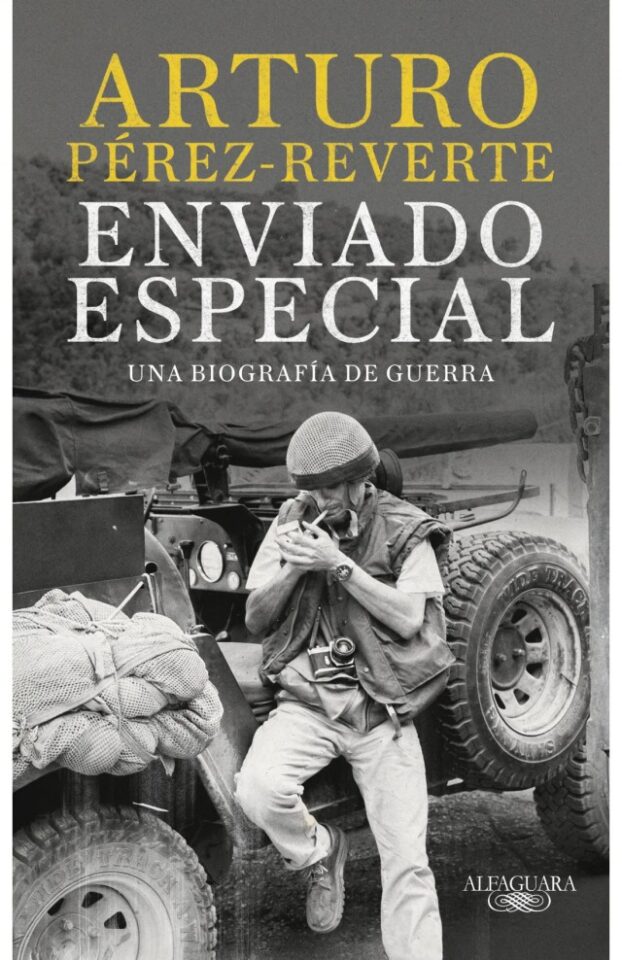
Q. You have been a reference point for many journalists over the years. But what about your personal life? In the prologue to your book Enviado Especial, you write that it is impossible to erase certain moments once you have experienced war. How do you deal with that?
A. There are places you never come back from, and war, wars, are those kinds of places. They stay with you for your whole life. Even today, forty years after my last war, there are moments when I feel I am still there. It usually happens at night, when I am dreaming. But it is not the horror that torments me or anything like that. It is simply the feeling of walking through uncertain places, profoundly alone. Later, of course, you look around and see people living their normal lives, and you ask yourself how it is possible that they are unaware of certain things. How is it possible that they do not realise that real life, the world, is not as they believe it to be?
Q. Your war chronicles must contain countless extraordinary situations and characters. What is the most Kafkaesque incident you can remember?
A. There are countless examples. War has a surreal side. In Beirut, for instance, in 1976, I was with a very beautiful female photographer when an artillery commander, to flirt with her, asked which enemy position she wanted his cannons to fire at. She pointed randomly at a place, and all the cannons fired there while she took photographs.
Q. Your chronicles of war document many of the most significant moments of the second half of the 20th century. Which is the mother of all conflicts, and why?
A. The mother of all conflicts is none other than human nature. Conflicts will always exist, as they always have. We believe, from this side of life, that war is a special state for humanity, but war is as natural as peace. Even more natural than peace. It is simply a matter of a human being doing what his instincts tell him to do, predation and survival, without the restraint imposed by civilised rules. Something which, I insist, is much more natural than we believe.
Q. How can a war correspondent come to terms with the deaths of so many colleagues in war?
A. By accepting them as the inevitable rules of the trade. If you work in a mine, you can die in a collapse. If you are a firefighter, you can die in a fire. If you go to war, a bomb or a bullet can kill you. If I die in a war, for a war correspondent, it is a workplace accident like many others. It is hard when it happens, but there is nothing extraordinary about it. I lost many colleagues, and I know they accepted the rules of the job, as I did. They were professionals, and so were we.
Q. Can a writer ever leave behind the journalist he once was and the special correspondent who still lives inside him?
A. No. Old instincts remain, and you apply them to everything you do, even to the novels you write. As I said before, there are places you never come back from. Or not entirely.
Arturo Pérez-Reverte’s appearance at the Gibunco Gibraltar Literary Festival on November 13, in conversation with journalist Clive Golt, has already sold out.