


Looking Up: October’s Night Sky


By Jordan Montado
You do not need access to a remote observatory or perfectly dark skies to take an interest in astronomy. Although light pollution limits what can be seen from the rock our position at the entrance to the Mediterranean allows many bright stars, planets and constellations to remain visible with the naked eye. Observing them is often less about having specialist equipment and more about knowing when and where to look.
As Earth continues along its orbit of the sun, familiar summer star patterns move steadily westward and begin to disappear earlier each evening. At the same time, the bright stars and constellations associated with winter return to the eastern sky. This seasonal transition gives observers the opportunity to see the last highlights of summer while beginning to identify the objects that will dominate the cooler autumn months ahead.
Constellations to Explore
The Return of the Hunter
Last month, we asked if you could identify the famous constellation returning to our skies. The answer? Orion, the great Hunter of ancient legend, whose arrival in the east has signalled the approach of winter for thousands of years. During October, he rises in the east during the late evening and is best seen after midnight, but as the month unfolds, he appears progressively earlier and becomes an increasingly familiar presence over Gibraltar.
Orion is easy to recognise by the three bright stars of his Belt, arranged in an almost perfectly straight line. Four other stars frame the Belt, marking the Hunter’s shoulders and feet and forming the distinctive outline that has inspired stories across cultures and generations.
Beneath the Belt hangs a shorter arrangement of stars representing Orion’s Sword. Look closely and its middle may appear slightly misty, as though the star has been smudged across the darkness. This is the Orion Nebula, a vast cloud of gas and dust where new stars are being born. It can be glimpsed with the naked eye under sufficiently clear skies, while binoculars reveal it more easily as a softly glowing patch.
Orion’s return is more than a change in the night sky: it is a celestial marker of the changing seasons and the opening chapter of one of astronomy’s most ancient stories. Over the coming months, as the Hunter climbs higher and earlier, we will explore Orion and the cast of constellations surrounding him.
Deep Space Spotlight
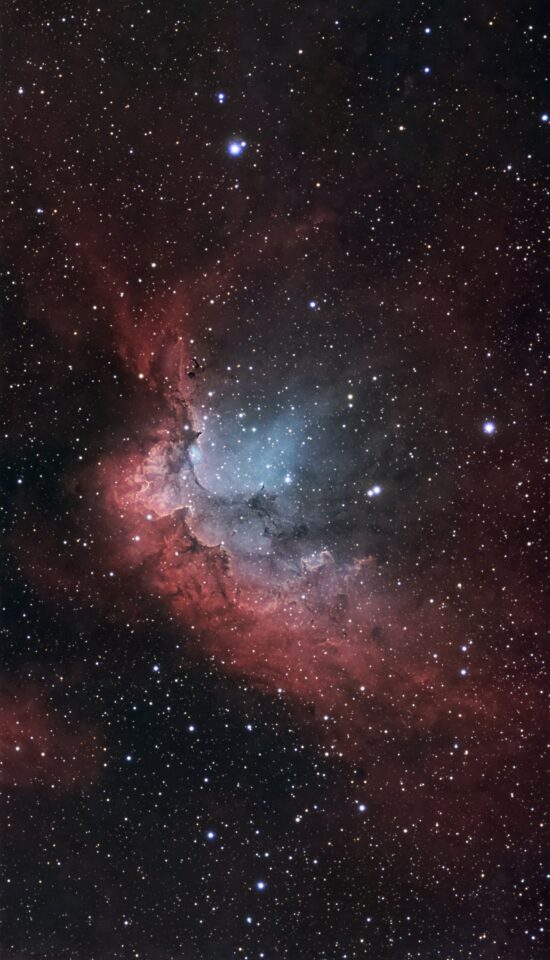
The Wizard Nebula
This month’s deep sky image is the spectacular Wizard Nebula. Hidden among the stars of the constellation Cepheus lies a vast cloud of gas and dust. Its name comes from its unusual shape, which in photographs resembles a robed figure wearing a pointed hat, with one arm seemingly stretched out across the stars. Can you see it?
Located around 7,000 light-years away and stretching about 100-light years across, the nebula is an enormous stellar nursery where new stars are forming. Radiation from these young stars deep within the nebula energises the surrounding hydrogen gas, causing the cloud to glow. The light captured in the image began its journey when Gorham’s cave was still being used by Neolithic communities around 5000BCE.
The Hunter’s Moon
October’s Full Moon is traditionally known as the Hunter’s Moon. Historically, it followed the Harvest Moon and provided additional light for hunters preparing for winter. With crops gathered and fields cleared, animals were easier to spot under the bright moonlight.
The Moon’s phases for October are:
- Last Quarter: 3 October
- New Moon: 10 October
- First Quarter: 18 October
- Full Moon (Hunter’s Moon): 26 October
The nights around New Moon provide the darkest skies and the best opportunity to search for fainter stars and meteors.
Astronomical Highlights
Orionid Meteor Shower
This month we welcome the Orionid meteor shower, which peaks on the night of 21–22 October. The Orionids are created by dust left behind by Halley’s Comet, perhaps the most famous comet in history. As Earth passes through this trail of debris, tiny particles enter our atmosphere at tremendous speed and burn up, creating the streaks of light we call shooting stars.
The bright waxing Moon will interfere with the Orionids this year, but the brightest meteors may still be visible. Europa Point and the Sandy Bay will provide the best viewing spots for this.
Fact of the Month
How Old Is the Light from Orion’s Belt?
When you look at Orion’s Belt, you see its three stars as they appeared centuries ago—not as they are today. Alnitak (Left Star) and Mintaka (Right Star) are roughly 1,200 light-years away, while Alnilam (Centre Star) is about 2,000 light-years from us. Their light therefore takes between 1,200 and 2,000 years to reach Earth.
This means the light entering your eyes this October began its journey long before Gibraltar became British and before the Moorish Castle was built.
Looking Ahead
As October ends, the clocks go back and darkness arrives even earlier. November will bring better views of Jupiter, the return of more winter constellations and another famous meteor shower connected to one of astronomy’s most dramatic comets.
For more astronomy updates and local stargazing content, follow @Gibnebula on Instagram and Facebook.
Most Read
CM pitches Gibraltar’s ‘next phase of growth’ in final Guildhall address
Mon 19th Oct, 2026
Revolut says Rock's ‘clear and stringent’ regulatory framework offers solid base for crypto innovation
Mon 19th Oct, 2026
Gibraltarian AI student brings professional youth perspective to UNESCO forum
Mon 19th Oct, 2026

Today's Paper
20th October 2026
Read our latest newspaper by downloading our app from the link below.


