


Karl Ullger and the power of identity in his book, Echoes of Legacy


Local artist Karl Ullger will launch his new book, Echoes of Legacy, at City Hall on Wednesday, November 4, at 6.30pm, as part of the Gibunco Gibraltar Literary Festival fringe programme.
The event will feature a discussion with Alice Mascarenhas and Martin Gonzalez, a recorded performance of Ophelia, by the Movement Collective, and Quiet Inferno, a live dance performance featuring three male dancers exploring mental health.
Mr Ullger spoke to our Senior Reporter, Eyleen Gomez, about the book, his creative process and his participation in the Literary Festival.
Was there one particular painting that started Echoes of Legacy?
It was more the idea of revisiting works that have stood the test of time and looking at them through my own eyes. The book developed from my solo exhibition in 2024; I wanted to explore that idea further and bring the paintings together in a way that allowed people to see the connections between the original masterpieces and my own interpretations. For me, it was never about copying these great artists. It was about taking something familiar and asking myself what I could do with it. But I would say Ophelia perhaps is the lead star of the show.
When you look at a famous painting, what catches your attention first?
The atmosphere and the way the artist make you feel before you even start analysing the painting. Obviously, as an artist and mentor, I naturally look at composition, colour, technique and the way the painting has been constructed. I can’t really switch that off. But what really interests me is the use of light, the figures and little details that perhaps you wouldn’t notice at first glance. I think the best paintings are the ones that keep giving you something new every time you look at them. That’s what makes them timeless, and that’s what I try to capture in my own work.
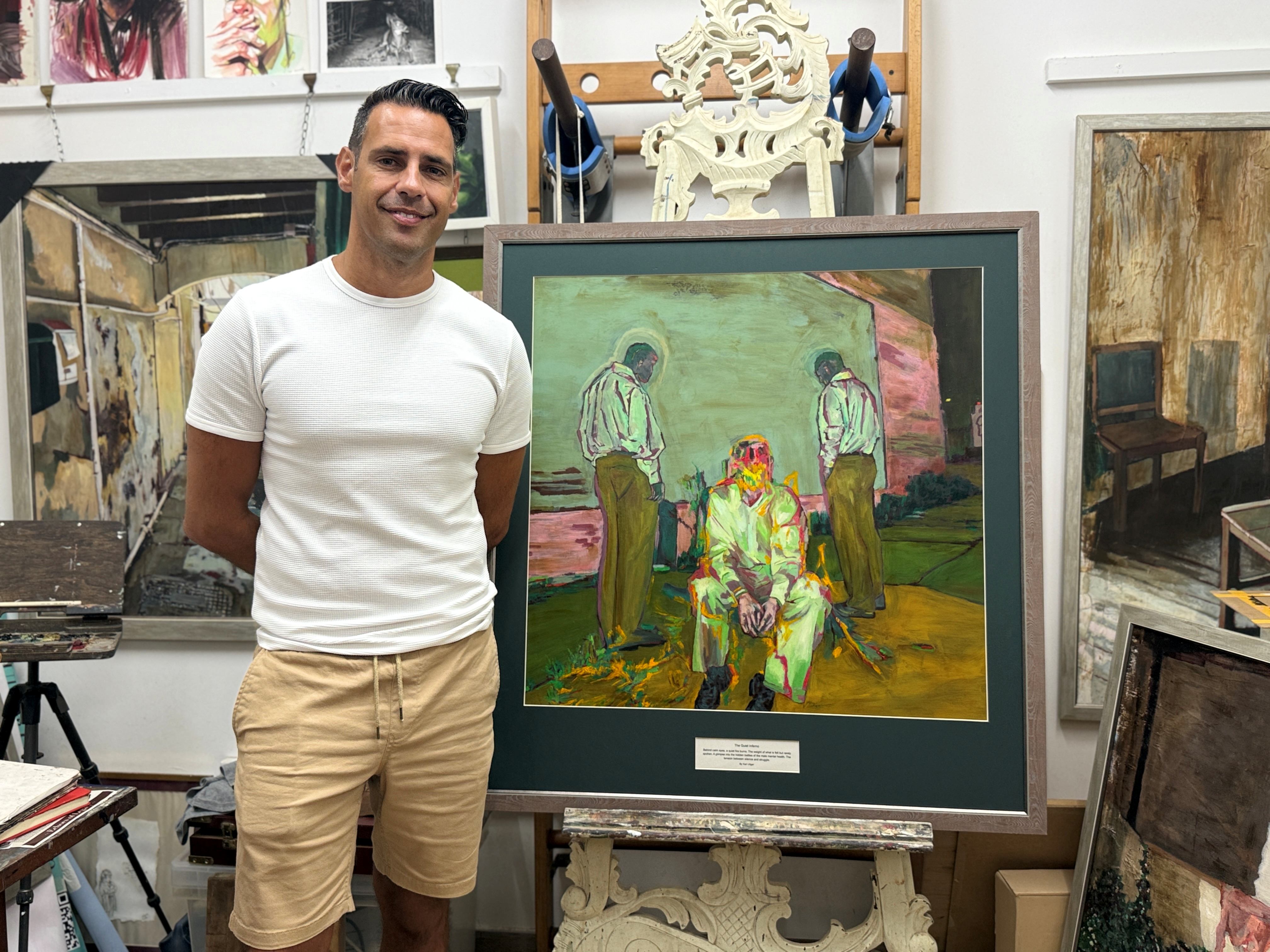
Karl Ullger with one of his paintings.
At what point does inspiration become reinterpretation, and at what point does it become an entirely new work?
I think the line between the two is quite blurred, which is what makes it interesting. Inspiration is that initial spark, something you see in another artist’s work that stays with you. Reinterpretation is when you start to question it, change it, and filter it through your own experiences, emotions, and way of working.
At some point, you have to let go of the original and trust your own instincts to not lose your own voice. My background in graphic design, alongside my Fine Arts training, has probably influenced the way I approach things. I’m always interested in experimenting with composition, materials and techniques.
For me, the original painting provides a starting point, but what happens on the canvas has to become my own. That’s when it starts to take on a life of its own.
When you reinterpret a masterpiece, do you feel a responsibility to remain faithful to the original artist’s intention, or do you feel you can do your own thing?
I have enormous respect for the original artists and what they achieved. These are works that have survived generations for a reason, and I wouldn’t want to lose sight of that.
But I also think art has to evolve. If we simply preserve things exactly as they were, we risk treating art history as something that belongs in a museum rather than something that is still relevant to us today.
If the original artist could stand beside your reinterpretation, whose reaction would you most like to witness?
I would probably say Diego Velázquez’s, particularly because of my reinterpretation of Las Meninas. It’s such an extraordinary painting, not just technically but conceptually. There’s so much happening in it, and it raises questions about perspective, the artist, the viewer and the act of painting itself. Also being a painting that has played such a big part in Art History and influenced so many greats.
Do you think art can genuinely help people confront difficult emotions, or is it more of a conversation starter?
I think it can absolutely do both. Art can give people a way of approaching feelings that they might otherwise struggle to express.
Sometimes you look at a painting and something resonates with you, even if you can’t quite explain why.
I’ve always been interested in people, their experiences and the emotions that sit beneath the surface. I think art can make us stop for a moment and look at things differently, whether that’s something in ourselves or something we recognise in someone else.
Do you think an artist’s legacy is determined by the work they have done or by the effect that work has on other people?
You can create something technically accomplished, and it might be admired for generations, but I think a work becomes truly significant when it connects with people on a personal level.
When someone sees something in your work that reminds them of their own experiences, makes them question something or simply makes them feel something, that connection can outlive the moment in which the painting was created.
I also think legacy is more than recognition or awards. It’s about what you leave behind, the conversations you start, and the people you influence along the way.
As an artist and mentor, that’s something I think about quite a lot. You might never know the full impact you’ve had on someone, whether through a painting or through encouraging a young person to pursue their own creativity.
For me, Echoes of Legacy is partly about that idea: how work created in one time and place can continue to speak to people in another. The original artists left something behind, and I’m responding to it in my own way.
Hopefully, someone else will find their own meaning in that too.
Is there a masterpiece you haven’t yet explored but would now like to?
There are so many, which is part of the appeal of a project like this. The more you explore art history, the more you realise how much there is still to discover.
There are so many masterpieces that would be good to explore on a personal note. Some that spring to mind are John Singer Sargent’s El Jaleo, Gustav Caillebotte’s Floorscrappers and a sculpture that I’m recently quite obsessed about is The Winged Victory of Samothrace. All incredibly powerful pieces, both visually and emotionally.
I’d be interested in what would happen if I approached it through my own visual language, rather than simply trying to recreate its historical narrative. I’d like to explore the human element, the vulnerability of the figures, and the emotional weight of the scene.
I think the real challenge would be finding a way to make a work like that relevant to the present without losing the significance of the original. That’s the sort of challenge that excites me as an artist.
Finally, a fun one: if you could have one conversation with any artist from history, who would it be, and what would you ask them?
I’d absolutely love to have a dinner date with Salvador Dalí. I think his character alone would make an extraordinary evening.
He had such an eccentric, fascinating personality, and I’d imagine the conversation would be completely unpredictable. I’d probably spend as much time listening to his thoughts on life, society and the human mind as I would talk about his art. You’d never be short of something to discuss with Dalí!
But from a purely artistic point of view, I’d also love to sit down with Joaquín Sorolla. His understanding of light and shadow is something I really admire and enjoy exploring in my own work.
I’d love to talk to him about his techniques, how he observed light, how he captured those fleeting moments, and how he managed to make light itself feel like such an integral part of the painting.
I think there’s so much you could learn from an artist like Sorolla, not just by looking at his paintings but by understanding how he approached them.
And the best part? They’re both Spanish, so we could very easily converse! Although, knowing Dalí, I’m not entirely sure how much of the dinner conversation would be about painting!
The talk at the City Hall
Karl Ullger is looking forward to the talk at the Mayor’s Parlour at City Hall, as part of the Literary Festival 2026 Fringe Events.
“I’m genuinely overwhelmed by the response, particularly that all the tickets sold out within just five days of being launched by the Ministry of Culture,” he said.
“It’s incredibly humbling to see so much interest in a project that has been so personal to me, and I’m really looking forward to sharing the stories, ideas and creative process behind Echoes of Legacy with everyone attending.”
The book will be available to purchase from Thursday 5th November, priced at £20, with £5 from every copy sold going to GibSams, a charity focused on supporting mental health and wellbeing.
Those attending the talk on Wednesday 4th November will have the exclusive opportunity to purchase copies in the evening before the book becomes available to everyone else.
“It’s a project that has taken a great deal of time, thought and passion to bring together, so seeing it finally come to life in book form is a very special moment for me,” Mr Ullger said.
“I’m incredibly grateful to the Ministry of Culture, Martin Gonzalez, Alice Mascharenhas and The Movement Collective along with everyone who has supported me along the way, and I hope people enjoy exploring Echoes of Legacy as much as I’ve enjoyed creating it.”


