GONHS at 50: The growth of a natural history society
Celebrating 50 years of GOHNS at the City Hall with members of the original group and founde members of what we know today as GOHNS. Left to right: Dr John Cortes, Charlie Perez, Dr Ernest Garcia and Professor Clive Finlayson.


 Can the Gibraltar community imagine itself without GONHS – the Gibraltar Ornithological and Natural History Society? Unbelievably, from its inception as a birdwatching group, it has now been with us for 50 years and has grown beyond all recognition involved in all areas of our natural environment – land, sea and sky. It all began with a group of youngsters with an interest in ornithology – all original birders. Most of them are in some way still involved in the life of this community. Over the next few weeks, Alice’s Table looks back on the work carried out locally by GONHS in all areas in these 50 years, its international recognition and its involvement in projects further afield. As I look at the names of those involved and who will join us at Alice’s Table as we tell its history, I very soon realise that my career as a journalist on radio, television and this newspaper, has seen me cover the story of GONHS practically from the start interviewing its prominent members (one or two I have even worked with), joining them on outings and reporting on a great majority of events. I dug out old articles including the article from 25 years ago I wrote for this newspaper on the 25th anniversary of GONHS then – I reported the following: “GONHS, Gibraltar Ornithological and Natural History Society, is 25 years old, and coinciding with the anniversary, the Society will host the European Partners Meeting of Birdlife International and although there has been great opposition from Spain it will become full partners of Birdlife International during this gathering… They have progressively been contacted by many organisations world-wide to become their representatives in Gibraltar… the World Conservation Union, the Iberian Council for the Defence of Nature, Royal Society for the Prevention of Birds, British Trust for Ornithology, World-wide Fund for Nature”.
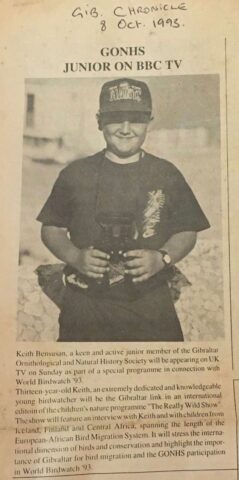
Today the society, 25 years later now celebrating its 50th birthday, is led by its current General - Secretary Dr. Keith Bensusan (he has joined us on Alice’s Table several times this year wearing another hat as the head of the Alameda Botanical Gardens). Like many of those involved in GONHS he was just a boy when he first joined the society which in fact is older than him. 50 years, he begins by telling me, is a major milestone for such a small organisation like GONHS. As a society it has survived and grown beyond all recognition, greatly contributing and debating the environmental changes which have locally taken place over the five decades. 25 years ago, GONHS had already gained representation in such bodies as the Development and Planning Commission (in fact it was the first NGO to do so), and 50 years down the line it continues to keep a watchful eye on all development that could threaten Gibraltar’s natural assets.
Keith is in no doubt that as Gibraltar faced environmental repercussions through the years GONHS was naturally placed on a path which not only helped it grow but which allowed it to become the broad-wide-ranging NGO it is today.
Former GONHS General Secretary, Professor John Cortes, today Minister for the Environment, Climate Change and Heritage, believes the longevity of GONHS has simply been the love of nature of its members, the richness of nature in Gibraltar, and the passion of its members.
John was an original member and the first Secretary of GONHS, with Professor Clive Finlayson, today Director of the Gibraltar National Museum and the UNESCO World Heritage site, who was also its first Chair. When in the late 1980s Clive stepped down changes to the constitution were introduced and John took on the post of General Secretary, a position he held until he was elected to Government in 2022. Over time the society became more than just a birding club and soon grew in stature as an NGO “carrying out research, education, and advocacy/campaigning, as well as joining international organisations. We lobbied successfully for the creation of the Department of the Environment and the naming of the first ever Minister for the Environment (Joe Pilcher), and we can claim credit for that,” John adds.
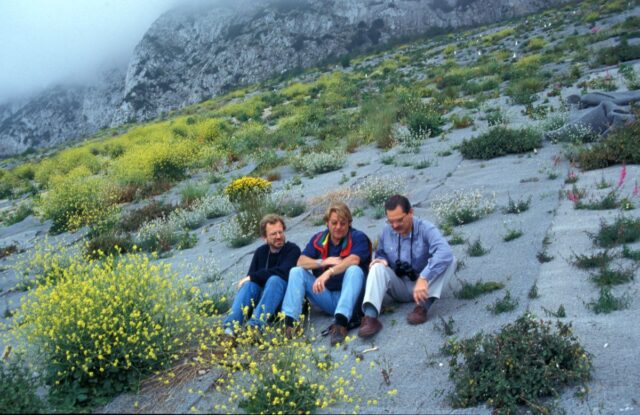
john Cortes and Leslie Linares with the late Eric Shaw, who was head of the Marine Section.
It was its work in conservation that would lead to the drafting of the Nature Protection Act and the Endangered Species Act. John also highlights the creation of the Upper Rock Nature Reserve which did not exist when GONHS first came to be – “later on, things like the gull control unit, management of the macaques and of course, saving the Gibraltar Campion from extinction. Also, publications like the Bird Report and Nature News (the latter I edited for some years, the former edited still by Ernest Garcia). And then there was international recognition, such as becoming a full Partner of BirdLife International and a member of IUCN.”
Clive, an original birder and founder member, acknowledges the importance of the Society and the part it has played in this community. He points out that in the days when conservation, especially nature conservation, was in its infancy, GONHS brought an awareness of the natural world to every household in Gibraltar.
“We were the pioneers at a time when we were probably seen as a bunch of eccentrics. The perception has changed thanks to GONHS. Others have come to light in recent times, and they also do good work, but it all started with GONHS… for a very long time we were alone,” Clive emphasises.
Charlie Perez, a lifelong volunteer and nature enthusiast (original member), recalls how in 1976 they organised themselves into a society at a meeting in the Gibraltar Museum, with the late Joaquin Bensusan (then Curator at the Gibraltar Museum) - together with Ernest Garcia, Clive, John and the late Mario Mosquera when the group was first called the Gibraltar Ornithological Society. Charlie presents me with the background of those early days, which eventually saw other disciplines join as well. Leslie Linares and the late Arthur Harper, whose interest was in photography, and who by taking pictures of plants, developed an interest in their identification. This led to the publishing of the book ‘Flowers of Gibraltar’, together with John (more about that in the coming weeks). Years later, Charlie continues, the late Eric Shaw (diver and all things under the sea) joined and expanded the Society with the Marine ecosystem. It was then that the name was changed. Keeping Ornithological in the name because of its historical value, the Society became known as the Gibraltar Ornithological and Natural History Society - GONHS. Its current General Secretary describes GONHS today in 2026 as a natural history and conservation group with a strong membership base as an NGO governed by a Council elected by the membership.
“We span across all the biological world: plant and animal, vertebrate and invertebrate, terrestrial and marine. Our aims are to conserve Gibraltar’s biodiversity and natural environment, foster research into local wildlife, and educate the public and official bodies on these,” Keith explains.
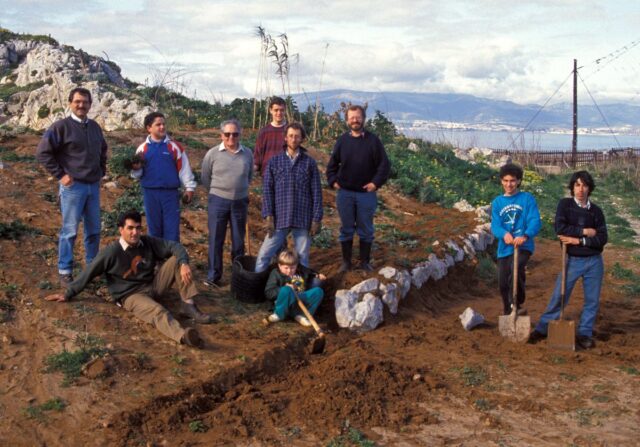
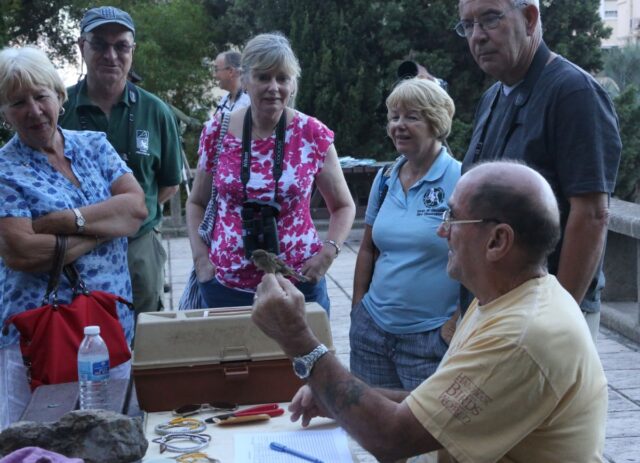
GOHNS hard at work on outdoor project.
Over the years many of us will have joined GONHS in so many of their outings and events as well as supporting the movement in its many projects and the growing areas of expertise. As a young Radio Gibraltar announcer in the Wellington Front Days I produced two series of ten 15 minutes progammes called ‘Below the Pillars of Hercules’ on marine life with Eric Shaw, and on nature with John Cortes.
Keith believes it is through the efforts of GONHS, and other local NGOs, that Gibraltar’s natural environment is today in a far better place than it would have been had they not been around. Evolving from those early days of the 1970s, a decade later in the 1980s its overall aims had multiplied, and although the group has remained small in size few would disagree it continues to have a very positive impact. Over time it took on a prominent role which it still holds to this day not just in our community but in the surrounding area and beyond as well. So, where did it all begin? For that we must go back to the late 1960s. All original members remember the influence of Dr Ernest Garcia. Originally the Gibraltar Ornithological Group was conceived as a birdwatching club by these, then young boys in school. Some of them (as we know) eventually became public figures, active in biological research and more. The original members included: Ernest Garcia, Clive Finlayson, Charlie Perez, John Cortes and the late Mario Mosquera. They grew their interest in the study of science. In particular they had a curiosity and an interest in the life of birds (they are still active birders). Ernest has edited the Gibraltar Bird Report for 25 years (2001- 2025). He keeps up to date with developments in ornithology from the entire Iberian Peninsula with publications to his name. When it all started Ernest felt there was an interest in birds and wildlife generally – “the interest was growing and I felt a society would help to sustain and increase such interest. It would also put recording of observations on a firmer footing.”
Ever since he was a child – just like all involved in the initial group – he has always been interested in wildlife.
“Birds are more obvious than most wild animals and grabbed my attention. My interest led to my studies in biology and work as an ornithologist. I wouldn’t call myself a birdwatcher; few who are interested in birds would do so. There are birders, who chase a variety, and rare birds. I am an ornithologist, interested in what birds can elucidate regarding biological and environmental matters,” he says.
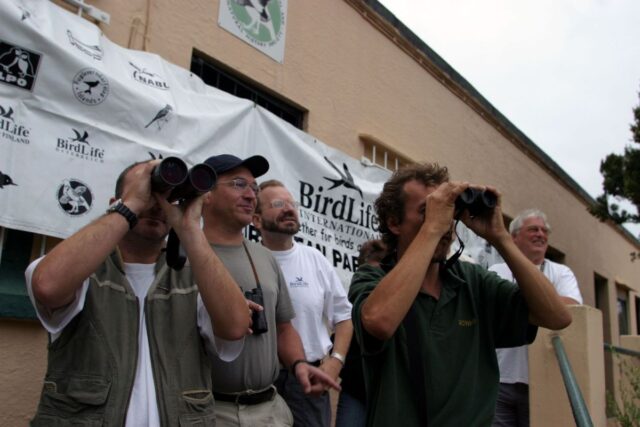
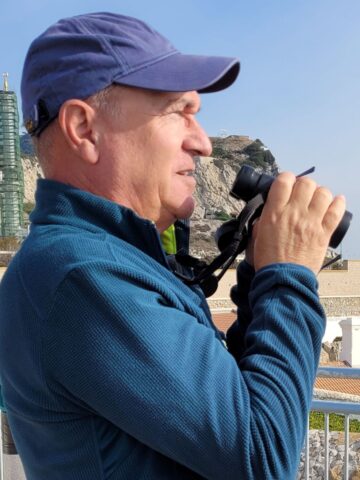
GOHNS members recording birds in flight.
Clive’s first entries of wild bird observations in his Field Guide Records were in April 1966 in which he wrote he was setting off to observe the Ospreys in Speyside (Scotland) that same year. He was 11. He recalls how Ernest had heard of his interest and approached him: “He took me to Windmill Hill a few times and we developed a friendship and common interest then. I recall Charlie being part of that initial “group”. Mario was there early on too, and then in 1976 we published a landmark paper in the journal British Birds about the migration of raptors across the strait,” Clive explains.
For Clive birds have always been his passion. They determined his study in biological sciences. University then gave him the formal background he needed. But he nearly did not make it to Oxford as the Gibraltar Government would not give him a scholarship for a doctorate and his parents could not afford to pay the fees. Applying for a studentship offered by the British Ornithologists’ Union (BOU) at the age of 24 Oxford University awarded him a doctorate, based on a study of swifts and warblers in Gibraltar.
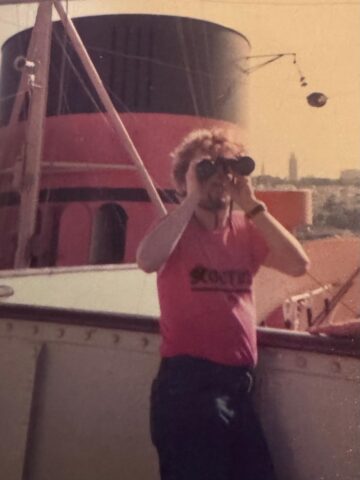
As for Charlie, he remembers taking an interest in nature at a very early age. At 10, his parents had bought him his first pair of binoculars. With this, he would count raptors and give details to his cousin Ernest. All the interested Birders, he says, first became acquainted when pupils in the Grammar School. Then when his cousin, Ernest, three years older than him, began birdwatching, he tagged along and began to take a bigger interest in nature.
“Everyone joined in. We collated bird records which Ernest kept meticulously. Ernest was in touch with the late Governor, Sir Gerald Lathbury, who also had an interest in Ornithology, and ultimately published the results of all our counts in a paper in the prestigious journal, Ibis,” Charlie adds.
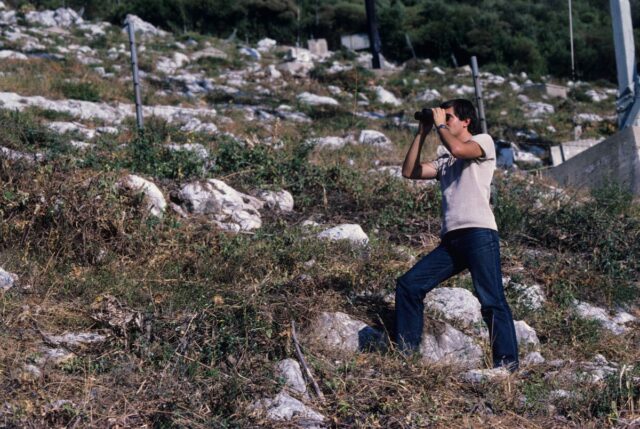
Clive Finlayson.
John was also fascinated by plants and animals. He recalls in the second year of secondary school reading the Gibraltar Chronicle articles on birds which had been penned by Ernest.
“These inspired me, and then Ernest, who was in the sixth form of the Grammar School, started taking us younger students birdwatching on the Upper Rock. We kept the group going, regularly ‘birding’ and watching migration, and eventually formalised it by becoming the Gibraltar Ornithological Group (GOG) of the since defunct Gibraltar Society. When the latter closed, we became the GOS -Gibraltar Ornithological Society, which then became GONHS in the early 1980s,” he adds to the story.
It was a group of friends who were ultimately responsible for the creation of GONHS which was eventually transformed into the internationally recognised organisation with research and support, Keith is keen to point out. As we chat about what came later, he talks of the important impact the reopening of the frontier had on the group in the 1980s. This saw the re-establishment of links with colleagues in Spain, and which saw the collaboration of joint-conservation work and projects. There were also ongoing projects with colleagues in Morocco. Today GONHS still continues its work outside Gibraltar.
Next Week: GONHS on biodiversity awareness.