


Alice's Table Unlocking Carrera’s Passage with local history enthusiast Gil Podesta


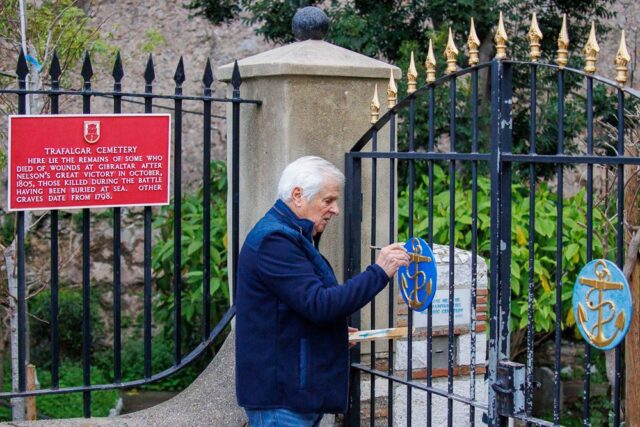
I know our weekly columns often lead to hearty conversations, surfacing as a trip down memory lane. At times Alice’s Table reminds us of a time in our history; tradition; characters we have lost sight of; identity. How do I know? Simply because I get stopped most weeks and given a little more information on whatever I may have written that week. So, this week we invite back a person who I have many conversations with because he is always on that heritage journey. My good friend Gil Podesta who has shared a few pages with us in Alice’s Table in the past. An avid reader of this column when we delved into different areas of town such as Turnbull’s Lane, and just recently City Mill Lane, he called me and said he was working on a sketch for me – for Alice’s Table - of his recollections of Carrera’s Passage. He had been inspired. Of course, I said yes.
Gil’s research carries great detail as did his wonderful sketch books of life in Gibraltar when he was a youngster – his books are priceless and give us great insight into the Gibraltar of the past in the post war years. What it was like to grow up in Gibraltar? What has been lost? What remains?
Gil is a detailer – and it is amazing how much he still remembers growing up – even after living away from the Rock for many years – but he has always been (and remains) passionate about our heritage.
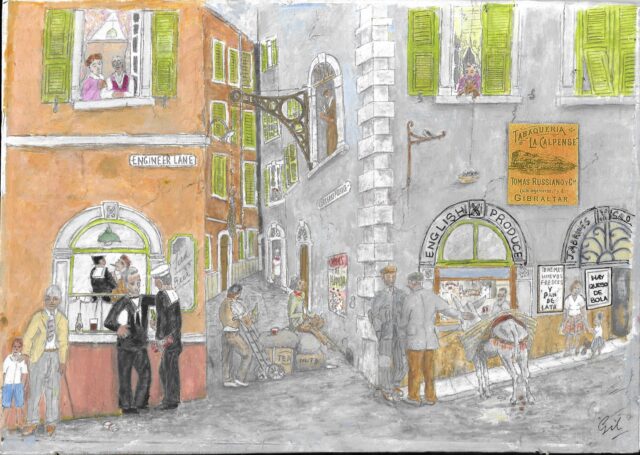
So, sometime after the first phone call – and a few chatty moments on Gibraltar’s Main Street and side streets – another phone call came. He had now completed the sketch and put together a few notes of his recollections and research. The sketch on cardboard and in colour depicted the entrance to Carrera’s Passage shooting up towards the rock as it journeys from its junction towards the bottom of Engineer Lane and leading onto the Main Street, at its junction with Turnbull’s Lane – y todo queda en casa. Gil’s sketch is rich with action as the entrance of Carrera’s Passage is brought back to life as it would have been circa 1950s. Inside the buildings on both sides of the narrow and long stretch of steps, moves up and up – this is where many families would have lived in the old days – this was patio living – but today much of it, especially the further up you go, lies derelict.
Gil begins by telling me about “the inside” of Carrerar’s Passage where the initial narrow passage “leads you to a dark maze of intriguing courtyards, passageways and often concealed patios, via an alleyway which one would have led you to Turnbull’s Lane”. As he continues to paint the picture deep inside this area, he recalls how further along there are the narrow steps which once led to the hidden parts of the upper town eventually emerging near Road to the Lines. Here he pauses for a second and points out how a walk past the steps will offer a nostalgic view of how families once lived “huddled together in old Victorian buildings”.
Gil further points out that this area also holds many hidden vaults. Interesting too, he adds, are the walls in this area – “some possibly dating back to the Moorish period and each with its own hidden story”. And how many times have we heard (and it is true) that at every turn there is a piece of history everywhere in Gibraltar. Carrera’s Passage is no different. All these stories “are waiting to be told”, Gil says. To which I add, “and should never be forgotten”. Sadly, he says, “it is a great pity that we have never had the foresight to refurbish some of these old buildings and alleyways as a tourist attraction, as they do elsewhere”. Well, it is never too late, and the area remains – looking very much the same for more than 70 years – a daily vivid reminder of our past.
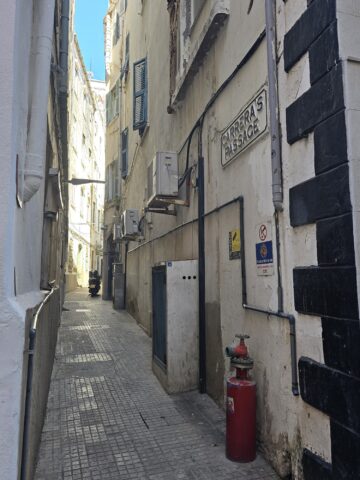
In the Gibraltar Government Ministry of Heritage website (www.ministryforheritage.gi) Carrera's Passage is described as a small cul-de-sac located at the northern end of Engineer Lane. The area, it points out, consisted of three large properties that were converted into tenements for working-class families. These tenements, often consisting of “just two or three small rooms, were typically home to large families living in extremely cramped conditions”—a common situation in Gibraltar throughout the 19th and much of the 20th centuries.
We must remember this was a time of overcrowding and many families lived within the town area. The colonial reports of 1950 and 1951 paint a picture of Gibraltar in those days when “unemployment among British subjects remained negligible” for these two years.
At the time that Gil was born progress had already been made with government permanent housing schemes with two schemes in the pipeline. One which would provide for the building of 472 flats at Governor’s Meadow in seven large blocks – known today as Humphries. The other provided for the building of 109 flats in much smaller blocks on various sites.
And just to add to the picture, let us remind ourselves of the 16,700 persons who were evacuated during the war, and had slowly been returning in the repatriation since 1944. The last party would return in February 1951. During 1950 and 1951 the Resettlement Board had found homes for no less than 2690 persons of which 1,750 were housed in new permanent flats and 940 in other areas around Gibraltar. However, at the end of 1951 there remained 391 families who were living in overcrowded conditions, and 376 others in temporary housing - mostly in Nissen huts all of whom required a new home and to solve the problem about 600 new dwellings additional to those under construction or planned for 1952 were also needed.
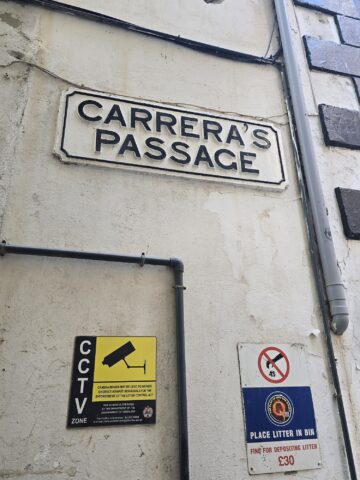
The name "Carrera’s Passage", according to the Gibraltar Government Ministry of Heritage website, likely refers not to an owner but to a tenant named Francis Carreras. “According to the 1816 Register of Inhabitants, Carreras, a tobacconist who had lived in Gibraltar for at least 15 years, resided at house No. 12 in Engineer Lane with his wife, Mary, and their two children, Mary and Frances. His tobacco shop appears to have been located on the south corner of Carrera’s Passage and Engineer Lane, while the family residence was on the third floor. The second floor housed a warehouse where tobacco bales were stored. These bales were hoisted using a derrick within the narrow passage entrance, likely giving the passage its name—Carrera’s Passage”.
So, now let us get down to his colourful and detailed sketch where Carrera’s Passage begins. If there is one thing I have learnt from Gil over the years is that most of his research has been carried out over the years by the people on the street – and over the years he has gathered some amazing stories and anecdotes which have added so much to his already incredible detailed sketches. Gil is a conversationalist, when you talk to Gil, even if you have just met him, you know instantly this is the man you want to share your stories with. Hence, his wonderful collection of character-filled stories looking back in history – and he remembers them all.
His stories normally begin like this: “I was once told… “, and just that makes you sit up and listen because you know what is coming will be of interest.
So, he begins: “I was once told by an elderly Spaniard that he knew of a night watchman who was rather fond of his drink. This watchman worked in a store like the one we can see on the picture (may even have been this one). One night, worse for wear, he made his way back to the store and helped himself to a tin of sardines before collapsing in a drunken stupor on the store's floor. A rat, of which there were many in those days, smelt the fish oil on his face and crawled up to bite his lip whilst he lay unconscious. This bite left the watchman’s lip disfigured. Now, this rat story I was told was true, and even if it was not, it ought to be.”
But then, who knows? Anything is plausible and these are some of the wonderful stories Gil has collected over the years. As to the rest of the picture, he begins with the tobacco sign seen above the J. Abrines stores (which were there for many years) and which read – Calle Ingenieros, 1 y 3. He explains, how there was time it appears there were a few tobacco outlets around this area as they were on Main Street as well. We have read on these pages in the past how the tobacco factories (like picadura factories) were to be found in Irish Town. Gil points out that many of the old newspapers such as El Calpense, and even the old Gibraltar Directory and Guide carried adverts for these tobacco outlets.
He then points to the colourful sign plastered on the wall of Carrera’s passage which reads – Circus at the Alameda. This would have been a touring circus visiting Gibraltar which performed at the Alameda Gardens in the open area or in a Big Top at the entrance to the gardens on the esplanade.
Let us now direct ourselves to the two Spaniards with the donkeys – both are charcoal sellers.
“The charcoal they sold was brought over from Spain and sold around Gibraltar’s narrow streets. The panniers on the donkeys in the picture appear to be empty after having sold all their charcoal around Gibraltar,” he explains, as he adds how he recalls seeing the blackened faces of the charcoal sellers when he was just a boy.
“Theirs was a hard life trudging around Gibraltar’s streets selling their wares – in Carrera’s Passage they would have had to have carried the coal up the steps of the long narrow passage to the many homes – and it must have been hard work especially in the hot summer months,” he adds.
But there were times when selling was (relatively) easy, and in the picture, Gil has sketched an elderly woman who we can see leaning out of the window whilst hoisting a basket full of charcoal that she had just bought from these Spanish sellers. Gil tells me this was a very common sight around the whole of Gibraltar at the time.
The picture also shows a cast iron hoist just at the entrance to Carrera’s Passage which would have been frequently used to hoist goods to the store above. When taking a walk in the centre of town – side streets, Main Street and Irish Town – one can still see a few of these remnants from our past either intact or just outlines and parts of what would have been a cast iron hoist. Just look up – I have often written this on these pages in the past – you never know what you might find.
Gil tells me he was fascinated as a child when seeing these cast iron hoists – “as a boy I was very lucky to have seen one still in operation in the early 1950s”.
In his view, he comments, “these old relics, which are so full of charm and would add so much character to our streets, should be fully restored today. They should feature as tourist attractions as they form part of Gibraltar’s history and would therefore enhance Gibraltar’s heritage.”
As he further reminiscences, Gil adds how as a “young lad” he also remembers seeing wooden trolleys stacked with perishable goods and being delivered by Spanish workers to the local stores.
“One of the workmen (at the centre of the picture) sitting upon a bag appears to have taken off his ‘apargatas’ to air his feet whilst his co-worker has a leisurely drink.”
And finally, he takes me to the left bottom-corner of the picture. Here the two sailors he points out are sharing a hearty drink over a friendly chat.
“One of them,” says Gil, “is holding a carton of cigarettes which he appears to have bought from the Abrines grocery store. Pools of Navy Sailors were commonly seen wandering the streets of Gibraltar, looking for bargains and exploring the local bars.”
And as we have discovered recently, the many cabarets offered entertainment – music and dancing – in their establishments such as the Winter Garden on City Mill Lane.
Every area of town as we have also learnt recently was different and offered their own characteristics – smells, sounds and looks. Carrera’s Passage, even if one stands at the entrance today looking in, remains very much unchanged – and easy to imagine what it must have been like 60 or 70 years ago. Housing hundreds of Gibraltarian families, this area as Gil depicts in his picture and with his many stories was a hive of activity day to day – and in the lives of many Gibraltarians.
I am hopeful I will get another phone call from Gil saying he has another picture for Alice’s Table – so we can uncover a little more of another important and heritage filled part of town.


