


The Cauldron Las Fallas of Valencia


If you want your mind blown then go to Las Fallas festival in Valencia. Think of the loudest thing you have ever heard and then times it by ten, add forty-foot flames and fireworks pinging off in all directions. Morrissey couldn’t handle it and cancelled his 2026 Valencia concert after being left in a “catatonic state” by city noise, saying it would take him at least one year to recover from the “indescribable hell”.
I, on the other hand, loved it and can’t wait to go back.
Spaniards are the trailblazers of weird festivals and compared to La Tomatina, the wine battles of Haro, or running of the bulls at San Fermín in Pamplona, Las Fallas is relatively safe and clean. Each March, hundreds of massive sculptures (fallas) and smaller figures (ninots) are displayed around the neighbourhoods of the city, then burned in a dramatic ‘crema’ finale on 19th March.
Opinions differ as to the origins of Las Fallas but there’s documentary reference to it in 1777 and, from 1848 onwards, the festival appears regularly in various publications.
Over time, and with the intervention of the church, the date of the burning was made to coincide with the feast day of St Joseph, patron saint of carpenters, 19th March.
Arguments have arisen over the years; is it pagan, is it secular, is it religious? There’s evidence of all three but it’s safe to say that Las Fallas is a genuine grassroots celebration which has adapted and reacted to Spanish events since the late 18th century.
Valencian carpenters are 100% the source of this wood-burning tradition. They used structures called ‘parots’ to hang their candelabras on during the winter.
With the arrival of spring and longer daylight hours, the parots were burned along with waste wood and material gathered to create a communal bonfire.
This tradition evolved and the parot was dressed with clothing so that it looked like a person, these were the first ninots.
These ‘monuments’ served as expressions of political satire and protest, closely intertwined with the social, political, and economic milieu of the era. Over the years people began to organise the building of the falles, and the famous festival was born.
The minute you arrive at Valencia’s beautiful central station Estació del Nord (famous for its historic Art Nouveau architecture), you’re in the thick of it with throngs of people milling around.
The city is well equipped to handle the hordes; the streets are vehicle-free and there are rows of portaloos everywhere. We arrived on 18th March in time for the Ofrenda de Flores where thousands of falleras parade alongside marching brass bands towards the Plaza de la Virgen.
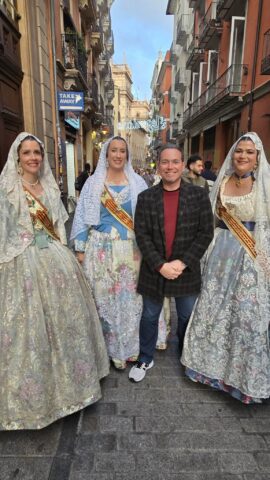
The falleras serve as the ambassadors of the festival participating in all events. They are the living symbol of Valencian pride, resilience, and community spirit and being a fallera is a serious tradition passed down through generations.
Since 1929, each neighbourhood elects a Fallera Mayor and a Fallera Mayor Infantil. The fallera costume is inspired by the Valencian peasant women of the 18th and 19th century. The crinoline dresses are handmade with silk, intricate brocade and embroidery. Hair is styled into three flat coiled discs, one at the back and two over the ears, adorned with combs. The look is finished with elaborate jewellery and a sash in the colours of the Valencian flag.
It really is a sight to behold and, if you happen to get up close to a fallera, you will appreciate the detail and effort. During the festival, many people, men and women, wear regional and historical costumes.
Under the Franco dictatorship, the celebration lost much of its satirical nature because of censorship, but the fallas were among the few fervent public expressions allowed in those times.
During this period, many religious customs such as the offering of flowers to the Virgen were taken up, today they are essential parts of the festival.
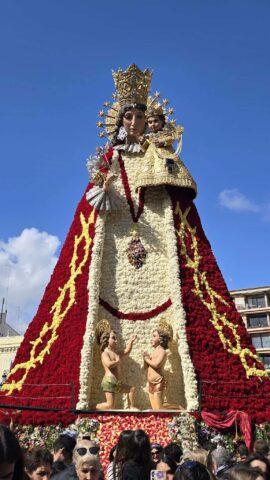
In front of the Basilica, a 15m-tall statue of the Virgin Mary rests on an immense wooden frame and, slowly, the gaps are filled with flowers brought by a continuous procession of people. One by one, each bloom is placed by attendants balanced high on ladders and gradually a floral tapestry comes to life.
And now to the mascletà. You might think a firework display at 2.00pm would be a waste of time, but think again. This is not about vision, it’s about sound, vibration and the smell of gunpowder.
We were advised to congregate at the main plaza, Plaça de l'Ajuntament, by 12.30 to get a good spot.
At 1:4,5 falleras filled the balcony of the town hall and the countdown began with one loud bang, then at 1.50 with another, then at 1.55 Un Beso Y Una Flor by Nino Bravo blasted out from loudspeakers and the whole crowd sang along with great emotion. At 2:00 pm the clock chimed and a Fallera Major made the call: “Senyor pirotècnic, pot començar la mascletà!” (Mr. Pyrotechnic, the mascletà can start now!)
The mascletà is a coordinated pyrotechnic spectacle of firecracker detonation which is so loud and powerful the ground seems to shake, not to mention one’s eardrums. Do not take young children or people with sensitive ears, but do go if you want to feel the earth move whilst laughing with glee alongside thousands of other people in a simultaneous experience.
The fallas is a continuous street party with each night progressively grander than the last. On the final evening, the Cavalcada del Foc (the Fire Parade) kicks off proceedings and the burnings begin.
This is not a good old fashioned 5th November bonfire that British people may be used to, no, each falla is laden with fireworks which explode as the monument burns. The heat drives the crowd back and the fire brigade are on hand with their hoses. In narrower streets, the heat scorches the surrounding buildings, and the firemen douse the façades to stop them catching fire or melting.
This main falla is always burned last. ‘Hope’, a gigantic 27m-tall figure of Charlie Chaplin dressed as a soldier surrounded by flowers, hearts, and butterflies, stood as an anti-war symbol.
There’s something therapeutic and mesmerising witnessing such a spectacle in these times. The burning soldier gave everybody pause for thought.
It’s not surprising that Las Fallas festival is on UNESCO's Intangible Cultural Heritage of Humanity list.
Go and experience it yourself.


