


Bringing down the border fence 'represents the future’
People entering Gibraltar without police controls at the border.


The dismantling of the border fence prompted emotional scenes on both sides of the frontier as residents of Gibraltar and La Linea gathered to witness a moment many had waited decades to see.
Ahead of Spanish Prime Minister Pedro Sánchez’s visit, crowds filled the area around the former frontier, with neighbours embracing as police controls came to an end.
For many, the day stirred memories of the hardship caused by the closure of the frontier in 1969 and hopes that future generations would benefit from a new chapter in relations between Gibraltar and La Linea.
Antonio Cañete was on the verge of tears as he reflected on how much had changed since 1969.
“More than 30,000 people had to leave La Linea seeking jobs in other places,” he said.
“They migrated to Barcelona, Zaragoza, Bilbao, UK... Now, I am living the dream which I always dreamt.”
“I believe that we must respect Gibraltar, whose rights have not been respected for long time.”
“But Linenses have not been respected by the Spanish Government for ages either. La Línea has been abandoned throughout the years.”
“Although La Linea and Gibraltar we use to say that we are sister towns, we have been always a bit distant.”
“In my opinion, this removal represents a good future for our children. This is the future.”
Gala Moreno Chacón, a data analyst at a company in Gibraltar, said she thought of her grandmother every time she crossed the border without having to show any documents.
Her grandmother, Antonia, was a cross-border worker in the 1950s.
“Part of my family could survive thanks to her job in Gibraltar when he became a widow, with two little children,” she said.
“She had to suffer the hardest part, the closure of the border.”
“I got the easiest one. This is why I am remembering her today.”
“Gibraltar means a project of life for us.”
Quini crossed the open border as soon as it was fully opened and she returned the following day for the Spanish Prime Minister’s visit.
She welcomed the changes but said she remained concerned about rising housing prices.
“The Spanish Government should have settled some strong companies in La Linea to help the town, but it didn’t,” she said.
Among those gathered near the border market were Inma and Adelaida, who reflected on the difficulties their families endured after the frontier closed in 1969.
Inma recalled how her father had worked in Gibraltar from the age of 25 before losing his job shortly before the closure. Her son now lives and works on the Rock.
“We lived well and wanted for nothing thanks to Gibraltar, because times were very different in Spain back then,” she said.
“Now my son is living and working there.”
Adelaida said the day had brought back memories of her father, who had been forced to leave La Linea in search of work.
“My father had to move to El Puerto de Santa María when the frontier closed,” she said. “He was given a job, but we had to migrate.”
The now-empty Policía Nacional and Guardia Civil booths stood as a reminder of a chapter that shaped generations on both sides of the frontier.
Diego and Márquez, members of the association of Spanish workers in Gibraltar, Ascteg, embraced each other as they marked the occasion.
Márquez, whose family struggled during the years of the frontier closure, described the day simply: “This is an overwhelming joy,” he said.
Ascteg spokesman Juan Jose Uceda said the removal of the barrier marked the end of years of unnecessary hardship.
“That border was so inhumane and caused so much round-the-clock suffering to so many people, often for purely political reasons.”
“Now that this day has come, all we can do is relax, rejoice, and say that, even if this were the only part of the agreements to actually work, it would already be a starting point for achieving other things.”
As the Prime Minister’s car approached, cheers and jeers mixed in the air.
One man standing on a power structure shouted criticism of Mr Sánchez, while many others applauded as his motorcade passed.
Police kept people behind the security perimeter before the crowds dispersed.
Many then continued on to work, or tourism, or simply enjoying the historic day.
They joined a steady flow of people crossing together without the fence, recording and sharing the milestone on their mobile phones and in their retinas.
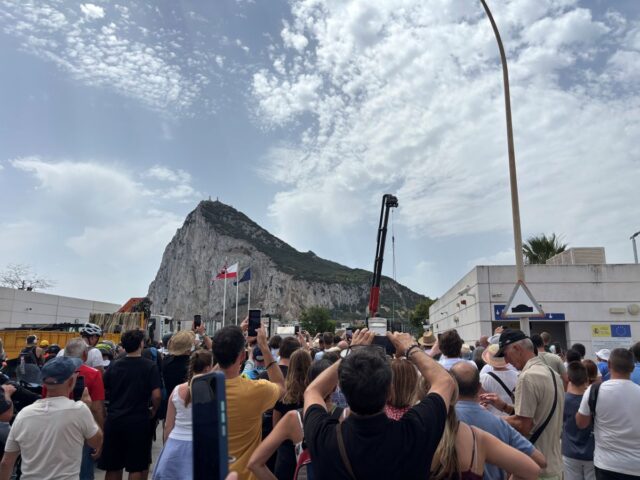
People recording the historical moment with their mobiles.


