


CM addresses Parliament on political agreement for UK/EU treaty


Chief Minister Fabian Picardo commended the political agreement for a treaty on Gibraltar’s post-Brexit relationship with the EU to the Gibraltar Parliament on Monday afternoon, insisting the treaty would ensure the stability and growth of the local economy.
During the first parliamentary session since the political agreement on June 11, Mr Picardo gave details to MPs on agreed areas such as border fluidity, transaction tax and air travel, and highlighted that no red lines on sovereignty, jurisdiction and control had been crossed.
Much of the Chief Minister’s statement reflected information already provided in multiple media interviews since June 11.
Throughout, Mr Picardo was keen to impress the significance of the political agreement, even if the legal text of the treaty has yet to be finalised.
“Ever since we conducted our first heat maps, back in the autumn of 2016, on the anticipated effects of Brexit to Gibraltar, it became clear to us that achieving fluidity at Gibraltar’s land border with Spain was vital to our economic wellbeing and to our way of life,” he said.
“It was what people wanted. It was what businesses were asking us to achieve. It was what this negation had to be all about.”
“This has, therefore, been the overriding political priority of my Government since then.”
“Only the worst moments of the Covid pandemic have displaced achieving that agreement as the top political priority of my Government since the autumn of 2016.”
“The treaty therefore focuses on the two EU laws that deliver border fluidity: The circulation of persons and the circulation of goods.”
In a 30-minute exchange, Mr Picardo and the Leader of the Opposition, Keith Azopardi, set out their positions the treaty, with the latter cautiously welcoming the agreement.
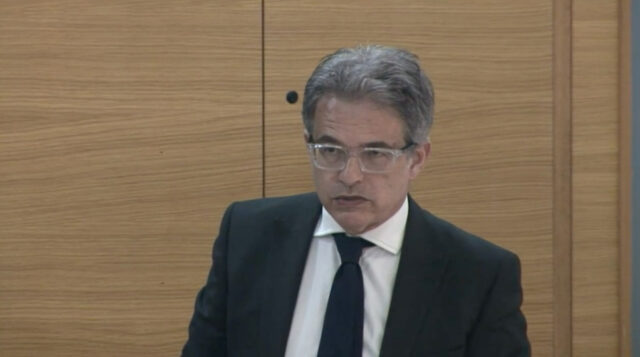
Mr Azopardi said that his party will suspend its judgement on whether it is safe and beneficial until the treaty text is published, while also seeking clarity on timescales of when a treaty is expected to be finalised and ratified, and when it is expected to be debated in Parliament.
He urged Mr Picardo to ensure the Opposition had sufficient time to study the treaty text before it was debated in Parliament and reminded the Chief Minister that at this stage, all that had been agreed was a political agreement.
“Until the fat lady sings and the treaty text is signed, sealed and delivered, there is no treaty,” Mr Azopardi said.
Mr Picardo said he would not be surprised if Mr Azopardi voted against the motion for the treaty once it was available.
“They don't vote in favor of the budget, Madam speaker, so I can't see them voting in favor of the motion for the treaty. They will find the fifth leg of the cat in a comma, in a full stop,” Mr Picardo said.
“There will not be a devil [in the detail] because the Cabinet will not approve a treaty text with the devil in it.”
“But they will find the devil where there isn't one and they will vote against it.”
Mr Picardo said there will be a full debate in Parliament on the treaty, during which all MPs will have an opportunity to speak.
It is expected the treaty text will run to hundreds of pages, with annexes amounting to thousands of pages.
Anyone reading the text, Mr Picardo said, would need a deep understanding of European law to properly understand it.
Once the text is finished in the autumn, the process will involve the cabinet considering the final treaty text which, if approved, will be followed by the Gibraltar Government laying a motion for a resolution seeking that the UK should start the process of ratification.
STABILITY AND GROWTH
In his address to Parliament, Mr Picardo detailed how the treaty will ensure the stability and growth of the local economy through border fluidity and a trade agreement to allow the free flow of goods between Gibraltar and the EU’s Customs Union.
A transaction tax will replace the current import duty regime and Mr Picardo stressed that this is not VAT.
“A formula has been agreed whereby Gibraltar will not apply a rate of transaction tax that is lower than the rate of VAT applied by any EU Member State,” he said.
“That currently stands at 17% in Luxembourg.”
“We will not move to that rate immediately, but an escalator will be agreed to get us there after a number of years.”
The agreement will include a mechanism whereby a panel of experts will annually assess the effect of the progressive rates being implemented.
Some goods will benefit from a reduced rate of 5% or no transaction tax (TT) at all.
Children’s clothing can be rated at 5% TT, foodstuffs at 0% TT, pharmaceuticals at 0% TT and medical equipment at 0% TT, Parliament heard.
Special customs procedures will also exist, whereby goods brought into Gibraltar but not sold in Gibraltar will benefit from certain exemptions including the non-payment of the transaction tax.
“This will cover bunkering, motor vehicles and ship supplies, thereby protecting these important sectors of our economy.
Traders purchasing goods in Spain or elsewhere in the EU will be able to do so VAT-free.
They will then have to pay the relevant transaction tax when they import those goods for sale in Gibraltar.
“But there will not be double taxation.”
A VAT refund will not be possible on goods purchased in Spain or the EU.
Mr Picardo told Parliamentarians that he could not emphasise strongly enough the spirit of “conviviality, friendship and sheer joy” shared by all four delegations in Brussels when they came to a political agreement.
“It has been tough, but we got there,” he said.
There have been 19 rounds of formal negotiations, numerous technical meetings and, more recently, “sherpa” meetings and meetings at ministerial level with the teams from the European Commission and the Spanish Government.
Mr Picardo said that for seven days negotiators were in permanent meetings, in person and on video conferences.
He described how “little Gibraltar faced the Goliath that is the EU”, and this was not with a slingshot but with reasoned argument and Attorney General Michael Llamas, an expert on EU law.
Mr Picardo said the treaty is bespoke to Gibraltar’s needs, and that it has never been a desire or option to join the UK’s own treaty with the EU, the Trade and Cooperation Agreement (TCA).
He said the TCA offers the opposite of what Gibraltar wants and needs after Brexit, whoile the bespoke treaty negotiated over the past four years would establish fluidity at the border vital to Gibraltar’s wellbeing and way of life.
IMMIGRATION ISSUES
The treaty will establish a common travel area between Gibraltar and the Schengen area, which Mr Picardo said was the overriding objective of negotiations.
“Gone will be the days of an aggressive Spanish Government or a rogue Spanish police officer being able to strangle our economy by being tougher on passport checks, especially in application of the Schengen Border Code,” he said.
Cumulative Gibraltar and Schengen immigration checks will be performed and all persons arriving in Gibraltar from a non-Schengen country will be subject to the dual immigration controls.
Gibraltar’s immigration officers will carry out the first checks and “only Gibraltar will be able to determine who comes into Gibraltar,” Mr Picardo said.
Subsequent Schengen checks will be principally by automated border control systems and physical checks will be limited, Mr Picardo added.
Additionally, Schengen IT systems will be configured to recognise Gibraltar red ID cards for travel into the Schengen area from other non-EU countries, and no visas will be required.
“Our power to grant red ID card is unaffected by the treaty,” Mr Picardo said.
“The treaty will also make it clear that we will remain responsible for issuing and renewing Gibraltar residence permits.”
“Since the effect of this part of the treaty is to grant residence permit holders access to the entire Schengen area, it is necessary and logical for the provisions on residence permits to be based on those which apply between Schengen States.”
“All Schengen states are, logically, also themselves required to consult one another when they propose to issue residence permits in their respective countries and, in the same way, the treaty will require us to carry out a further consultation with the Schengen states before we issue or renew residence permits.”
The purpose of the consultation on residence permits will be to check whether the applicant poses a threat to any of the Schengen states.
“That is exactly the same reason as to why Schengen states are required to consult each other before they issue or renew residence permits,” Mr Picardo said.
“The threshold is very high and in keeping with that which would, in effect, prevent a citizen of one member state from establishing themselves in another member state.”
“Quite frankly, we would not want a person who fails to pass such a high threshold test to be residing in Gibraltar.”
Mr Picardo also said that Gibraltar will not become less safe by the removal of immigration checks at the frontier, and that there will be a new police substation in the area of the airport.
He stressed that neither the treaty nor any action taken in application of the treaty will prejudice sovereignty and jurisdiction.
“Not one grain of our land. Not one drop of our water. Not one breath of our air.”
“That was the negotiating objective and it has been met.”
Further treaty provisions will include environmental protection, climate change, labour and social standards, frontier workers and transport.
The airport will be open to EU flights, which Mr Picardo called a “truly remarkable” achievement negotiated in a way which does not cross any red lines on sovereignty, jurisdiction or control.
“We trust that this will put to rest an issue which has plagued Gibraltar’s political history ever since Spain first opposed Gibraltar’s participation in the EU single sky package of measures close to 40 years ago in 1987,” he said.
The Chief Minister added that an email address to receive the queries of citizens on the agreement had received almost 1,000 emails, adding the Chief Secretary is working to marshal responses to all queries and publish an FAQ based on the most frequently asked questions coming into that address.


