


Environmental roadmap sets out key priorities for next 25 years
Photos by Johnny Bugeja


Gibraltar's 25-year environmental plan, developed with input from various agencies and NGOs, was launched at No.6 Convent Place on Monday afternoon.
The plan, based on 17 UN Sustainable Development Goals, is divided into six key themes: governance, healthy and sustainable cities, combating climate change, reducing pollution and waste, developing the green economy, and healthy ecosystems.
Dr John Cortes, Minister for the Environment, unveiled the landmark plan alongside the Department of Environment’s CEO, Stephen Warr.
“It's a long-term plan, a plan that looks at our existing environmental policy, the myriad of documents that have been produced to date, the Gibraltar's Climate Change Strategy, the Gibraltar Nature Reserve Management Plan, our Active Travel Strategy, and it consolidates all those plans into one document that we can use moving forward,” Mr Warr said.
He stressed the plan’s basis in international standards and its commitment to including core environmental principles that are enshrined in a number of EU treaties, such as the polluter pays, the proximity principle and the principle of no regression.
“These are all principles that we need to ensure we include in all our legislation and policies moving forward, and that's exactly what the plan does,” he said.
Key initiatives include net biodiversity gain, net zero energy buildings, renewable energy, and sustainable diets.
There is also a strong focus on environmental education.
“Educating the next generation is the only way that we're going to achieve the targets included in this plan,” he said.
Dr Cortes said he anticipates criticism and welcomes the public challenge.
He said he makes no apology for putting down what has to be done, because this is the way to progress and to move forward, adding that there is more work to be done.
“Gibraltar needs to be aware how lucky we are to have such a committed team of environmental scientists working in the Department of the Environment,” he said.
“It’s a pleasure to work with them and to contribute in my own small way... They really do work so hard, and this is a really important document.”
The 25-Year Environmental Plan launch was attended by members from the environmental team, and the plan itself was described as a “long time in the making” and represents a comprehensive “dynamic” strategy for Gibraltar’s environmental sustainability.
In introducing the plan, Mr Warr promised major updates every five years, but also potentially more if technology or other elements should warrant it.
Mr Warr said that there will be annual reports which will be made public on key performance indicators and strong community engagement through environmental education and green job development.
He explained that the plan is designed to be dynamic.
“It is an ambitious plan, but it certainly sets the mood and the strategy of what we think Gibraltar's environment should be like in 25 years’ time,” he said.
“During that time, no doubt things will happen. There will be a lot of technological advances, certainly in the fields of energy, transport.”
“So the plan needs to be a dynamic plan, and it will undoubtedly have to be updated.”
“We've committed to updating the plan every five years, but if we see that there are improvements in any particular field, then clearly the plan will have to incorporate that to a large extent.”
The 25-Year Environmental Plan is structured around six key themes.
Environmental Governance focuses on upholding core environmental principles, enacting effective policy, and ensuring broad inclusion, transparency, and accountability. Strong emphasis is placed on environmental education.
Healthy and Sustainable Cities advocates for city planning that supports public health, biodiversity, and energy efficiency including net biodiversity gain in new development and aiming for net zero energy buildings.
Combating Climate Change covers renewable energy, better energy efficiency, carbon literacy, and sustainable lifestyles, aiming to make Gibraltar resilient to climate impacts.
Reducing Pollution and Waste seeks to improve air quality, reduce waste and pollution, and align with or exceed international standards.
Developing the Green Economy supports the creation of green jobs, promotes sustainable finance, and encourages investment in clean technology and infrastructure.
The Healthy Ecosystems theme aims to protect natural capital and biodiversity, restore ecological systems, foster connections between people and nature, and even integrate eco-therapy approaches.
The UK Minister for Nature, Mary Creagh, was given an advanced copy of the plan by Dr Cortes during his recent visit to London.
Impressed by it, she recorded a video to express her thoughts.
She called it a “clear, ambitious goals for a greener and bluer Gibraltar” and noted that, “Gibraltar’s plan shapes a fairer future for people and wildlife by embedding the UN Sustainable Development Goals at its core.”
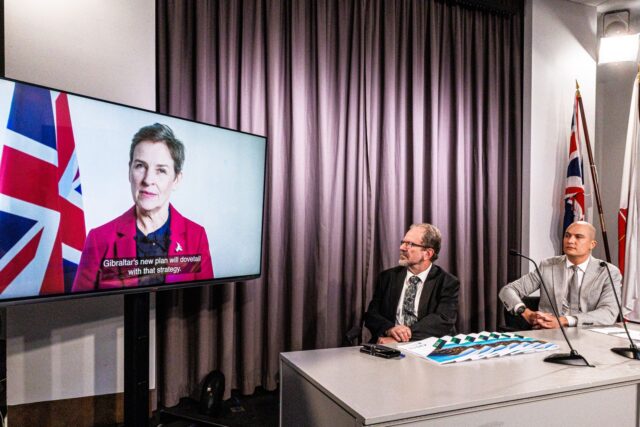
During her video, she underlined the importance of the environment for local well-being.
“Nature is the monopoly provider of everything we need to live. Gibraltar is blessed with an environment that underpins the health, prosperity and culture of its people, and it is, of course, home to the iconic Barbary macaque and a bay teaming with dolphins, groupers and migratory seabirds,” she said.
She also added that the publication of the Plan “is not just a roadmap for Gibraltar, it’s a contribution to the collective UK-wide effort to protect nature for generations to come.”
Dr Cortes told the Chronicle that, politically, he hopes the strategy will continue to receive broad support since it is for the benefit of the entire community.
He added that there is a tradition of bipartisan calls in Parliament for more ambitious environmental action rather than opposition.
On the construction industry, he said that this sector is being engaged with to promote sustainable practices, with officials confident the industry will step up to support a low carbon transition.
“We have a very good relationship with the Sustainable Construction Group that are working in that direction, and we are engaging with developers, contractors and architects in order also to encourage and move in that direction,” he said.
“So I'm quite hopeful that the industry will be very supportive.”
Regarding single-use plastics, the Government plans to strengthen enforcement of existing legislation, which Dr Cortes said is regarded as among the world’s best.
“I think people seem to forget that these laws are there, so we want to enhance enforcement,” he said.
“In fact, our single-use plastic legislation is pretty good, and it's as good as any anywhere else in the world.”
“But I think we need awareness perhaps more than enforcement, because some people seem to have forgotten that there are certain restrictions. So we will use this as a platform to engage further on this with the industry and with the public in general.”
Marine protection also featured prominently in the plan, with ongoing efforts to expand designated conservation zones and support biodiversity. New initiatives, including collaboration, are one element of the plan.
“One of the things we're doing is supporting The Nautilus Project on the sea grasses project. So that's one of the areas,” Dr Cortes said.
“We're always very careful whenever there's any, for example, reclamation to make sure that the coastline is suitable for enhancing biodiversity.”
Responding to concerns around air quality in busy areas and at the cruise terminal, the Government is set to implement a suite of measures.
“Cruise ships are a challenge, and we know that, and we are supporting the GEA in doing everything it can to provide cold ironing, so shore power,” he said.
“The question of air quality. The main problem with air quality now is traffic, and we are going to be working hard in promoting electrification of vehicles and promoting public transport and walking.”
“We're shortly going to be announcing additional new buses.”
“We're going to be enhancing our bus routes, and we're also working with tour operators in renewing their fleet in order to reduce pollution from them, as well as launching a renewed initiative this coming year for petrol stations to provide electric charging points, as well as providing some in different parts of Gibraltar.”
“I think that's all part of the of the mix that's going to show some real effects.”
He noted that HVO biofuel is already in use for public transport and expressed optimism about broader adoption.
“We are encouraging the industry to introduce it more generally,” Dr Cortes said.
“The fact that the Government is now purchasing it gives them the incentive and gives them the basis that they need in order to extend it further.”
A potential future ban on two-stroke motorbikes is under consideration, with authorities acknowledging the need for a careful, phased transition.
“This is something that that I personally think we need to look at. We need to give people time. We need to allow them to transition,” he said.
“One of the things we're doing, and we're having a press call next week about it, is increasing the regulation and the safety of e-scooters, and some people may then decide to use scooters which are electric, rather than those bikes.”
“But we've got to allow people time to convert and to change the way they travel. So that is something I would like to do, but we've got to do it sensibly and sensitively”


