


Filmmaker hopes ‘dog film about people’ will inspire adoption and change


A 1,500-mile journey to collect a sick rescue dog from Los Barrios led British photographer and filmmaker Paul Murphy to begin work on Perros, a feature-length documentary about abandoned animals and the volunteers who care for them.
Mr Murphy had travelled from the UK to collect Ryan, a dog suffering from Leishmaniasis and unable to make the journey through the usual transport arrangements.
Mr Murphy and his partner, Helen, had recently adopted another dog, Goku, from the the same shelter when they saw Ryan sitting beside him in a photograph accompanying an urgent appeal.
“I talked it over with Helen and we both agreed I should drive the 1,500 miles to Los Barrios to collect Ryan,” he told the Chronicle.
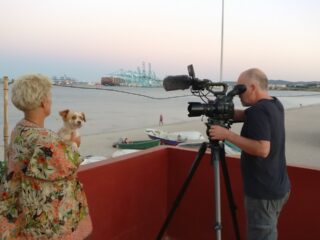
“At this point, I had no idea I was going to make a film but, by chance, I took a camera and some sound equipment. My friend Chris jumped on board, and we both set off to Southampton to catch the overnight ferry to Santander.”
“The next morning, we made the long journey south to Los Barrios.”
When they arrived, they went to see Ryan at his fosterer’s home and recalled: “He was so beautiful”.
They spent some time together and got to know each other a little.
It was then suggested that Mr Murphy go to the pound at Los Barrios to have a look.
“I had never been to a pound before. Driving up to the gate, I could hear the dogs, lots of dogs, all barking in excitement at a new person arriving,” he said.
“When I got out of my car and walked up to the gate, it took my breath away.”
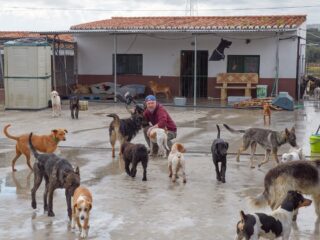
“At the gate were around fifteen or twenty little faces looking up at me, all trying to get my attention.”
“Then I looked behind them and into a yard that had lots of dogs ambling around, eating, sleeping and playing.”
“There were so many.”
“At that very moment, I turned to Chris and said, ‘We need to film this. We need to tell the world that this place exists, with so many animals’.”
He began filming without a defined plan and soon met the volunteers who would become central figures in the documentary.
Among them were Edu, who he said “was so lovely, but I could tell that she was having to work hard to stay on top of what was happening in the pound. She seemed so under pressure,” and Richard, a Peruvian volunteer, “the Pied Piper with the dogs. Wherever he went, hundreds of dogs would follow, all of them with their tails wagging.”
“As I watched Richard and Edu work and watched all of the little dogs blending together, because there were so many of them, I decided something had to be done,” Mr Murphy said.
“So with no money, borrowed equipment, no knowledge or experience of how to make a film, no crew and just me, I decided that I was going to make a feature film to tell their story.”
“Little did I know that it would take me quite a few years to finish Perros.”
Mr Murphy visited Los Barrios four times and continued filming in the UK, with the Covid pandemic adding further delays.
He also had to teach himself how to edit the footage, work with colour and sound, write the script and translate the finished film into seven languages.
The editing process alone took around 15 months.
“It was quite overwhelming at times, as there was only me. Helen was my audience. I would cut something, then watch her reaction,” he said.
Mr Murphy said the title Perros (Dogs) was chosen for its simplicity after he considered a long list of alternatives.
“The list of titles I had for the film was very long. I nearly settled on A Kingdom of Dogs, but something kept bringing me back to the simplicity and straightforwardness of Perros. It has a sort of romantic and slightly ambiguous sound to it when spoken by an English speaker,” he said.
“In fact, most people do not know what it means, but I like that, as it makes people think, and when they find out, it tends to stick in their mind.”
“To get around the possibility of someone not knowing what the movie was about, I put a large portrait of a dog on the poster. From the start, I knew I did not want to show a dog in the pound, behind wire, or a sad looking dog.”
“I felt the hopeful tone of the film needed an image that portrayed that. So, having seen the work of the British painter Sally Muir, I knew her painting of a Spanish dog was perfect. Clear enough to get across that it’s a film about dogs, but soft enough to not put off people who are sometimes unsure of watching a film with animals.”
He described the film as being loosely based on the life of an imaginary dog, told through the experiences of several animals.
It follows the possible course of a dog’s life from birth and abandonment to rescue, time in the shelter and, ultimately, the journey to a new home.
But as filming progressed, Mr Murphy said the stories of the volunteers became equally important.
“The more I chatted with them, the more I realised that they were the driving force for keeping these poor animals healthy and out of danger,” he said.
“So, I wanted to give the volunteers equal footing to the dogs, hence the tagline, A dog film about people.”
With no budget for an interpreter, Mr Murphy used an app on his phone to ask questions in Spanish.
He often did not know what contributors had said until he returned to London and translated the footage.
“Some of it just blew me away,” he said.
“It was so poetic.”
“That’s when I decided not to have narration and to let them tell their own story, in their own words.”
Mr Murphy said he wanted audiences to understand the scale of animal abandonment and the existence of municipal pounds filled beyond capacity.
During filming, he also met farmers, hunters and families surrendering animals.
He said many were not bad people but viewed dogs through attitudes rooted in long-standing cultural practices, including not neutering animals or keeping them tied up.
“To understand this cultural acceptance, you could look at the UK and how we race greyhounds around tracks, sometimes to their deaths, and most of the UK population never give it a second thought because it’s part of our ‘historic’ culture to do that,” he said.
The documentary does not avoid the conditions faced by abandoned dogs, but Mr Murphy said he was conscious that making the film overwhelmingly distressing could deter audiences.
“This was constantly on my mind, that a film that’s distressing is not a film that a lot of people want to see, but it’s impossible to be true to the story of Los Barrios and not show some of the reality,” he said.
“So, I structured the film loosely around a three-act structure.”
“For the first third of the film, I need to show you the truth, because that’s what’s happening. Then I slowly move away from that, and the film becomes much more hopeful and uplifting, with the odd emotional punch seeded through the last hour.”
Among the animals that remained in his mind after he left the pound was a black cocker spaniel whose arrival was the first admission to the pound he witnessed.
He later learnt that the dog had been rehomed within days.
He also remembered a small white dog that repeatedly followed him around as he filmed.
“I would pick it up, and it was so happy, and I was starting to formulate a plan to bring it home,” he said.
“Then, with filming and everything else that was going on, it went from my head, and for years later I kicked myself for not following through with it.”
“I never found out what happened to it.”
“I like to think it’s somewhere nice, getting walked every day.”
Mr Murphy said volunteers and donations are essential to the operation of the Los Barrios pound.
He understood that volunteers had taken over its day-to-day running and worked to prevent animals from being put down when they were not claimed.
“Some pounds in Spain had a 10-day rule that if the dog was not claimed in that time, it was put to sleep. Edu and the volunteers did their best to stop that from happening, so you could say that the volunteers being there was essentially saving the dogs’ lives, as most of them do not get claimed,” he said.
“All of the expenditure at the pound comes from donations, both locally and abroad.”
“Without those donations, they probably could not exist, and the conditions would be terrible for the animals.”
The response from early viewers had been overwhelmingly positive, he said, with some describing the documentary as both informative and uplifting.
“Someone told me that they felt that my film was an important film because not only does it highlight the problem, but it also educates, and this was exactly the response I was hoping for,” he said.
“Others have said that they started watching the film a little nervous because they might see some bad things, but were then surprised that when they finished, they actually felt quite uplifted.”
“That positive feeling, I believe, is as much to do with the strength of the characters, Edu, Richard, Harriet and so on, and their ability to look after those dogs every single day, as it is to do with my filmmaking.”
“It would not be the same film if it had not been for the poetic honesty of all of the characters.”
While it is too early in the day to know if anyone goes online after watching the movie and chooses a dog, he hopes they do.
“If just one dog gets adopted because of the film, then the film for me is a success,” he said.
At present he is working with the UK-based charity Spanish Stray Dogs to help raise money to relocate the Los Barrios pound as they need to move urgently, he said the reason why will be obvious in the movie. Many in the locality know that the shelter often floods in bad weather and the animals are affected as a result.
Land has been purchased and planning permission obtained, and part of the fee charged to watch the film will go towards building the new facilities.
A smaller share will support Mr Murphy’s next animal documentary, which he suggested could be Perros 2.
He also hopes the film can be screened in Gibraltar, as well as in Los Barrios and potentially Madrid.
Mr Murphy said a screening in Spain could encourage people to reconsider attitudes towards dogs and recognise that animals were not tools to be discarded.
“I thought about the idea of showing it in Los Barrios and having people come and bring their dads and grandads, with a view that maybe it will show them that dogs are not in fact tools to be discarded, that they are beings that feel pain and sadness to be put in the position they are in,” he said.
“There was also a thought to try to show the film in Madrid in front of the Spanish politicians, again to show what people are having to do down in Andalucia.”
But his central hope is that viewers will agree with what he is trying to say in the film and “tell their friends and their families, tell the world, shout it from the rooftops, tell everyone that something bad is happening in Spain and it needs to stop, and the only way to stop it is to change the culture,” he said.
“I want them to tell their friends and extended family that it’s actually not ok to abuse a dog and keep it in such bad conditions.”
But, “above all I hope that whoever watches the film might be inspired to consider adopting a dog because, in doing so, they will change the dog's life and the dog will certainly change theirs, for the better.”
Perros is only available to watch at perrosthemovie
Donations to the dog shelter can be made at SOSCanya.
Most Read
Local man arrested on suspicion of assisting illegal immigration after port incursion incident
Fri 4th Sep, 2026
Cross-party UK delegation to visit Gibraltar for first National Day since treaty took effect
Mon 7th Sep, 2026
Potential for new flights prompts Gib to discuss airport parking with La Linea
Mon 24th Aug, 2026

Today's Paper
20th July 2026
Read our latest newspaper by downloading our app from the link below.


