


Gibraltar Astronomical Society working to prepare for eclipse crowds


A total solar eclipse will occur over Gibraltar in the morning of Monday, August 2, 2027, with a partial eclipse (92%) occurring on the evening of Wednesday, August 12, this year.
A solar eclipse occurs when the Moon passes between Earth and the Sun, and either totally or partially blocks the Sun for all life on Earth.
A total solar eclipse occurs when the Moon's apparent diameter is larger than the Sun's, blocking all direct sunlight, effectively plunging day into complete and utter darkness.
Planning is underway on the Rock for these two major solar eclipses which are predicted to draw thousands of visitors, the reason being that, between 2001 and 2100, there will be only 67 total eclipses around the world, and there will be 77 partials.
The 2027 eclipse will be visible across the Iberian Peninsula, with totality in the north, while Gibraltar is set to be one of the few places in Europe to experience more than four minutes of totality.
Environment and Transport Minister Dr John Cortes chaired an initial coordinating meeting with stakeholders including the Gibraltar Astronomical Society, the RGP, transport officials, and public health.
During this meeting, key topics included viewing locations, traffic planning, and strong public health messaging on safe eye protection were discussed, with further consultations planned as the dates approach.
Talking to the Chronicle, William Recagno from the Gibraltar Astronomical Society summed up the events in five words.
“It’s going to be massive.”
Over 20 years ago there was a partial eclipse, at 70%, viewable from the Rock, and it caused chaos with the number of people making their way to Windmill Hill to view it.
Those who could not see it still felt it, the darkness that envelopes the Rock accompanied by a drop in temperature.
On August 12, this year, Mr Recagno said the event will begin at “quarter to eight and... it will end at 9.15” in the evening.
He and his colleagues at the society are in the midst of making plans to organise a place where people can gather to witness it. It will serve as a dry run for 2027, which will be bigger.
The 2027 eclipse starts at 9.41am and ends at 12.01 with the start of the totality commencing at 10.45am.
It won’t be a spectacle enjoyed in isolation.
If the skies are clear, thousands could converge on the Rock. Getting people to where they need to be and avoiding them using their cars is also forming part of the planning. As is having the street lights, which turn on automatically when dark, not do so.
Mr Recagno said he is aware that a number of the hotels on the Rock are already booked and that is just one aspect of how the event will be a tourist attraction.
However, no matter how spectacular or rare the event is, safety for eclipse viewers is paramount. They are going to be speaking to schools on how they can watch it safely.
He also warns that “not all eclipse glasses are created equal,” and that they need to have a certain level of verified ISO.
ISO 12312-2:2015 is the international standard, which ensures the glasses meet safety requirements for filtering harmful UV, infrared, and intense visible light.
Sunglasses are not enough, he also warned.
A website created for the 2027 event, https://gibraltar-eclipse.com, notes that, after the eclipse starts, people are to view the Sun during the partial eclipse phases before and after totality through eclipse glasses or a handheld solar viewer.
You can view the eclipse directly without proper eye protection only when the Moon completely obscures the Sun’s bright face, during the brief and spectacular period known as totality.
You’ll know it’s safe when you can no longer see any part of the Sun through eclipse glasses or a solar viewer, the website notes.
It also warns that, as soon as you see even a little bit of the bright Sun reappear after totality, immediately protect your eyes again.
“The Gibraltar total solar eclipse of 2 August 2027 will be a mesmerising event, but be aware: You must NEVER observe the Sun without proper protection. Get a pair of safe solar eclipse glasses to ensure you and your family remain safe when observing the solar eclipse,” noted the website.
“Do NOT use eclipse glasses or handheld viewers with cameras, binoculars, or telescopes. Those require different types of solar filters.”
“When viewing a partial or annular eclipse through cameras, binoculars, or telescopes equipped with proper solar filters, you do not need to wear eclipse glasses.”
“Seek expert advice from an astronomer before using a solar filter with a camera, telescope, binoculars, or any other optical device.”
“Note that solar filters must be attached to the front of any telescope, binoculars, camera lens, or other optics.”
As the Rock prepares for the two events, Mr Recagno and the society will be working with stakeholders and partners to ensure every angle is considered and accounted for, with the events expected to “huge. I mean, huge. This is not National Day.”
Finally in a message to people on the Rock in a bid to encourage them to go see the eclipse he said, “it’s something you have to experience, you can’t explain it.”
Paul Maley reflects on decades of eclipse chasing ahead of 2027 expedition
Paul Maley, Science Expedition Coordinator for the NASA Johnson Space Center Astronomical Society, is a dedicated solar-eclipse observer who has documented, a total of 87 to date, the eclipses he has attempted to view including partial eclipses as well as total and annular events.
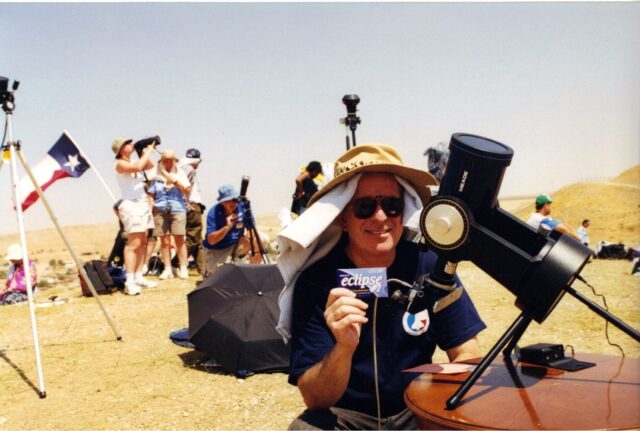
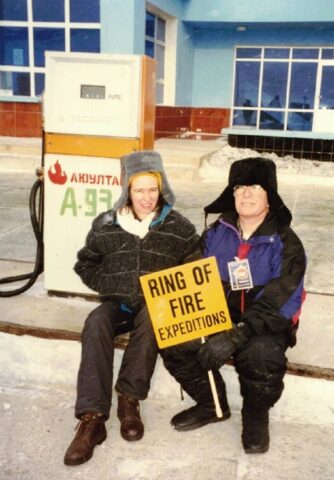
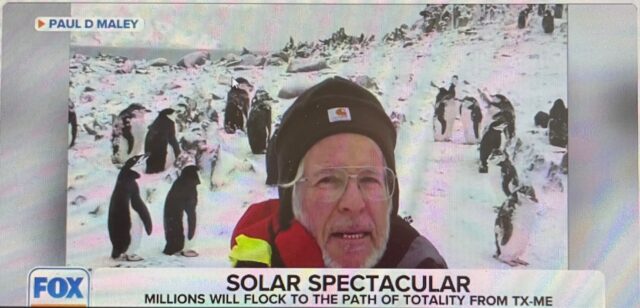
Antarctica solar eclipse 2023
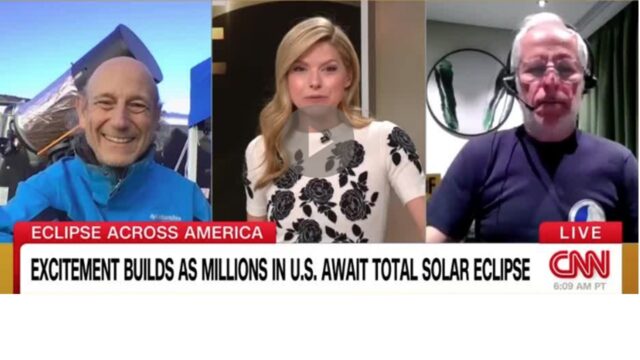
He has also organised a number of events and for, the 2027 eclipse, he has arranged for two ships, one leaving Barcelona and another Rome, with over 1000 on board to be in the area.
“In 2027 we do not plan to conduct any science except perhaps to determine effects on shortwave radio propagation,” he said.
“In past years, we have collected data on the appearance of Baily's Beads during totality by going to the edges of the eclipse path to determine changes in the diameter of the Sun for eclipse to eclipse.”
“However since the last time (2010) we have determined that satellite data is proving more reliable.”
The logistical challenges of managing nearly 1,000 people at sea for such an event will include having to “appear on both ships which means transfer at sea on small boats”, as well as “being sure that both ships head toward the same spot in the Mediterranean Sea and, most importantly, that both ships are able to manoeuvre to avoid cloud.”
Ignoring any cloud issues from an astronomer’s perspective, he explained his opinion on Gibraltar as a location for viewing the eclipse.
“Gibraltar [airport] will see 4 minutes 25 seconds of total eclipse. If one was to travel southwest to Tarifa you would gain 13 seconds [4 minutes 38 seconds]; if one travelled to Egypt it would jump to 6 minutes 25 seconds,” he said.
“So, that is why relatively few serious eclipse observers will choose Gibraltar because eclipse travel means seeing the most totality that you can.”
After witnessing so many eclipses, he forecasts that those who have never seen a total eclipse will likely be completely shocked and amazed by the sight and warns it is potentially a once-in-a-lifetime experience.
“The real benefit is for those people and children that are supervised by adults so that they don't fail to observe it safely,” he said.
“I hope people feel emboldened to go to another eclipse and will appreciate how rare it is to witness one without spending a lot of money to travel to a remote destination.”
“Note the next time a total eclipse crosses Gibraltar will be in 2053; the last time was in 1870. So this shows that you cannot stay at home and wait to see a total solar eclipse.”
So far, Mr Maley has organised 54 eclipse expeditions. Some of these stand out more than others.
“1995 in Peru and 1999 in Turkey when in both cases we had to worry about being in areas where there had been terrorist activities in each country,” he told the Chronicle from his home in Arizona, USA.
“We hired guards and luckily had no problems.”
“However, in my scouting trip in 1998 to Diyarbakir, Turkey, I was met at the airport by 18 security personnel and an armoured car.”
“Both eclipses were quite successful in spite of this.”
“In 2003, we had an expedition to Zambia and a fire started not far from our site; however, all of our team were able to see and photograph the eclipse.”
His first eclipse experience was in Georgia, USA, in 1970 where it rained uncontrollably.
“No way to get around that. This was before long range weather forecasts became more reliable,” he noted.
Having witnessed so many total eclipses, he prepares himself for disappointment and he assumes the weather will be cloudy every time.
“That is why I put everything into finding the best possible place to see it without cloud,” he said.
“I get emotional to see first-time observer reactions immediately after the eclipse.”
“These vary from absolute joy to some crying and others exclaiming 'it was too short!’”
“In 1983 we had one person hyperventilating during the eclipse such that he had to blow into a paper bag to maintain his ability to watch.”
“After an eclipse, we always get new people joining our tours eager to see the next eclipse. Each one is different from the last and the next.”
He noted that sometimes events like this encourage people to become umbraphiles, people who travel to experience solar eclipses, and form a greater interest in science.
“Depending on the role or activity one has [student, educator, parent] the answer can be 'yes'; but it all depends on the individual person and the level of motivation that they have,” he said.
“Sometimes people become umbraphiles and take up eclipse travel as a hobby.”
And if he had one sentence to persuade someone to travel to see a total eclipse, it would it be.
“This is the closest you can experience to seeing the universe up close and personal.”
Interesting phenomena to look out for during the eclipse
Shadow bands: About a minute before totality, faint, moving wavy bands of light and dark can ripple across the ground and walls. They’re caused by turbulence in Earth’s atmosphere bending the last thin rays of sunlight.
Diamond ring: Roughly 10–15 seconds before and after totality, the bright “jewel” of the Sun shines alongside the newly visible corona. Together they form the dramatic diamond ring effect.
The Sun’s corona: As the diamond ring fades, the corona becomes clearer as a pale halo around the Moon’s silhouette. It’s extremely hot, around 200–300 times hotter than the Sun’s surface, reaching over 1 million °C.
Baily’s beads: About five seconds before totality, tiny beads of light appear along the Moon’s edge. They happen when sunlight streams through lunar valleys and gaps between mountains.
The Sun’s chromosphere: Just after totality, a thin reddish glow can briefly show at the Sun’s edge. This layer is only visible for a few seconds.
Crescent shadows: During the partial phases, small crescent-shaped patches of light can appear on the ground. Anything that can cast a shadow while allowing small amounts of sunlight to peer through can create this effect.


