


Gibraltar entrepreneur develops eco-friendly paddleboards with an eye on sustainability


Local businessman Tom Cawthorn is set to launch eco-friendly paddleboards, motivated by the environmental impact of traditional plastic boards.
For the past two years, he has evolved various prototypes made from agave cores, which are 70% more environmentally friendly than traditional boards.
Mr Cawthorn, founder of In2Adventure, Supability and now Tide and Timber Boards, believes his boards could be one of Europe’s first truly eco-friendly paddle boards and told the Chronicle he started the project after becoming increasingly uncomfortable with the environmental impact of conventional paddle boards.
“Two years ago, I think I realised that we were using these plastic boards that weren’t very good for the environment,” he said.
“It’s good to be on the ocean and the water, but we’re actually making our environment bad by all these plastics and toxins that are going in there.”
“We’re part of the problem.”
He explained how, over the years, inflatable paddle boards flooded the market, especially during Covid, as prices dropped. But so did the quality.
Many boards, he said, were “made very cheaply, the glue would fail, and they burst a lot, and they weren’t made with good quality materials,” leaving him with boards that were broken after one or two years and could not be fixed.
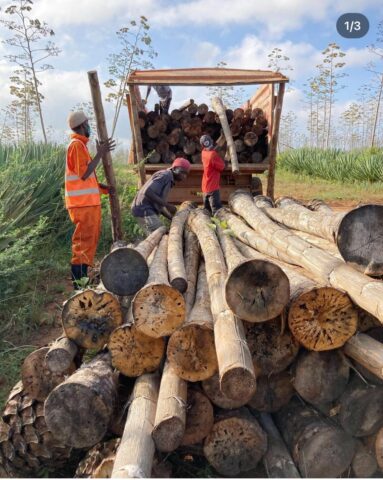
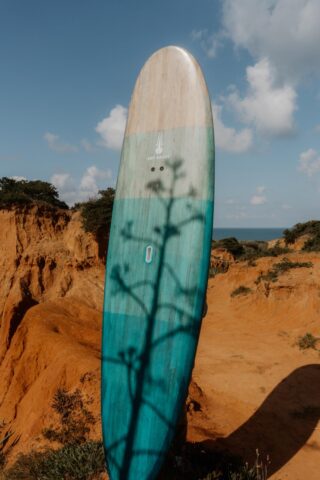
Unable to find a genuinely eco-friendly alternative, Mr Cawthorn began searching for new materials and eventually found a surfboard manufacturer in Kenya using a natural core from the agave plant.
“The core, which is the middle of the board, is from a plant called sisal or agave. It’s just a waste product and very similar to foam,” he said.
Boards are traditionally made of foam with a high environmental cost, from CO₂ emissions in production to microplastics released when the boards are shaped.
Working with the Kenyan company Grow Blanks, Mr Cawthorn went to Kenya and undersaw a project that bundles stems of the agave plant and glues them together to form the centre of the board, before they are shaped into paddle boards using local shapers.
The first prototype, however, was too heavy.
“It’s really good on the water and lovely to look at, but really heavy,” he said.
“That was our first prototype, and we’re thinking ‘this isn’t kind of working, because it’ll be really difficult to lug down the beach or put on the car’.”
As a result, he then partnered with a company in Germany to produce a second prototype, introducing chambers into the agave core to save weight and increase buoyancy.
The design has continued to evolve.
A third prototype has now been produced and Mr Cawthorn expects his first boards for sale and rent to arrive in Gibraltar this month.
Cork sourced from Portugal is be used for areas such as decking, thereby replacing plastic.
Accessories that are typically plastic, such as handles, mounts and other fittings, are being redesigned in walnut and recycled wood to avoid plastics, while the fins will be made from recycled fishing nets which are already available on the market.
Beyond its environmental ambition, Mr Cawthorn is also proud of the fact that the project is having a positive impact in Kenya.
“The great thing about this is also it’s creating jobs in Kenya,” he said.
“It’s a really high unemployment area and [Grow Blanks] is employing lots of people as carpenters to start making these boards. So it’s got a really good journey behind it.”
Once the agave blanks are prepared and dried in Kenya, they are shipped to Europe where finishing work is carried out in Germany, with future plans for this to potentially be carried out in northern Spain too.
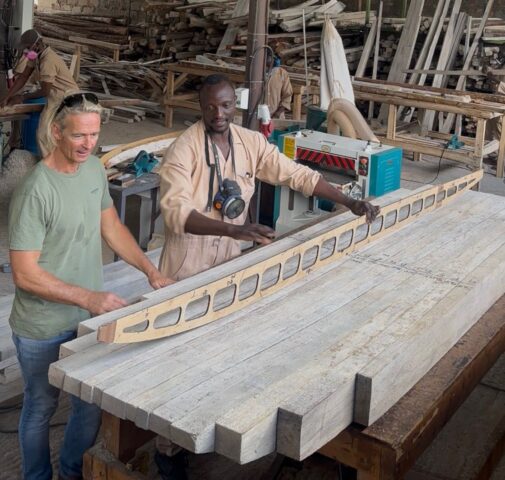
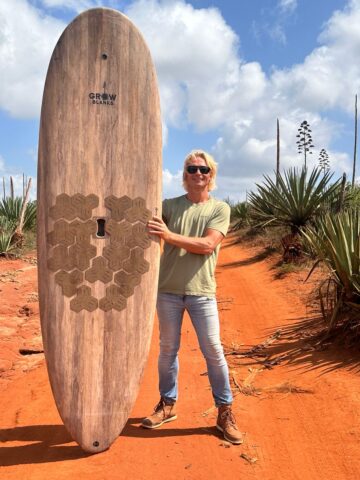
With the cork being supplied from Portugal, Mr Cawthorn described it as a cross-continental supply chain built around sustainability.
He has branded the boards under the name Tide and Timber Boards and says that, unlike many so-called ‘eco’ products, these boards are designed to be environmentally considerate at every stage of their life cycle, particularly as a key design principle was durability and repairability.
“These can be fixed. These boards, if we look after them, and if people fix them… will last for about 10 years or longer,” he said.
The natural fibre core is also biodegradable if a board is ultimately written off.
Mr Cawthorn is aware that a number of people bought non-environmentally friendly inflatable paddle boards simply because of lack of storage on the Rock. He has come up with a way to combat this.
“For Gibraltar, the problem is we don’t have garages, and this is where the hut and the facility [on Sandy Bay beach] comes in. We can offer storage as part of it,” he said.
Mr Cawthorn’s plan is to create a storage rental facility where boards are kept in secure racks with combination locks.
Local customers, including corporate clients, would be able to access their boards before work, at lunchtime or after hours.
“The idea is to provide a facility in Gibraltar for paddle boarding. They can come down here, grab it at lunchtime, do sunrise paddles, but they can manage themselves, and then we can do a course so they’re nice and safe,” he said.
He believes this model will allow companies to buy or share eco-friendly boards for their staff, using them as both a wellbeing initiative and a marketing tool, with corporate logos applied to the deck.
In addition, interest in the boards is already coming from outside Gibraltar.
Mr Cawthorn said eco resorts in Portugal and elsewhere in Europe have approached him, keen to use the boards both as equipment and as a visible sustainability statement for their guests.
Part of his pitch to corporate and hospitality clients is that the boards support ESG (Environmental, Social and Governance) goals by avoiding toxic materials and promoting outdoor, nature-based activities.
“It’s all part of a kind of circular economy that has like-minded people that want to look after the environment,” he said.
His environmental approach to things extends beyond the boards themselves.
He is in discussions with Bassadone Motors about reusing some of their waste materials.
“They have material that we could probably use for board bags. So, old seat covers that they don’t need, we can build board bags. And then, for example, the straps could be the old seat belts,” he said.
Throughout the design journey, he says he has repeatedly returned to the same question: Is there a less harmful alternative?
“I kept asking going through the design process, is there an alternative that’s not bad for the environment? and then changing the board,” he said.
For Mr Cawthorn, the project is more than just a business.
“When you’re paddling, [you feel] the difference of being on something natural that has an authentic story behind it,” he said.
“I know because I’ve been to Kenya, and I’ve seen the job creation, and I’ve seen everything from the start point.”


