


Gibraltar’s military role has sharpened in a more dangerous world
Photos by Johnny Bugeja


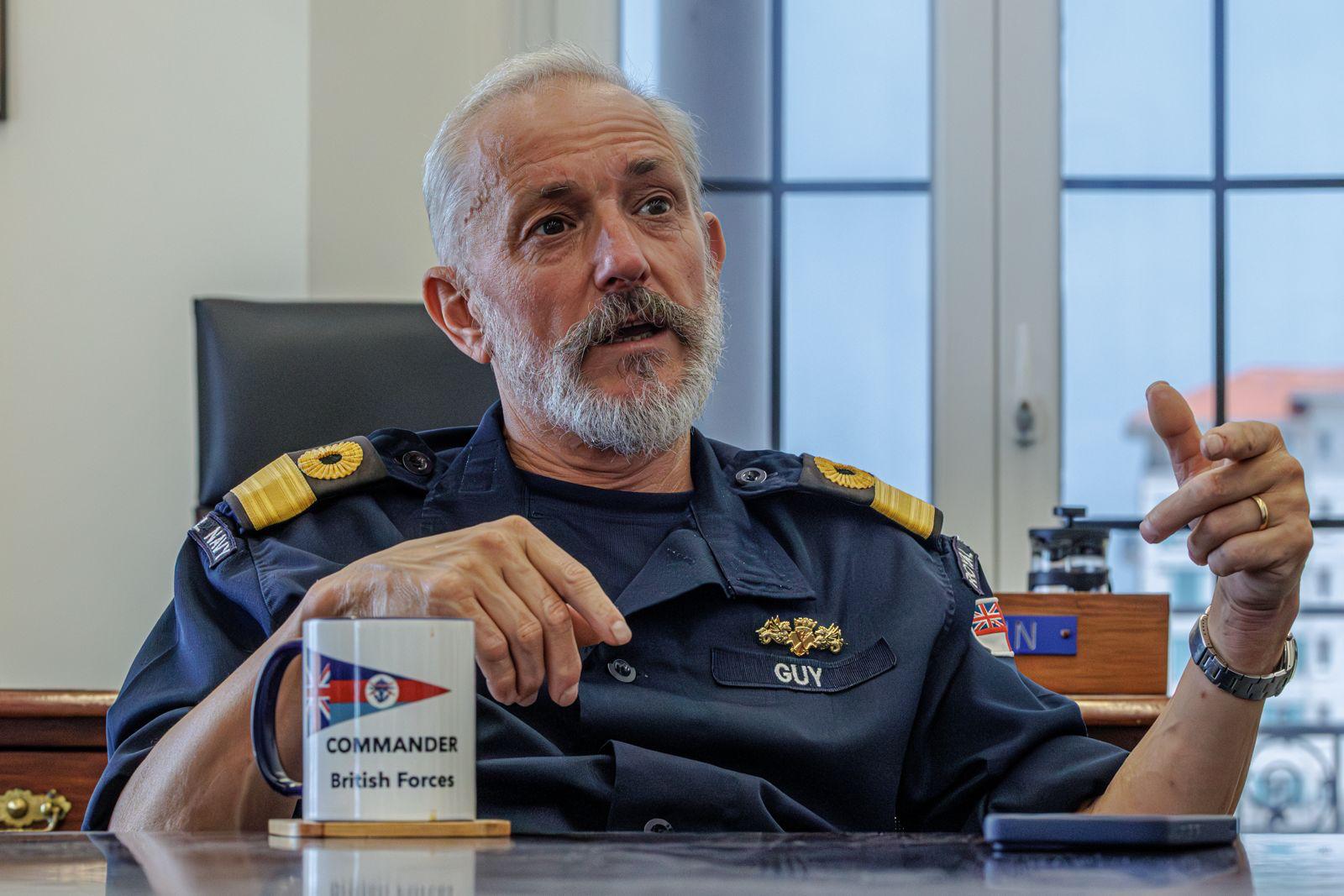
Gibraltar’s military strategic importance has sharpened in recent years as conflict in the Middle East and Ukraine, instability elsewhere and a shifting European landscape have underlined the value of sovereign infrastructure at the gateway to the Mediterranean, Commodore Tom Guy said, as he prepares to leave Gibraltar after four years as Commander British Forces.
Looking back over his four years in post, Commodore Guy said Gibraltar had emerged from what he described as a long period of decline in defence investment following the end of the Cold War, with policy now focused on bolstering the base’s role as a functioning forward platform rather than simply a contingency site.
From being able to “break glass” in times of emergency, Gibraltar has become a “resilient and sustainable” forward mounting base that the Ministry of Defence increasingly leans on in support of operations around the world, particularly in the Middle East,
That shift, Commodore Guy said, had meant work on infrastructure, rebuilding the team on the ground and making fuller use of the base’s capabilities.
“Having made the commitment to do that, well, you absolutely have to squeeze every bit of goodness you can out of the place because you've got to sweat the asset,” he told the Chronicle.
GLOBAL STABILITY
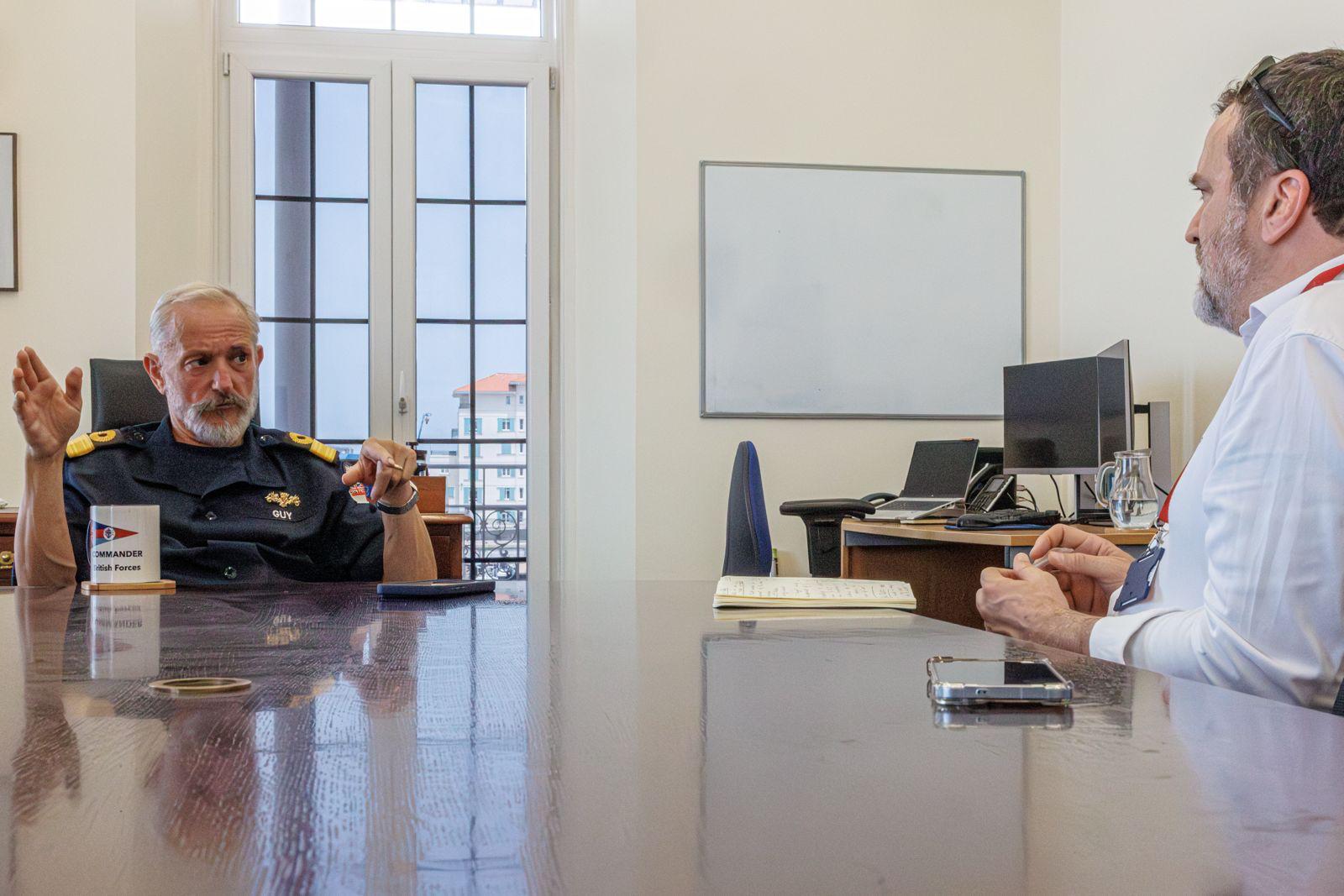
Commodore Guy was speaking to this newspaper ahead of the official handover to his successor, Commodore Tim Davey, on Friday.
He pointed to a growing tempo of military activity in Gibraltar, particularly over the past two years as operations linked to the Middle East intensified.
Commodore Guy pointed to the example of HMS Diamond, which called into Gibraltar for support after operations in the Red Sea during attacks on commercial shipping by the Houthis in Yemen.
From the operational area of the Bab el Mandeb strait at the bottom of the Red Sea, Gibraltar was in practical terms no further away than Bahrain once transit through the Suez Canal was taken into account, while crucially offering sovereign facilities for ammunition, engineering, logistics and personnel movements.
“She could have gone to Bahrain or she could have come here,” Commodore Guy said of HMS Diamond, which was providing protection against missile and drone attacks.
“But if she'd gone to Bahrain, she wouldn't be able to get the weapons or we'd have to fly the weapons out and it would be difficult and complicated.”
“At that point, Gibraltar as a sovereign UK base becomes hugely attractive.”
Commodore Guy said Gibraltar was able to offload spent canisters, receive military flights direct from the UK, provide engineering support through local contractors and allow part of the ship’s company to return home on overdue Christmas leave.
“And then, having done all that, the ship was in fine fettle and off she goes again,” he said.
“You could argue that she could have gone and done that back in the UK, but that's an extra four or five days steaming, so there's an extra 10 days where that strategically-important ship is not on task.”
Commodore Guy added that, because Gibraltar only has a small number of ships based here, visiting vessels are “front of the queue” and get what they need “immediately”, whereas in the UK there can be “a logjam” of competing interests.
“That's not to sort of deride the UK, that's just a fact of life,” he said.
“And I think what that brings home is that Gibraltar has really, really valuable additional capacity, as well as being in a different, more convenient geographical location.”
He drew a similar lesson from the recent adaptation of RFA Lyme Bay in Gibraltar to support new autonomous countermine capabilities destined for the Strait of Hormuz, describing it as another example of how the base could support operational requirements quickly and at scale.
“That was a really exciting opportunity for Gibraltar to contribute to global stability,” he said.
‘SHADOW FLEET’
Commodore Guy also pointed to the contribution of the Royal Navy’s Gibraltar Squadron in helping build intelligence on the Russian ‘shadow fleet’ moving through the Strait of Gibraltar, adding that local capabilities offered a more accurate picture than automated vessel identification systems alone.
“The one thing that you need to be able to deal with the problem is information,” he said.
“And what we have here is a really good view of what's going past.”
He added that there were more “subtle things” too that Gibraltar could help with to assist in building “a more comprehensive picture and better legal premise on which to take action”.
That might include, for example, visual confirmation on whether a ship was laden or unladen.
That type of intelligence has assisted allies such as France to intercept at least two ‘shadow fleet’ tankers carrying Russian oil in recent months.
But asked whether similar cooperation existed locally with Spain, Commodore Guy said it did not, despite both countries being NATO allies.
“Do we work with the Spanish on that? No,” he said.
“Do I think that that's an incredible shame? Absolutely.”
Commodore Guy, who served in a NATO role before his posting to Gibraltar in 2022, said he hoped the UK/EU treaty and a separate bilateral military agreement between the UK and Spain would, over time, provide a framework for more normal cooperation, though he acknowledged the sensitivities.
Spain and the UK cooperate fully elsewhere as NATO allies. A Spanish frigate, for example, integrating into the UK-led carrier strike group last year.
“Absolutely business as usual for NATO allies, and the alliance is stronger for that,” he said.
“It’s just that Spain has this particular blind spot when it comes to Gibraltar, which prevents us from being able to cooperate locally.”
The treaty and the bilateral military understanding, which lays out a framework for cooperation, may in time allow that to change.
“We’ll take it one step at a time,” he added.
Commodore Guy said the treaty outcome had been positive from a military perspective because it protected the key principle of “military autonomy”.
“The big thing was for us to be able to continue to operate to, through and from Gibraltar unhindered,” he said.
“And that was the much-vaunted military red line and that we have achieved.”
He acknowledged there would be procedural changes in the way information was shared where commercial movements were concerned, but said the treaty preserved the core issue of military autonomy.
“One of the critical things was for us to be able to bring our ships and our aeroplanes and our people and our stuff by military means in and out of here as a sovereign nation, as we had done before,” he said.
“Anything else would be a diminishment of our sovereignty.”
INVESTMENT
Commodore Guy said Gibraltar’s future military role would depend not just on geography and political agreements, but also on continued investment.
The UK government is under huge pressure to increase its defence budget, which means Gibraltar must “vociferously and enthusiastically” make its case within wider competing defence interests.
But Commodore Guy said that, to date, “we’ve been pretty good at it”.
He cited progress on communications’ investment, refurbishing the South Mole and dredging, hinting that dredged sediment from the seabed on the military side of the port could potentially provide “an elegant solution” to help reclaim land at the other end of the harbour.
There was a strong operational case for further work to enable larger ships, including aircraft carriers, to berth in Gibraltar, Commodore Guy said, adding: “It’s an absolute no-brainer that this harbour should be dredged so we could put the [aircraft carrier HMS] Queen Elizabeth alongside.”
He said too that work to potentially reactivate King’s Lines, including surveys of pipelines and engineering studies, also remained strategically important because assured fuel storage was central to military resilience.
“Ships are going to be running on liquid fuel of some description for a long time to come,” he said.
“And therefore, having an assured sovereign supply of liquid fuel whatever that is... makes financial sense.”
“It makes huge, huge sense financially, but also from a strategic resilience sense.”
Like other parts of the military establishment, the MoD team here is awaiting the outcome of the Defence Investment Plan to see how much spending will be earmarked for Gibraltar.
Commodore Guy acknowledged that Gibraltar’s military significance inevitably brought visibility and with it questions about risk in a more volatile world.
“It’s obvious that if we're doing very, very visible military activity, that will get noticed by everybody, whether you're talking about the society here or whether you're talking about potential adversaries,” he said.
“And of course that brings with it the challenge of defence.”
“But defence is what we do and what we prepare for.”
“We naturally don’t divulge lots of detail on that, but it's something that focuses a large part of our efforts.”
WAR FOOTING
Last year, the UK government called for an "all-of-society effort" to prepare the country for war.
Asked what a more overt war footing might mean for civilians in Gibraltar, Commodore Guy said the most likely threat was not a dramatic conventional attack but the sort of “grey-zone” pressure already being seen elsewhere, from cyber disruption to unattributable interference with daily life and services.
“I think the biggest threat is what we call the grey zone threat,” he said.
“You'll wake up one morning and you can't do your internet banking and can't do this, that and the other. That's always sort of the underlying worry, I think.”
But he suggested Gibraltar may be better placed than many communities in mainland UK to understand the realities of defence, because of its history and long relationship with the military.
“It feels to me as if the society of Gibraltar is much, much more closely connected to the military and their military history than society as a whole is, certainly in mainland UK,” he said.
He pointed to the collective memory of the Second World War, the evacuation and the Falklands conflict as part of a wider public understanding that military activity carried real purpose and consequences.
“That’s not the same as everybody being ready for war,” he said.
“But again, I think Gibraltar has an advantage because there is such a strong corporate memory.”
That connection with the Gibraltarian community is one reason, he said, why leaving after four years in post would be difficult.
“There’s a reason I’m four years into my two-year assignment here,” he said, with bitter-sweet irony.
Continuity mattered in a place like Gibraltar, he added, both to “get things done” and to build the relationships needed across the military and civilian institutions, and the wider community.
“It takes time to get to know the place, get to know the job,” he said.
Asked what advice he had for his successor, Commodore Guy had one clear message.
“Be ambitious for Gibraltar,” he said.
“There’s no point in self-censorship.”
“It’s got huge potential and if we’re not the ones shouting loudly about it, then nobody is.”
Most Read
Bayside construction site fire brought under control, no injuries reported
Wed 23rd Sep, 2026
As long-stay patients move to Rooke, plans for new services at St Bernard’s Hospital
Mon 21st Sep, 2026
New bus stop signs and solar-powered lighting rolled out across Gibraltar
Mon 21st Sep, 2026

Today's Paper
25th June 2026
Read our latest newspaper by downloading our app from the link below.


