


Julian Felice launches full-length book of Flavius play
Photos by Johnny Bugeja


Gibraltar’s celebrated playwright has extended his play, Flavius, into a full-length version and published it in an 80-page book of the same name. It was launched at the John Mackintosh Hall last week.
In its first incarnation, it was a one-act play performed at the 2013 Drama Festival and centred on the shooting of three suspected IRA terrorists by members of the SAS on Sunday, March 6, 1988 at Landport, quite close to a petrol station and a residential neighbourhood.
The gripping story is told from the point of view of a young Gibraltarian character and it raises uncomfortable and provocative questions about how the British authorities and Thatcher’s government handled the affair.
Flavius, named after the codename given to the operation by British authorities, aims to expose the many contrasting points of view that surround this murky incident, now an almost forgotten dark chapter in our recent history.
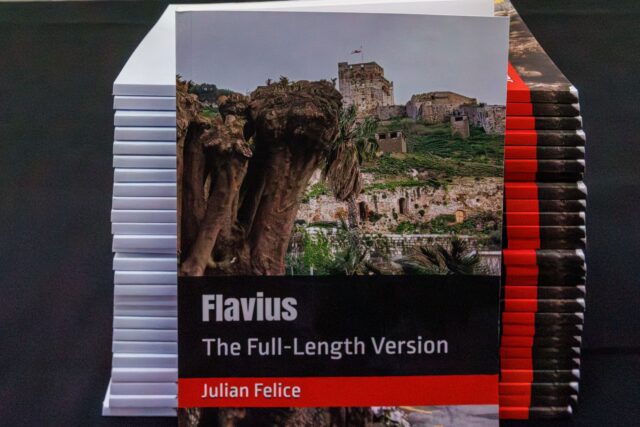
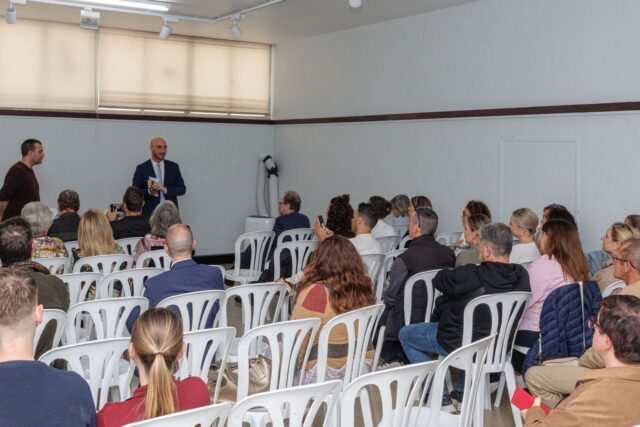
In a short introduction at the launch, Minister for Culture Christian Santos recalled how the shooting impacted him as a young boy whose upcoming 11th birthday party was clouded by fallout from the incident.
“Very few came to my party as everyone pondered at what might have been if the suspected bomb had gone off so near to Bishop Fitzgerald school,” Mr Santos said.
“Memories like these are a great way to tell a dark story and now that Julian has added another 45 minutes to his play, it falls on me to urge people to support him, our writers, and our culture.”
“Make sure you read (Flavius) as this forms part of history and now that Gibraltar is going to go through some big changes, we need to support local art, support local writers and anything that comes out of our beautiful Rock of Gibraltar.”
In his address, Julian Felice thanked the minister for agreeing to write the foreword to the book and also thanked minister Dr John Cortes, who has always supported his plays.
“I’m very touched that you are both here this afternoon as you have always been strong supporters of my work and we have been alongside on stage many times,” Mr Felice said.
“I have always been very grateful for your friendship and support.”
“38 years ago now, this play tells a story that Gibraltar doesn’t really want to tell. It’s a story that we treat with almost shame.”
“It’s a story about conflict, about violence, about colonialism, about conspiracy and cover-ups, so to me as a dramatist it’s like a gold mine. I’ve been tapping into that goldmine for years now.”
“This play had lain dormant until 2020 when I was able to develop it as a full-length play after research, discussion and development in UK and Belfast. The play has grown and grown, but I think that through all those versions of the play, there are three strands that run all the way through.”
“The first strand is what happened in March 1988, which is very difficult because no one will ever know what really happened. It’s shrouded in secrecy and I have taken poetic licence because no one really knows what happened on that day.”
“The second strand is what could have happened, and that is when it gets very sobering. If a bomb had gone off, which was targeted at the band of the Royal Anglian Regiment, there would have been many people watching in the area near a school and the consequences of what could have happened are quite shocking.”
“The third strand is what should have happened, the play asks whether it was right that three people were shot on that Sunday afternoon on the streets of Gibraltar.”
“Throughout this process, the story has always been a tussle between what my heart says and what my head says.”
“It’s my dream that one day this version of the play gets performed and if you are going to buy the book, please read it. It can be read in an hour and a bit. Books and plays are meant to be read and not just live on shelves.”
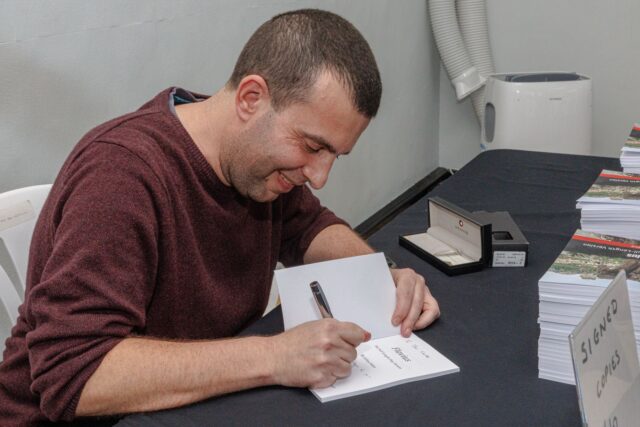
Julian followed his introduction with a book signing for which there was a long queue and, judging by the visible demand, it seems that the grim story of the IRA shooting will not be allowed to fade away from public gaze, as Felice aims to enlighten us with his neutral and rightly critical stance on a dark episode in our recent history, an episode which prompted his creative juices to write a play about it.
A play which “will keep growing”, he admits, even after this full-length version of it has been seen on stage. Hopefully it will and it deserves to.
The book is priced at £10 and is available from the author and other platforms. It is also on international release and he hopes that it might be performed away from our shores.
Four of his plays have been published abroad and over thirty productions performed across the US.
Having read the play and found it compelling I now look forward to seeing it performed locally in the future, hopefully before the Flavius files are de- classified and prompt the author to re-write about this grim chapter of our recent history.


