


Non-partisan Youth Parliament for 16–19 Year Olds launches
Photos by Johnny Bugeja


The Speaker of the Gibraltar Parliament, Karen Ramagge, has unveiled a new initiative for young people with the creation of a Gibraltar Youth Parliament.
Aimed at 16 to 19-year-olds whether they are in full-time education or not, the initiative is designed to demystify Parliament, make it more accessible and encourage young people to have a say on issues that affect them.
“We invite schools into Parliament and we tell them all about what Parliament does, just to raise awareness. But I wanted to do something more structured for older children,” the Speaker said.
“The idea is to have a forum where we can make Parliament accessible and understood to the young.”
The Youth Parliament is intended to provide a neutral space where young people can learn, debate and contribute without the pressure of party allegiance.
“We have a very strong GSLP Youth, a very strong GSD Youth, and a very political arena in Parliament, as it should be, but I wanted to open this up for young people who perhaps hadn’t thought very much about politics or weren’t involved in politics,” she said.
“The message is about what Parliament does, not about party politics.”
Young people are invited to apply via a 200-400 word essay, and those selected will form teams of four for a debating competition that will be held in the Gibraltar Parliament.
“The format will be a parliamentary debate in Parliament,” she said.
“They will sit in Parliament on both sides and they will debate a topic. I will chair the debate. We will apply the parliamentary rules of debate so that it will very much feel like a parliamentary debate.”
Debate topics will be chosen by the parliamentary team, taking into account suggestions from the young participants.
However, the Speaker made clear that highly emotive or deeply divisive issues, such as religious questions or extremely contentious social topics, will be avoided at the outset.
“We don’t want anything highly emotive, highly contentious,” she said.
“Just subjects that are of national, international interest. We will be asking the young people to nominate topics that they would like to debate.”
The debates will be adjudicated as a competition, with judges selecting the winning teams. These judges will be members of the public who are yet to be approached about their participation.
“Elections are in themselves competitions. We thought it was a good idea to include that element of competition,” she said.
The competition will be held over two days on June 9 and 12 followed by a final debate on a separate day.
The timing of the debates has been chosen to enable winners to take part in the British Isles and Mediterranean Regional Commonwealth Parliamentary Conference, which is being hosted in Gibraltar on June 17-19.
“We wanted to have the winners of the debates participate in that conference,” she said.
“Maybe take part in panel discussions, maybe present a talk. We were very keen to have them actually form a part of that conference.”
Everyone who applies, whether or not they are selected to debate, will be offered a one-year membership of the Gibraltar Youth Parliament.
The aim in future is to have sessions where young people are invited to come in and discuss particular Bills that are going through Parliament or particular topics that are popular within the community.
She hopes to involve both Government and Opposition MPs in these sessions, so, “we can all get a finger on the pulse of what is important for young people in Gibraltar and how we can make Parliament more accessible to them.”
Aware some young people might be interested but feel shy or hesitant about taking part, she said they need to remember that their view matters.
“We should all want to be involved with what’s happening in Gibraltar, we should all want to have a say,” she said.
“Even if you say, ‘Well, it’s not going to make a difference,’ expressing a view can make a difference, because people will hear that view and people can take that view on board.”
She drew a parallel with women gaining the right to vote and how it was fundamentally about having a voice.
“Now we need to attract the youth, demystify Parliament, and I know this almost sounds like a contradiction in terms but depoliticise Parliament to generate that interest.”
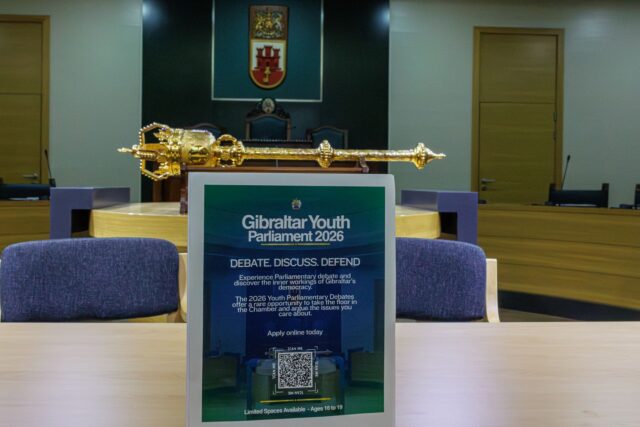
The deadline for applications is Friday April 24, 2026.
Applicants must be between the ages of 16 and 19 on June 9, 2026 and the form can be found online at https://shorturl.at/nZqRE


