


The Abrines Family: A Historic Gibraltar Trading Dynasty Immortalised by James Joyce
Hygiene and Cleaning Committee. Seated (from left to right) – Isaac Abensur, Achille Petri, Dr. Cenarro, Ernesto Marlé (Spanish Consul), Abraham Pimienta, Gregorio Trinidad Abrines. Standing (from left to right) – Carlos Marco, Benjamín Branschvig, Adof Renchaussen, Jules Goffart, Dr. Güitta, Isaac Laredo, Eugenio Rendós, Mrini.


By Marti Crespo
In an article published exactly one year ago for Bloomsday 2025, I explored the story of a Catalan monk from the Monastery of Montserrat who was assigned to Gibraltar at the beginning of the twentieth century and whose name, by a remarkable twist of fate, found its way into one of the most celebrated novels in world literature: James Joyce’s Ulysses. In the novel’s final monologue, as Molly Bloom recalls her childhood in Gibraltar, Father Ildefons Vilaplana is mentioned by name, becoming forever linked to the Rock in literary memory despite having spent only a short time there.
Far more deeply rooted in Gibraltar, however, was the Abrines family, a prominent commercial dynasty that also receives a passing mention—alongside the Benady family—in the closing pages of Joyce’s masterpiece. In The Real People of Joyce’s Ulysses: A Biographical Guide (2016), researcher Vivien Igoe notes: “The Abrines family came originally from Minorca and settled in Gibraltar [...]. Richard and John had a bakery, R. and J. Abrines, Ltd, The Aix Bakery, 292 Main Street, Gibraltar.”
Igoe explains that the business had been established in the mid-nineteenth century by John Abrines and was later inherited by his sons, Luis Richard Abrines and John L. Abrines, at 25–26 Church Street. The Aix Bakery—named, most likely, after a prize won by the Abrines brothers in Aix-en-Provence—supplied a substantial portion of Gibraltar’s daily bread consumption until the 1960s. 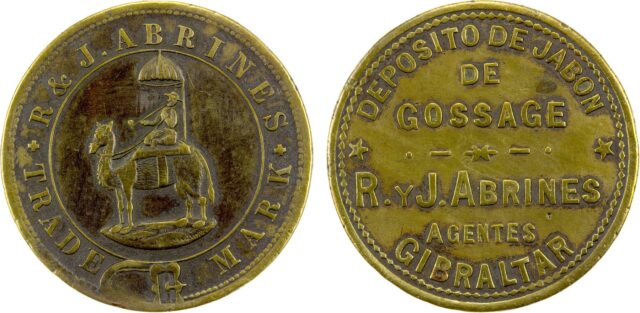
The family’s activities extended well beyond baking. Under the trading name R. & J. Abrines, they spent decades distributing groceries, wines and consumer goods from premises at 27 Waterport Street. One of the earliest advertisements for the company, dating from 1863, lists wines, champagnes and spirits, hams, bacon, lard, cheese, butter, potted meats, preserved meats and soups, Havana cigars and Manilla cheroots. Another advertisement, published in 1879, describes the firm as “importers and dealers” in wines, groceries and provisions, while also serving as Gibraltar agents for the affordable soap brand founded in England by William Gossage.
A further advertisement from 1899 announced that the company distributed preserved foods from London-based Crosse & Blackwell, English biscuits from Huntley & Palmers, and a range of colonial and overseas products. Prominently displayed in large type was another distinction: the firm proudly identified itself as suppliers to the Duke of Edinburgh.
By 1920, operating from warehouses at 76 Main Street, the company had reached the peak of its commercial success. It described itself as wholesale and retail grocers and provision merchants, importers of delicacies from India and China, and suppliers to “the Admiralty, the War Office and the Colonial Government,” while remaining Gibraltar’s leading bread manufacturers.
In 1985, trading under the name Louis J. Abrines Limited, the company became part of the Saccone & Speed Group, an old distribution giant whose reach extended far beyond Gibraltar itself.
As Vivien Igoe points out, the origins of this distinguished commercial dynasty can be traced to John Abrines and also his elder brother Richard. Both were born in Gibraltar, in 1832 and 1829 respectively, as had their father Miguel Abrines and grandfather, also named Miguel. Yet a closer examination of the family tree leads back to Menorca through their great-grandfather Josep Abrines, who was born in the Raval de Sant Felip district near the entrance to Port Mahon during the island’s first period under British rule.
The census of 1777 reveals that Josep, then aged forty-seven, had already lived in Gibraltar for forty-three years. His elder brother Gregori Abrines, aged fifty, had resided there for a similar period. This suggests that both brothers arrived on the Rock as young children around 1734. Based on this evidence, historian Tito Benady speculated that the Abrines may have been among the earliest Menorcan families to settle in Gibraltar during the eighteenth century, when Menorca itself spent three separate periods under British control.
Gregori and Josep were born in the Raval de Sant Felip to Josep Abrines, originally from Palma de Mallorca, and Maria Àngela Rogé from Tarragona. After settling in Gibraltar shortly after the Franco-Spanish siege of 1727, the couple continued to expand their family. The archives of the Cathedral of St Mary the Crowned record, for example, the baptisms of Antonio in 1735 and Teresa in 1739.
Gregori Brines—as his surname was occasionally recorded—married a daughter of Lorenzo Picardo and Ventura Mayor of Alicante on 23 February 1759. The couple had numerous children before Gregori’s death in April 1795. Josep, meanwhile, married Beatriz Infante from Estepona and fathered no fewer than five children between the 1760s and the 1780s. Consequently, the 1777 census records some fifteen members of the Abrines family spanning several generations.
Interestingly, although Josep appears in the census as a mason, historian Richard Garcia notes that he was better known for a different occupation: that of scavenger. In Ordinary Life in Peace and War (1749–1783), Garcia explains that Gibraltar’s military authorities sought to improve public hygiene and reduce soldiers’ exposure to diseases common in Mediterranean ports by introducing organised waste-collection services. In this capacity, Josep Abrines reportedly pursued around twenty residents who had failed to pay the fees owed for the removal of rubbish from their homes… 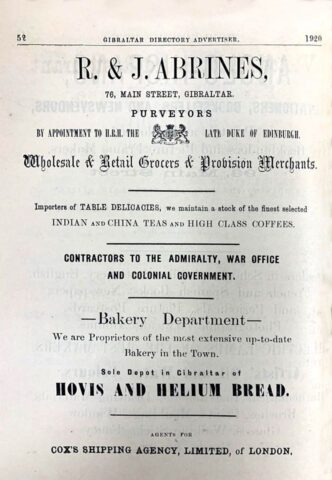
His social standing improved considerably after his retirement at the age of fifty-seven, shortly after the end of the Great Siege of Gibraltar (1779–1783), when reconstruction generated vast quantities of debris throughout the city. Through one of his many children, the family became connected to Joseph Gazzo, a native of Cádiz who served as consul in Gibraltar for both the Holy Roman Empire and the Republic of Genoa: on 23 March 1788, Gazzo’s daughter Juana married Miguel Abrines in a ceremony attended by notable witnesses including Juan Morrison, “Judge of the Town and City of Gibraltar,” and Antonio Abrines, master of the pratique boat.
The marriage elevated the social status of the Abrines family, granting them greater prominence within Gibraltar’s growing civilian society. Gazzo himself remarried on 10 October 1802, wedding Maria Cardona of Port Mahon, daughter of Gabriel Cardona and Teresa Abrines. Notably, Beatriz Infante, Josep Abrines’s wife, served as a witness at the ceremony.
The family’s association with consular affairs did not end there. By the early 1880s, Gibraltar Directory—the very publication Joyce later consulted when searching for names to populate the world of Ulysses—show John Abrines combining his work as a wine merchant and grocer on Waterport Street with the position of Chilean consul in Gibraltar.
Additional diplomatic links emerged elsewhere. In a marriage licence issued in Reus in 1804, Gibraltar-born Josep Abrines Picardó [sic] declared his intention to marry local resident Teresa Gallissà Combelles. The document clearly identifies him as Danish vice-consul. Following their marriage, commercial relations between Reus—one of nineteenth-century Catalonia’s principal wine and spirits trading centres—and Gibraltar flourished through both Josep and his son Francesc Abrines Gallissà, who maintained strong connections with both locations.
The extensive network of Gibraltar’s Abrines family reached not only northwards into the Iberian Peninsula but also south across the Strait of Gibraltar. Gregorio Trinidad Abrines, baptised at St Mary the Crowned in 1844, established Tangier’s first printing press and, on 28 January 1883, co-founded the city’s first newspaper, El Magreb al-Aqsa, together with José Nogales Nogales of Huelva.
Published every Sunday, the newspaper was financed by the Spanish Delegation in Tangier with support from a British industrialist and was consequently regarded as an instrument for advancing British interests in Morocco. Covering both local and international affairs, it was initially published in Spanish before switching to English in 1892 under the title The Times of Morocco.
In 1923, Gregorio Abrines sold both the printing press and the newspaper to Lord Bute and Ernest Waller, who subsequently launched the Tangier Gazette (1923–1962). Just three years later—exactly a century ago—the bearer of a surname that had travelled from Mallorca through Menorca and Gibraltar passed away. Yet the name endured, immortalised in the pages of James Joyce’s greatest work.
Most Read
2.6 tonnes of cocaine seized in Atlantic, four arrests including Gibraltar resident
Mon 27th Jul, 2026
Airport ‘a different ballgame’ after catchment area expands to 4m people
Tue 28th Jul, 2026

Today's Paper
17th June 2026
Read our latest newspaper by downloading our app from the link below.


