


The artist Andrew Carnie explores the dialogue of science and art


British artist Andrew Carnie has brought two unusual works to the Traces of Humanity exhibition in Gibraltar, using pollen and mosquitoes to explore the human immune system and the relationship between art and science.
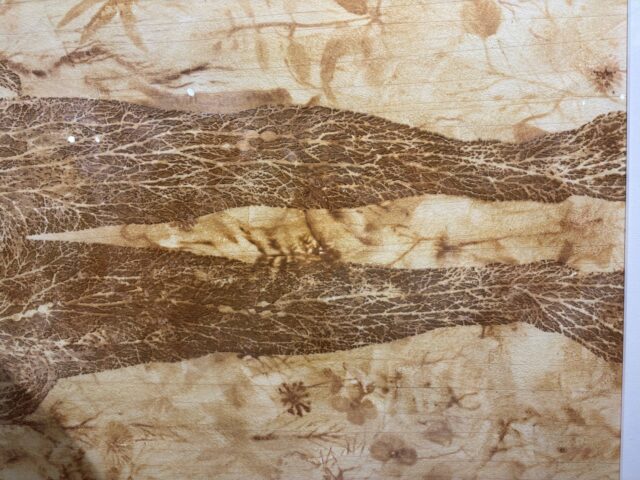
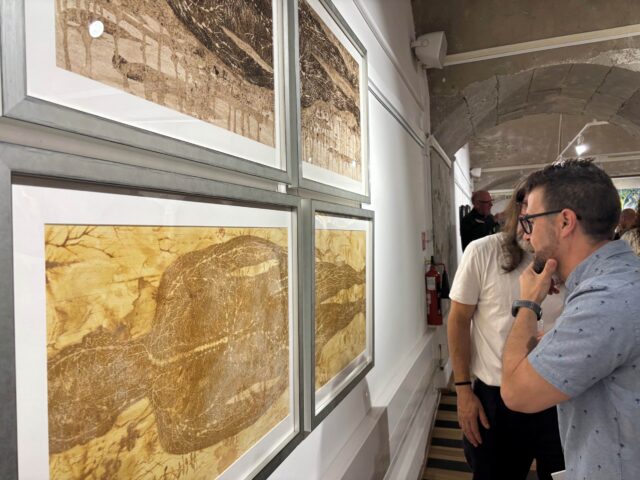
Carnie, an academic at Winchester School of Art at the University of Southampton, is exhibiting Sneeze, sternutation, circumstance (2016), a pollen-based watercolour, and Self and other irritant (2017), created using mosquitoes. Both works are made on two sheets of Hahnemuhle paper.
The pieces were developed as part of an immunology project in Portugal alongside scientists.
"I was doing a piece for an immunology project, based in Portugal, with five or six other artists, making work about the immune system," Carnie told the Chronicle.
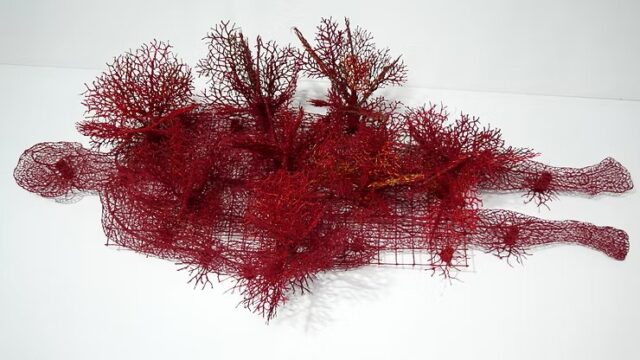
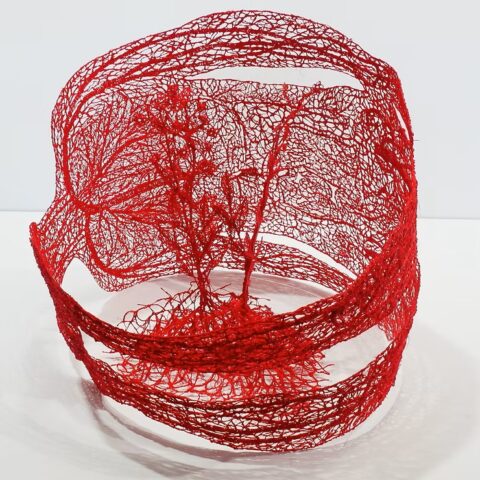
"This is one of the parts of the body I think is very impressive that we don't really think about is the lymphatic system."
"That plays a big part in the immune system, distributing liquids and everything. And so the immune system protects us against various things."
Carnie said pollen and mosquitoes became natural subjects through which to represent the body's defences.
"This is meant to represent parasites, because the mosquito carries parasites and pollen is another one that it defends us against," he said.
"So, basically, the lymphatic system only appears as a kind of opposite to the pollen or as an opposite to the dead mosquitoes."
Obtaining the constituent parts proved less complicated than might be expected.
"Basically, I just collected the material," Carnie said.
"I mean, you can buy pollen, so that was straightforward. It would have taken me a long time to collect it... [laughs]. You can buy it, because it is used as a regular medicinal product everywhere."
The mosquitoes came from a testing centre in Colorado after Carnie contacted it to ask whether it could provide dead specimens.
"I always cheat. Well, I mean, it's not cheating, I just find the easiest way to do things," he said.
"And I was lucky with the mosquitoes as well."
"I was trying to find out ‘how could I work with parasites’, and then I thought: ‘Ok. It carries malaria, it's a parasite, that will kind of work’."
"And I don't know how I came across it, but I came across a testing centre for mosquitoes in North America, Colorado."
"And just, in a cheeky way, I emailed them and said: Could you supply me with some dead mosquitoes? And they were really helpful."
The shipment arrived without incident.
"They asked for a DHL label and a kilogram of mosquitoes appeared one day in a small box at my home door," he said.
"No customs, no biological offence, it just arrived in a small box one day."
To create the finished works, Carnie crushed the mosquitoes before applying the material through cardboard stencils using glue.
"I think I kind of mashed them up quite a lot, but there are little bits of wings and things that you can see," he said.
"I just painted the mosquito liquid fluid with glue, and the pollen with glue through the stencils."
He said each piece took only a few hours to complete before being sealed with a fixative.
The two works reflect Carnie's wider practice, which frequently explores the relationship between art and science. Much of his work focuses on the human body, organ transplantation, immunology and neurology, examining how scientific ideas influence our understanding of identity.
His installations often use slide projections and video projected onto layered suspended screens, creating immersive environments in which images slowly emerge and disappear.
Carnie's work has been exhibited internationally at venues including the Science Museum in London, the Natural History Museum in Rotterdam, the Design Museum in Zurich, Exit Art in New York, the Pera Museum in Istanbul, the Dresden Hygiene Museum and the Daejeon Museum of Art in South Korea.
His work can now be seen at the Gustavo Bacarisas Gallery as part of the Traces of Humanity exhibition, which runs until July 31.
Most Read
Local man arrested on suspicion of assisting illegal immigration after port incursion incident
Fri 4th Sep, 2026
Potential for new flights prompts Gib to discuss airport parking with La Linea
Mon 24th Aug, 2026

Today's Paper
23rd July 2026
Read our latest newspaper by downloading our app from the link below.


