


Thomas-Symonds hails ‘pragmatic’ Gib treaty


The UK/EU treaty on Gibraltar is a “pragmatic outcome” that will guarantee “hugely important” border fluidity for the benefit communities on either side of frontier, Nick Thomas-Symonds, the UK Minister for EU Relations, said on Thursday.
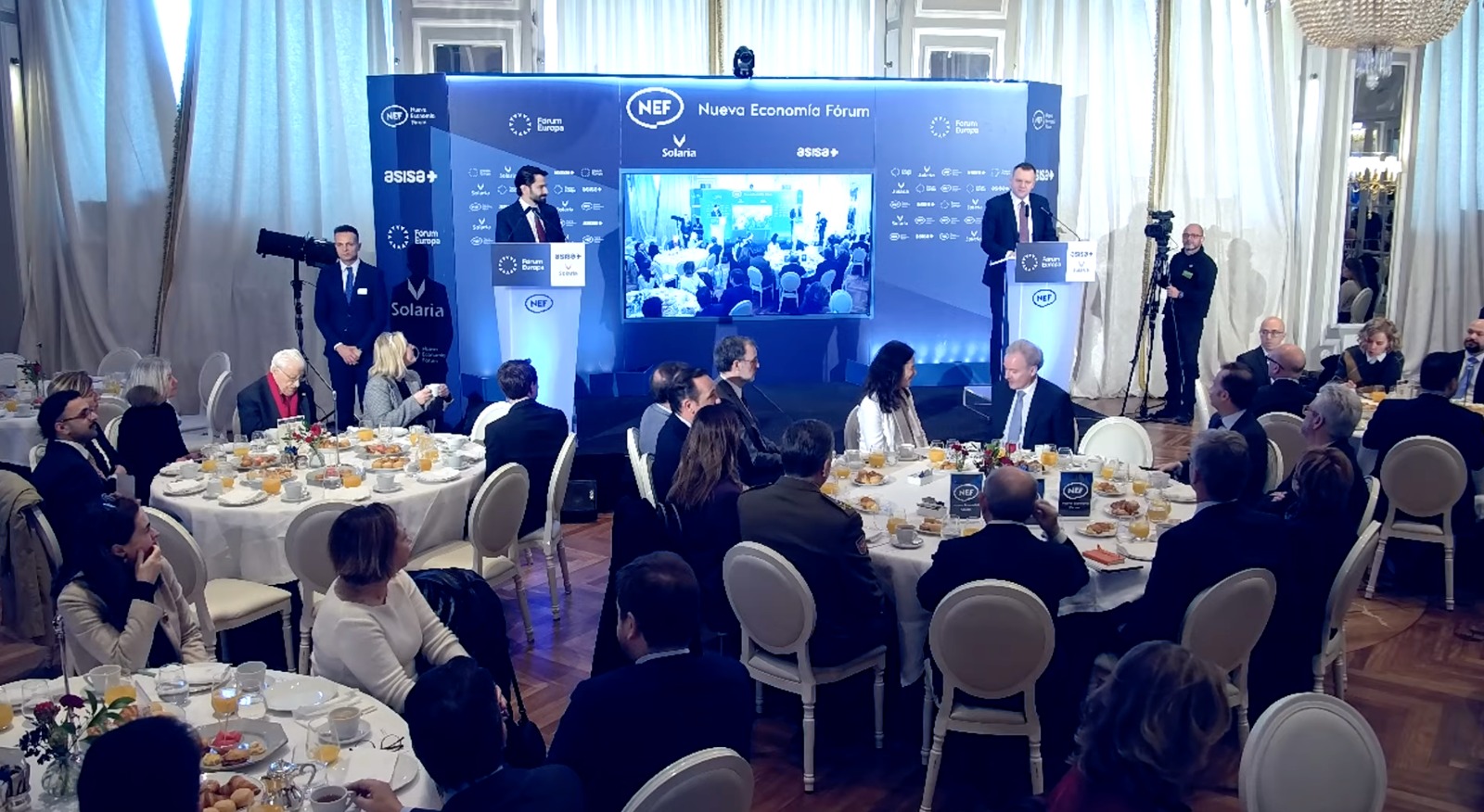
Mr Thomas-Symonds was speaking during a breakfast briefing in Madrid organised by Nueva Economia Forum and attended by diplomats and business representatives.
Mr Thomas-Symonds spoke primarily about the UK’s reset of its relations with the EU and Spain.
He said the UK’s future “is inextricably bound with that of Europe”, adding: “The Britain of the Brexit years is behind us.”
During the briefing, Mr Thomas-Symonds was asked from the audience about the Gibraltar treaty.
“Can you guarantee today that the pact will offer lasting legal certainty and full economic fluidity without this entailing explicitly or implicitly, any concession in the British position on sovereignty?” he was asked.
“Will a system be consolidated that eliminates systematic physical checks at the border fence and ensures the smooth circulation of Spanish and European workers in the Campo de Gibraltar?”
“How will the new agreement avoid tensions in taxation and regulatory competition that could create uncertainty for peace businesses established in the Campo de Gibraltar and in the territory?”
He was also asked when he expected that the agreement on Gibraltar would be debated and approved in the UK Parliament, and whether this would be it be before April 10 or whether it be applied provisionally pending ratification by the UK and European parliaments.
Mr Thomas-Symonds avoided answering the questions with any degree of depth, saying only that the treaty text “will obviously be published shortly, so everybody will be able to see the details”.
“But let me just say in terms of this, because it is very important, this was something that was left after the Brexit process, after the United Kingdom had left the European Union,” he added.
“I am pleased and I pay tribute to all those who were involved in this negotiation, on all sides of it, that we have reached this pragmatic outcome.”
“To your question on border fluidity, around 15,000 people cross that border every day, so that border fluidity is hugely important.”
“And I think this is precisely what that agreement does guarantee going forward.”
“But I should also say that this is an important agreement as well for the whole region.”
“It's important for jobs, investment and prosperity for the whole region.”
“I'm sure I'll be discussing this with Spanish counterparts and with other European counterparts going forward, but this really is about that prosperity going forward.”
“And I'm delighted and very pleased that that agreement's been reached.”
Mr Thomas-Symonds was speaking two days after the European Commission confirmed it had adopted its proposals “for the signature and provisional application, as well as for the conclusion” of the UK/EU agreement on Gibraltar.
Maros Sefcovic, the Commissioner for Trade and Economic Security, Interinstitutional Relations and Transparency, who has played a key role in the treaty negotiation, welcomed the announcement.
“Our goal has been clear and strategic: to secure long-term prosperity for the region, while fully safeguarding Schengen, the EU Single Market and our Customs Union,” he said at the time.
“With 15,000 people crossing daily between Gibraltar and Spain, this is about legal certainty, confidence for businesses and people as well as a cooperative future that reinforces our mutual relationship.”
Separately, the European Council also confirmed it had formally commenced its examination of the treaty text.
The Council’s Working Party on EU-UK Relations, made up of diplomats and civil servants from the 27 EU Member States, the European Commission and the General Secretariat of the Council, held its first round of discussions on the text last Friday, an EU official told the Chronicle.
The Commission has recommended that the treaty be handled as an “EU-only” agreement, meaning it would need approval only by the Council, which brings together representatives from all member states, and the European Parliament.
If the treaty were handled as a “mixed agreement”, it would also require approval by all national parliaments of the EU.
While the parties involved in the negotiation are confident that the Commission’s recommendation for an “EU-only” agreement will be adopted, the position has yet to be confirmed by the Council.
“There is a request by several member states for an opinion by the Council Legal Service on the matter,” the EU official said.
April 10 is the deadline for EU-wide implementation of the Entry/Exit System [EES], the EU’s new automated border control system.
The treaty includes provisions that will ensure Gibraltar residents are not subject to strict EES controls including biometric scans and restrictions on how long non-EU nationals can be within the Schengen zone.
Without those provisions, the fear is the EES requirements could severely disrupt frontier fluidity and impact negatively on communities either side of the border.
The treaty allows for provisional application once signed, even pending full completion of the ratification process, and the hope is to have it in place by April 10.
WIDER CONTEXT
Mr Thomas-Symonds told the audience in Madrid that the UK Government had been elected with a mandate to “reset” relations with the European Union, arguing that the post-Brexit arrangements were “not working for anyone” and had made trade with the UK’s largest bilateral partner harder.
He said closer UK/EU cooperation was needed to address shared challenges on security, defence and economic competitiveness, while maintaining the UK’s decision not to return to the single market, the customs union or freedom of movement.
Mr Thomas-Symonds pointed to progress since a UK/EU summit in May last year, including a new security and defence partnership focused on support for Ukraine, resilience against hybrid threats, space security, irregular migration, drug trafficking and the protection of critical infrastructure.
He cited Prime Minister Sir Keir Starmer’s line from the Munich Security Conference last weekend that “there is no British security without Europe and no European security without Britain”.
On people-to-people links, he said the UK would rejoin Erasmus Plus in 2027, describing opportunities for students and youth and sports staff.
On trade, he said negotiations were continuing on an agri-food and food and drink agreement intended to cut red tape and reduce costs, which would also benefit Spanish exporters.
Noting the importance of Spanish food exports to the UK, he said: “Every time someone in the UK adds oranges to their Pimm's cocktail or prepares cauliflower cheese for their Sunday roast, they are indebted to Spain.”
Mr Thomas-Symonds also highlighted work to link UK and EU emissions trading schemes to reduce decarbonisation costs and support key industries such as aviation, and increased cooperation on energy, including improving electricity trading to help lower consumer bills and develop renewables.
He cited investment links, including Iberdrola’s investment in UK energy grids and BP’s investment in hydrogen and biofuels infrastructure in Spain.
In answer to questions, he said structured UK/EU dialogues were in place and the UK Government aimed to provide regulatory certainty for businesses, adding that Britain was “open for business” and that Spanish foreign investment in the UK was significant.
He argued for a “made across Europe” approach to competitiveness to avoid harming integrated supply chains, flagging UK investment in Spain and Spanish firms importing UK iron and steel, and adding both sides were aligned on priorities including green technologies, defence and digital.
He also said the UK would pursue further progress on mutual recognition of professional qualifications through an annual summit process, and that the UK would deepen defence cooperation through participation in relevant programmes and projects.


