


The wall that changed everything


In the second instalment in a series exploring the origins of the city and fortress of Gibraltar, Professor Clive Finlayson, Director of the Gibraltar National Museum, traces the history of the Rock’s first defensive walls.
In 1436, Enrique, the second Count of Niebla—already in his sixties and descended from the famous Guzmán “el Bueno,” the hero who defended Tarifa and took Gibraltar in 1309—had finally had enough. Muslim troops based in Gibraltar kept raiding his lands, and he decided he wasn’t going to tolerate it any longer. If no one else would stop them, then he would. With his own money, he put together a fleet of more than twenty galleys and led nearly 3,000 infantry himself, backed by some cavalry. At the same time, he sent another force—2,000 cavalry and some foot soldiers—overland under his son, Juan Alonso.
The land army set up on the isthmus, facing Gibraltar from the north. On the 31st August, Enrique began landing his men on the Red Sands while his galleys blasted the shore with artillery to cover them. But he immediately saw something he hadn’t expected: the defenders had extended the wall farther south than he had known, blocking the landing spot. Stranger still, no one rushed out to fight. The reason became obvious shortly after—the tide was rising fast and waves were picking up, trapping Enrique’s knights between the sea and the wall. He ordered everyone back to the ships, but as he returned to his galley he saw some of his soldiers still stuck on the shrinking beach under heavy fire.
Enrique refused to abandon them. He climbed onto a small boat, went back toward the shore, and tried to help cover the retreat. The sea was rough, the undertow strong, and men weighed down by armour were struggling to stay afloat. As planned, Enrique drew the enemy’s fire toward himself. When he reached the boat that was supposed to take him back to safety, he saw one of his own knights in the water up to his neck, shouting, “Help me, my lord!” Enrique ordered the boat toward him. But as it approached, other terrified soldiers grabbed at it, desperate to escape the Moors. Too many climbed aboard at once. The boat capsized. In the chaos, Enrique of Niebla drowned along with about forty knights.
The Muslim defenders of the city recovered Enrique’s body, cut off his head, and placed it in a wicker basket high on the turret of the Water Gate—clearly visible to the Christian troops on the isthmus, to the men on the galleys, and later to anyone who came to Gibraltar. As long as his body was denied a Christian burial, the shame of it hung over his son Juan Alonso and every Christian knight who served the house of Guzmán. They considered it a duty to avenge him.
Enrique’s remains stayed there for twenty‑six years, until 1462, when Gibraltar was finally retaken by the Christians. By then, Juan Alonso—now the first Duke of Medina Sidonia—tried to claim Gibraltar for himself, but King Enrique IV declared it royal property and ordered him to hand it over. Before surrendering the fortress, Juan Alonso removed his father’s long‑exposed body from the wicker basket above the Water Gate and laid him to rest inside the tower of the castle, in a chamber he had turned into a chapel.
In this article I have skipped forward 276 years from the construction of the first settlement in Gibraltar in 1160, described in my previous article. Why the jump? I have done so in order to illustrate one very important point which is central to our understanding of how Gibraltar developed. Something had changed from the time that the Castilians lost Gibraltar – 1333 – and Enrique’s failed attempt to recover it just over a century later. That change was a sea wall, which now protected the coast. It is remarkable that Enrique had been unaware of this significant change to the fortifications of Gibraltar. His ignorance, perhaps arrogance, of this vital piece of intelligence cost him his life and those of many of his knights.
Ibn Battuta was a famous Muslim traveller, adventurer, and scholar from Tangier. Over about thirty years, from 1325 to 1354, he travelled across huge parts of Africa, Asia (including China) and Europe (including the Iberian Peninsula). He ended up covering more distance than any other explorer before modern times, far more than famous travellers like China’s Zheng He or Marco Polo himself. Ibn Battuta actually visited Gibraltar - in 1351 - and we are fortunate to have a first-hand account of what he saw. He tells us that:
“The first part of Andalusia that I saw was the Mount of Conquest [Gibraltar]. I walked round the mountain and saw the marvellous works executed on it by our master [the late Sultan of Morocco] Abu’ l-Hasan and the armament with which he equipped it, together with the additions made thereto by our master [Abu ‘Inan], may God strengthen him, and I should have liked to remain as one of its defenders to the end of my days.”
Then, citing Ibn Juzayy, he adds
“Gibraltar was recaptured by our late master Abu al ’Hasan, who recovered it from the hands of the Christians after they had possessed it for over twenty years. He sent his son, the noble prince Abu Malik, to besiege it, aiding him with large sums of money and powerful armies. It was taken after a six month’s siege in the year 1333. At that time, it was not in the present state. Our late master Abu ‘l-Hasan built in it the huge keep at the top of the fortress; before that it was a small tower, which was laid in ruins by the stones from the catapults, and he built a new one in its place. He built the arsenal there too as well as the great wall which surrounds the Red Mound [my emphasis], starting from the arsenal and extending to the tile yard. Later on, our master, the Commander of the Faithful, Abu Inan (may God strengthen him) again took in hand its fortification and embellishment, and strengthened the wall to the extremity of the mount, which is the most formidable and useful of its walls [my emphasis].”
This tells us that the sea wall was put up during the rule of Abu al‑Hasan, sometime between 1333 and 1348, when Abu ‘Inan took over. It was probably reinforced during King Alfonso XI’s long siege of Algeciras (1342–1344) when precautions would have been taken in case Gibraltar was attacked after Algeciras. When Algeciras fell, Gibraltar became the only Muslim‑held port on the northern side of the Strait. The sea‑wall must have been extended “to the extremity of the mount” between 1348 (Abu ‘Inan’s accession to the throne) and Ibn Battuta’s visit in 1351. Once that wall was in place, the kind of amphibious attacks that used to land on the Red Sands and climb up toward the Rock—common before 1333—would have been far harder to pull off.
Another contemporary writer – Ibn Marzūq – writing around 1371 tells us this of Abu al‑Hasan
“He then understood that he needed to reinforce that side of the mountain with a wall, surrounding it completely so that the enemy could no longer even consider attacking it, leaving no possibility of a siege. People were astonished by the idea, thinking it impossible, but he provided the money and appointed those who would carry out the work, choosing trustworthy and reliable men whose character matched his noble intentions and plans.
Thus, he completely surrounded it with defences, as well as other areas that are now well walled and equipped with passageways and towers. He also set up watchtowers (maharis) and houses all along the coastline (with divine help and support), and the red sands, on filling with so many buildings and such tall constructions, appeared white from afar [my emphasis].
Gibraltar came to have markets and a congregational mosque for prayer and preaching, along with baths, and its mosques multiplied—both there and in other parts of the mountain—where farmsteads and houses were built. All of this was commemorated by the construction of the Pilgrim’s House (Hājj), so that travellers could lodge there, on the very spot where our lord [Abū al‑Hasan] had stayed when we crossed to this side of the Strait, serving him then as a palace.”
These two fourteenth century accounts leave no doubt as to what happened. Briefly put, the beach leading onto the red sands all along the western coastline of Gibraltar had been the traditional amphibious landing point when attacking the Rock. From there catapults and other siege engines were hauled up to then attack the town and fortifications. This happened repeatedly, and was an important factor in the capture of Gibraltar by Abu Malik in 1333. Having understood this flaw in the defences, and with the pressure of the Castilian siege of Algeciras (1342-1344), the new conquerors of Gibraltar set to work on a sea wall in order to address this obvious weakness and the sea wall, right up to the extremity of the mount, had been completed by the time that Ibn Battuta visited Gibraltar in 1351. It was then, and only then, that the area of the red sands could be developed to such a degree that they “appeared white from afar”. It could not have been developed prior to this time, in spite of its potential for settlement, as it offered no guarantees of security whatsoever. When Enrique de Guzman attempted his fatal amphibious assault on the Rock in 1436, Gibraltar had been transformed radically. The new town had been built on the red sands between 1342 and 1371. The district was known as the Turba (meaning sand) al-Hamrā (meaning the red).
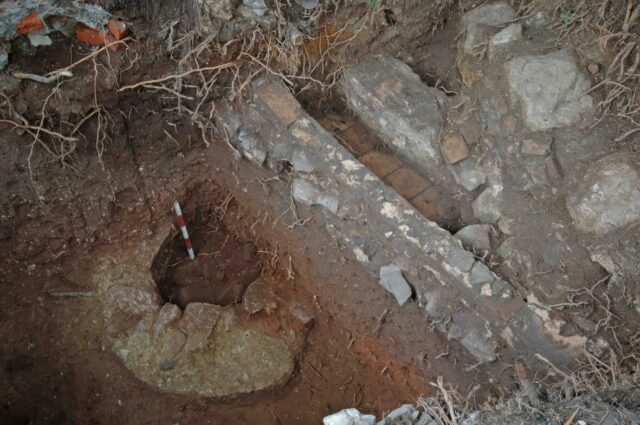
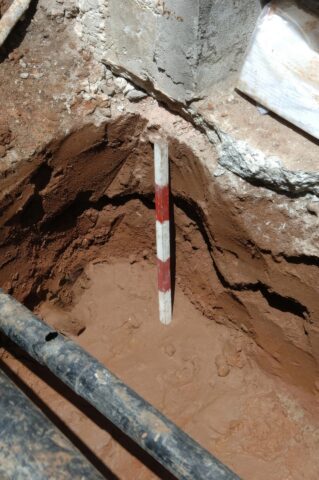
One final word, in case there is any doubt left as to when the area between present day Casemates and southwards, including the area round the present Parliament Building, the Cathedral of St Mary the Crowned and the Gibraltar National Museum, was first developed. I have directed a good number of excavations in this district of Gibraltar since 1995 and I will be describing what we found in future articles. For now, suffice it to say that the archaeological evidence indicates that the oldest material culture from here dates to the fourteenth century. We have found nothing to suggest an earlier settlement here. The archaeology matches the historical evidence with remarkable precision.


