


Northern Defences continues to reveal complex military and urban past


Excavation works along Path V between King’s Place of Arms and Prince’s Lines continues with fresh archaeological excavations revealing further evidence of the Rock’s layered military and urban past, project director Carl Viagas said.
Mr Viagas told the Chronicle that the work by the team at the Northern Defences has now intensified along several key sectors of the Northern Defences, with investigators increasingly combining documentary research, archaeology and landscape analysis to reassess Gibraltar’s historic development.
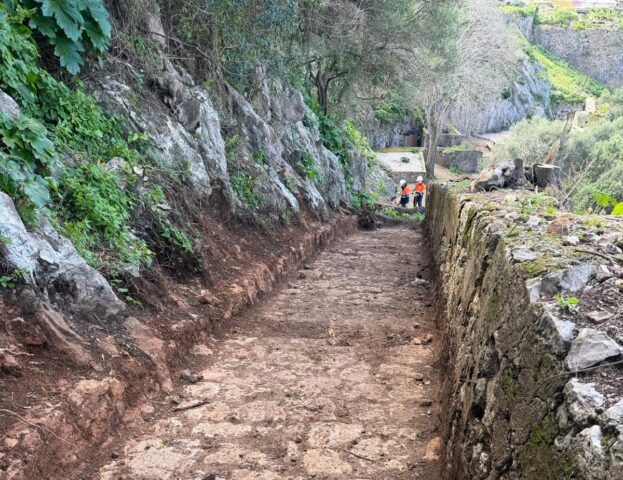
“One of the latest areas under investigation is the route known as ‘Path V’, extending from King’s Place of Arms towards Prince’s Lines,” he said.
“Recent excavations and clearance operations along this route have begun exposing substantial surviving historic fabric, including what appears to be a carefully engineered stone-paved communication route integrated directly into the northern defensive system.”
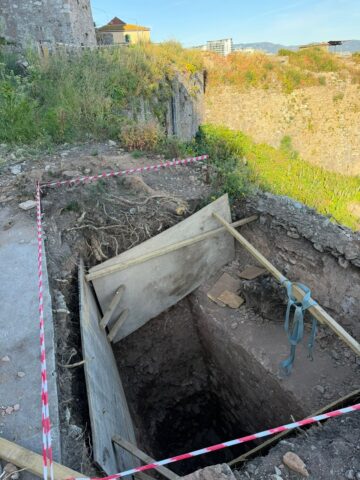
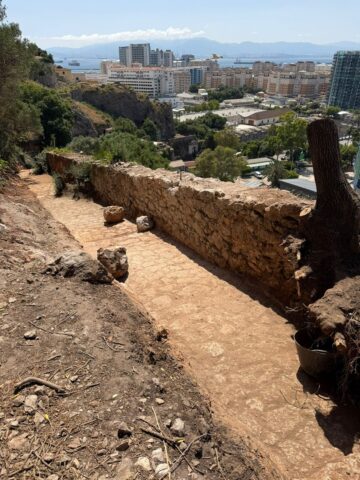
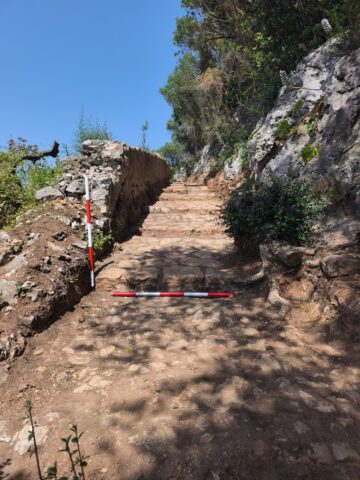
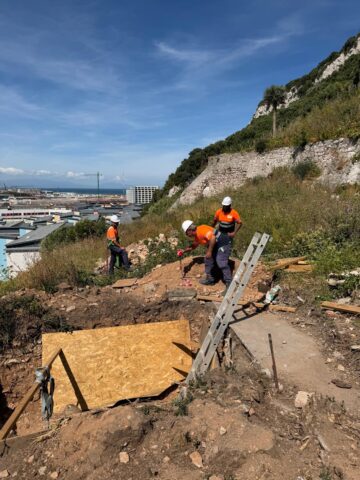
He added that researchers believe the discovery is important because it “further reinforces the growing interpretation that the northern slopes of Gibraltar functioned not simply as isolated fortifications, but as part of a highly organised defensive communication network linking various military positions, gates and fortified enclosures.”
Mr Viagas believes that the pathway, portions of which had remained buried for generations beneath collapse, vegetation and later deposits, appears to demonstrate deliberate military planning and sustained use over multiple historical periods.
“The exposed paving and retaining structures suggest a route capable of moving troops, supplies and communications through difficult terrain while remaining partially protected within the defensive landscape,” he said.
He explained that the discoveries are helping researchers better understand how Gibraltar’s upper northern slopes functioned as a connected military environment.
“What we are increasingly seeing,” Mr Viagas said, “is that the Northern Defences were not simply individual walls or batteries placed randomly across the landscape.”
“They formed an interconnected communication system carefully adapted to the terrain itself. Every newly exposed section helps us better understand how movement across these slopes was controlled and protected.”
Mr Viagas added that the discoveries continue to feed into wider debates regarding the medieval and early modern development of Gibraltar, including the relationship between the Castle precinct, Villa Vieja and the various northern access routes into the city.
Looking ahead, new excavation works are also expected to commence near the Puerta de Granada area, where researchers hope to further investigate one of the most historically significant sectors of Gibraltar’s medieval defences.
“The Puerta de Granada has become the focus of increasing academic interest in recent years, particularly following studies suggesting that the structure may have functioned less as a traditional civic entrance and more as a fortified military gateway controlling movement between internal defensive zones,” said Mr Viagas.
He added that archaeologists and researchers involved in the project believe the upcoming works may provide further insight into both the chronology and the evolution of the surrounding fortifications, while also “helping clarify how the upper northern approaches connected into the broader defensive network.”
Mr Viagas also pointed out that community engagement remains a major component of the Northern Defences project, with the Gibraltar Heritage Trust undertaking guided visits to view the latest archaeological and conservation works firsthand.
The tour he said showcased several newly exposed features while also allowing members of the public to engage directly with the researchers, archaeologists and specialists involved in the ongoing investigations.
He added that such visits are becoming increasingly important as public interest in Gibraltar’s heritage continues to grow.
Mr Viagas also noted that in a major upcoming publication by historian Tim Wellburn on The Northern Defences of Gibraltar, is expected to provide one of the most detailed studies ever produced on the evolution, architecture and military development of the Northern Defences.
“The publication is already generating considerable interest amongst heritage specialists and researchers both locally and internationally,” said Mr Viagas.
Tim Wellburn’s forthcoming publication: The Northern Defences of Gibraltar
Foreword by Deputy Chief Minister Dr Joseph Garcia.
Alongside the physical works, researchers have confirmed that further information, imagery and updates will continue to be released online and through social media platforms in an effort to improve public access to the discoveries and ongoing research.
“There is a real sense that people want to reconnect with these spaces,” Mr Viagas said.
“Every excavation or clearance operation is not simply about uncovering stones — it is about reconnecting the community with parts of Gibraltar’s history that have remained hidden for centuries.”
The Northern Defences project has increasingly embraced digital outreach as a means of documenting progress and engaging both local and international audiences interested in military heritage, archaeology and Gibraltar’s history.
The growing international attention surrounding the project is also expected to continue next month when Mr Viagas travels to Diest, near Brussels, to close a major European conference on fortresses organised by EFFORTS.
The invitation follows a recent visit by representatives of EFFORTS and Forte Cultura to Gibraltar, during which delegates were given guided tours of the Northern Defences and briefed on the ongoing restoration, archaeological investigations and interpretation strategy being developed across the site.
The conference will bring together specialists, heritage organisations and researchers from across Europe to discuss the preservation and interpretation of historic fortifications, with Gibraltar increasingly being recognised as an important case study in the adaptive reuse and reinterpretation of complex military landscapes.
Researchers involved in the Northern Defences say the combination of archival study, archaeological investigation and public engagement is beginning to transform understanding of Gibraltar’s past in ways that would have seemed unlikely only a few years ago.
“What is emerging,” Mr Viagas said, “is a much more complex and interconnected picture of Gibraltar’s history — one that spans manuscripts, archaeology, military engineering, landscape analysis and international collaboration. Every new discovery adds another piece to that puzzle.”
Most Read
HMS Queen Elizabeth sails into Gibraltar, strengthening long-standing links
Sun 25th Oct, 2026
Police governance reform aims for ‘democratic accountability’ alongside ‘operational independence’
Mon 26th Oct, 2026
PP MEP says ‘things will change’ on Gib treaty with right-wing govt in Madrid
Tue 27th Oct, 2026

Today's Paper
7th June 2026
Read our latest newspaper by downloading our app from the link below.


