


Spain seeks EU solidarity over Ceuta migration crisis
Members of the Civil Guard’s Underwater Operations Group (GEAS) help rescue some babies from the water in Ceuta. / Credit: QUINO / EL FARO DE CEUTA


Spain will press European Union member states for greater solidarity over the migration crisis in Ceuta, with the Spanish government stating that the city represents a unique external border of the bloc that requires a tailored response.
The Spanish minister for Foreign Affairs, José Manuel Albares, said Spain would ask for “solidarity from all the states of the European Union", stressing that Ceuta and Melilla were not only Spanish cities but also European cities forming the EU's only land border with Africa.
Speaking during an interview on Spanish broadcaster TVE, Mr Albares said the characteristics of that border meant the migration challenge could not be addressed in the same way as elsewhere in Spain or Europe.
"We are probably talking about the most unequal border in the world because it separates the European Union from the African continent," he said.
He added that Brussels should recognise the specific challenges facing Ceuta and Melilla, saying the Spanish government was already aware of those realities but Europe also needed to acknowledge them.
The comments came ahead of a meeting of EU interior ministers requested by Spain after ambassadors from EU member states met to discuss the situation.
Addressing the sequence of events that led to the crisis, Mr Albares maintained Spain's position that Morocco had cooperated from the outset.
He said the Moroccan authorities had offered assistance to stop the flow of people crossing into Ceuta and to facilitate the return of those who had entered irregularly.
"Morocco has collaborated in those returns and in bringing this to an end with unprecedented speed," he said.
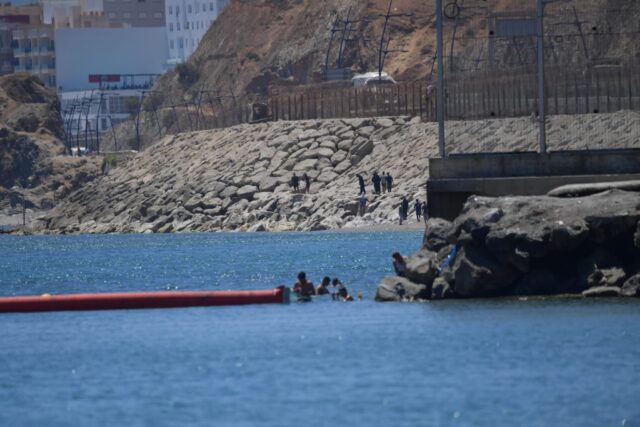
Migrants attempting to scale the new barrier on the breakwater in the Tarajal area of Ceuta. / Credit: QUINO / EL FARO DE CEUTA
Mr Albares also pointed to what he described as unusual activity on social media, adding that online networks had amplified and distorted the impact of a Spanish Supreme Court ruling affecting the return of migrants arriving in Ceuta.
He alleged there had been a coordinated campaign spreading misinformation about the Schengen area and Spain's actions, and that Spain should monitor social media activity to identify those responsible.
The minister described the mass arrival of migrants in Ceuta as an unprecedented event and praised the work of Spain's police and armed forces during the crisis.
He said Spain was reinforcing security arrangements along the breakwater and at the frontier to adapt to the Supreme Court ruling and reduce the likelihood of similar incidents.
Mr Albares also said diplomatic channels with Morocco had remained open throughout the crisis, including direct contact with Morocco's foreign and interior ministers.
According to Mr Albares, the Moroccan authorities immediately indicated their willingness to deploy police resources to stem the flow of migrants without seeking any additional concessions from Spain.
He contrasted that cooperation with migration pressures faced by other European countries, arguing that Spain had consistently shown solidarity during previous migration crises elsewhere in Europe and expected the same support in return.
Official figures cited by the Spanish government indicated that around 2,500 migrants remained in Ceuta, with about half gathered near El Trampolín beach and the city’s immigrant reception centre, which remained over capacity.
The figures also indicated there were around 860 unaccompanied minors, while some migrants from sub-Saharan Africa had expressed an intention to seek asylum.
The national government’s delegation in Ceuta also stated that 88 deaths had been recorded, together with a further 11 in Morocco, with forensic teams from mainland Spain expected to assist in identification work.
Mr Albares described the crisis as both a migration challenge and a humanitarian tragedy.
"Behind the numbers there are men, women, boys and girls," he said.
He said Spain would seek EU support to strengthen border management, combat disinformation and maintain close diplomatic cooperation with Morocco.
Mr Albares also criticised calls from Italy to suspend the Schengen system and urged political unity within Spain in support of Ceuta and Melilla.
On the question of sovereignty, he said there was no doubt over the status of the two cities.
"The Spanishness of Ceuta and Melilla is beyond any doubt," he said.
"They are as Spanish as Valladolid or Santiago de Compostela."


