


Commissioner says human oversight central to Rock’s digital border
Photos by Johnny Bugeja.


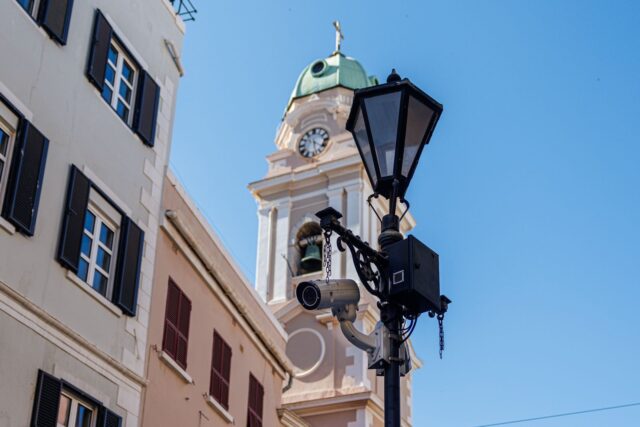
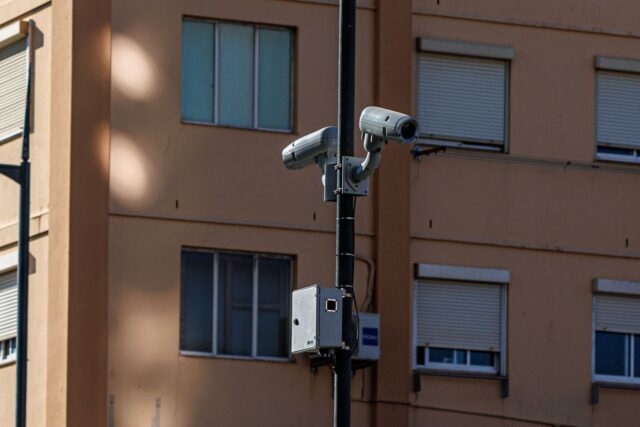
A network of live facial recognition and CCTV cameras deployed at the border, Main Street and other locations in Gibraltar provides the Royal Gibraltar Police with a powerful tool to combat crime, but at the heart of its effectiveness is human oversight, police Commissioner Owain Richards said.
The cameras are controlled by the RGP and their use must always be proportionate and relevant to a policing purpose, he told the Chronicle in an interview.
The way fixed facial recognition cameras have been deployed on the Rock is a departure from how they have been used in the past in the UK and the EU, where such technology is normally restricted to temporary deployments and sensitive locations.
But even that is starting to change. Conscious of their value as tool to tackle crime, static cameras are set to be deployed in the West End and Soho by the end of the year, albeit not without controversy.
The cameras were deployed in Gibraltar after immigration controls were removed at the land border.
Facial recognition is hosted on the National Centralised Intelligence System by OSG, the contractor which operates the platform, and the RGP can upload images from its management database of people of interest.
Images are selected for the live facial recognition watchlist on a case-by-case basis under an internal RGP policy, taking into account the seriousness of the offence, the relevance of the person to Gibraltar, proportionality and legality.
That may include people wanted for serious crime or by the courts and individuals sought by other jurisdictions through agencies such as Interpol or the UK National Crime Agency, but only where there is a clear rationale to believe they may be in Gibraltar or the surrounding region. It also enables police to track the movements of missing people.
“That [uploaded] image is basically scanned 24 hours a day, seven days a week by the cameras,” Mr Richards told the Chronicle.
“So if that person walks past the camera, there's a positive match. That positive match then creates an alert.”
“The alert comes through to New Mole House, to the 24/7 control room, and then we respond to apprehend the individual.”
“Now, in my experience, facial recognition cameras in London and in South Wales [where he previously served] are mobile cameras that are deployed to a set location for a set period of time with a ring of steel of officers around there, so if somebody walks through that area, there's a net there to capture them.”
“This is different.”
In Gibraltar as in the UK, there is no specific legislation governing the use of live facial recognition cameras.
Instead, the framework draws on data protection and crime legislation, taking into account the European Convention on Human Rights.
There are safeguards too on retention of images of people of no interest to the police, the vast majority caught by the cameras.
In Gibraltar, though, those are stored for a short period and later deleted, compared to the UK where images in that category are normally deleted automatically.
Mr Richards said the RGP has worked closely with the Gibraltar Government to ensure the use of cameras is fully compliant with the law.
“There has to be a policing purpose, there has to be relevance,” he said.
“There has to be a rationale for it.”
“Each case is assessed based on the defined criteria, which we’ve consulted with government on, but it's an operational policy because we have to look at the offence, the proportionality, the legality.”
“So it's common law powers that we're using to do this. We have data protection. We've taken account of the European Convention of Human Rights, and also there are safeguards in relation to retention periods, which I'm not going to go into in any detail now, but there are safeguards on retention of [images of] innocents.”
The facial imagery database also allows for retrospective searches as well, including on footage recorded using standard CCTV.
The cameras have been strategically placed based on a report that the RGP made to the Government in relation to threats. risks, footfall and records of past incidents.
“I think it is a departure from standard facial recognition practise in the UK,” Mr Richards acknowledged.
“However, it is justified in relation to the international open land border that we have, and therefore it's a very good reason to test it in that way.”
“We'll wait and see how it goes. Everything is audited [and] tested, we look at the false positives as well.”
“What that means is, if a [wanted] person is matched to an innocent person but they're not the person on the watchlist, we work with the provider to ensure that we eliminate those so far as possible.”
“The key thing with facial recognition is that the technology is one thing, but it's the human police officer judgement that goes with it.”
“So even if and when we detain somebody on the street because of a positive match, we then check to make sure that the person who has been alerted on the camera is the person that we're interested in speaking with. We seek their ID, check their documentation, we compare the images.”
“Because there have been false positives in other jurisdictions.”
“So this is about Gibraltar and other jurisdictions' most wanted people being apprehended if they are positively matched on the facial recognition.”
‘NOT BIG BROTHER’
Aidan Cleverly, the Government’s data protection officer who previously worked on data protection at the Gibraltar Regulatory Authority, was clear the security cameras “are not there for the surveillance of people”.
“They are there for the detection of crime,” he said in a recent video published by the Government on social media.
Mr Cleverly has worked with the RGP to ensure the use of the cameras is compliant with data protection legislation.
“The ordinary person does not need to worry that we essentially have a Big Brother system in Gibraltar, because that's not what the CCTV system is there for,” he said.
“It's there to ensure that you're protected and that Gibraltar can continue to be as safe as it has always been.”
“Data protection legislation in Gibraltar ensures that the Royal Gibraltar Police or any other organisation cannot just capture images and use it for whatever purposes they want.”
“They have to have this clearly documented, and that's exactly the work that has been carried out behind the scenes.”
“People do not have to worry. Gibraltar is safe, their data is protected, and the system is running smoothly.”
The use of static live facial recognition has so far generated limited public debate in Gibraltar, but the Metropolitan Police’s decision in June to deploy them in the West End has raised some concern in the UK.
Explaining the rationale for the move, Met Commissioner Sir Mark Rowley said facial recognition “is one of the most revolutionary technology advances in policing in recent years”.
“Public confidence in this is clear – around 80% of Londoners support its use. That backing reflects a simple truth: it works.”
A six-month deployment in Croydon, he said by way of example, resulted in 170 arrests, a reduction in crime and a significant fall in violence against women and girls, with only one false alert among hundreds of thousands of people.
Since the start of 2024, the force has arrested more than 2,000 people using live facial recognition cameras.
But Akiko Hart, director at human rights organisation Liberty, said the Met should pause its use of the technology until a legal framework is put in place to govern its use.
“Robust safeguards, oversight and transparency on the use of facial recognition cameras should have been in place before they were ever introduced to our city centres and high streets,” she said.
“To reach the level of fixed cameras across the capital before we even have a law in place is deeply concerning.”
“The [UK] Government has committed to a dedicated legal framework for facial recognition technology.”
“It is vital that this includes clear and consistent rules around how the police use facial recognition to ensure the rights of the public are protected at all times.”
Asked whether such concerns should also trouble people in Gibraltar, Mr Richards insisted the cameras were a tool to assist his officers keep Gibraltar safe.
“I understand and acknowledge those concerns,” he said.
“This is about taking those concerns and weighing them up against the national security, the community safety, and the threats that are posed by the people who may be coming to Gibraltar who we don't want to be here.”
“And this database allows us to apprehend them.”
INVESTIGATORY POWERS
In parallel, the RGP will benefit too from new legislation providing law enforcement agencies and other public authorities investigating serious crime with a range of investigatory powers, including intercepting communications and covert electronic surveillance.
The Investigatory Powers Act 2026 was recently passed in Parliament and provides for a range of intrusive powers including interception of communication, acquisition of communications data, equipment interference, surveillance and decryption of protected information, alongside oversight arrangements intended to strengthen the safeguards governing the use of those powers.
Mr Richards said that when he applied for the job, he included implementing investigatory powers as part of his four-year plan presented during the interview.
“Now, the RGP is not currently set up to deliver all of the other legislative investigatory powers, [including] directed surveillance, covert surveillance, covert human intelligence sources, because with that comes a whole infrastructure, a covert authorities bureau, authorisation, training officers, technical equipment,” he said.
“I've got a meeting with the [UK] National Crime Agency who are going to help us set up these structures to be putting a case to Government for some investment in order for us to deliver that, which will help us to investigate [and] disrupt organised crime.”
Once in place, the new framework will be “absolutely” game-changing, he added.


